By Goldseed Research · March 2026
You hear the number a lot — “a million dollars in sales” — and it sounds like a lot until you start subtracting. Cost of goods. Rent. Payroll. Insurance. By the time you get through the list, what looked like a thriving business leaves the owner with a take-home number that would surprise most people. The gap between revenue and actual earnings is where retail gets interesting, and where most people considering a store investment get the math wrong.
The Short Answer: What a Small Retail Store Actually Earns
According to BusinessDojo’s 2026 retail analysis, the average small retail store in the United States generates approximately $910,000 in annual revenue. That figure covers everything from a neighborhood hardware shop to a clothing boutique on a busy street corner.
Revenue alone means nothing, though. What matters is what stays after expenses. Net profit margins in retail typically fall between 3% and 8%, depending on the category and how tightly the operation runs. On $910,000 in revenue, that works out to somewhere between $27,300 and $72,800 in net profit per year.
That range is wide for a reason. A convenience store in a high-traffic urban area with a well-optimized product mix will land on a very different number than a gift shop in a small town that closes at five. The category you operate in, the rent you pay, and how efficiently you manage labor all push that percentage up or down.
One thing the averages consistently show: retail is not a business where you get rich on volume alone. Margins are thin, and the difference between a profitable store and a struggling one often comes down to a few percentage points of operational efficiency.
Revenue and Profit by Retail Category
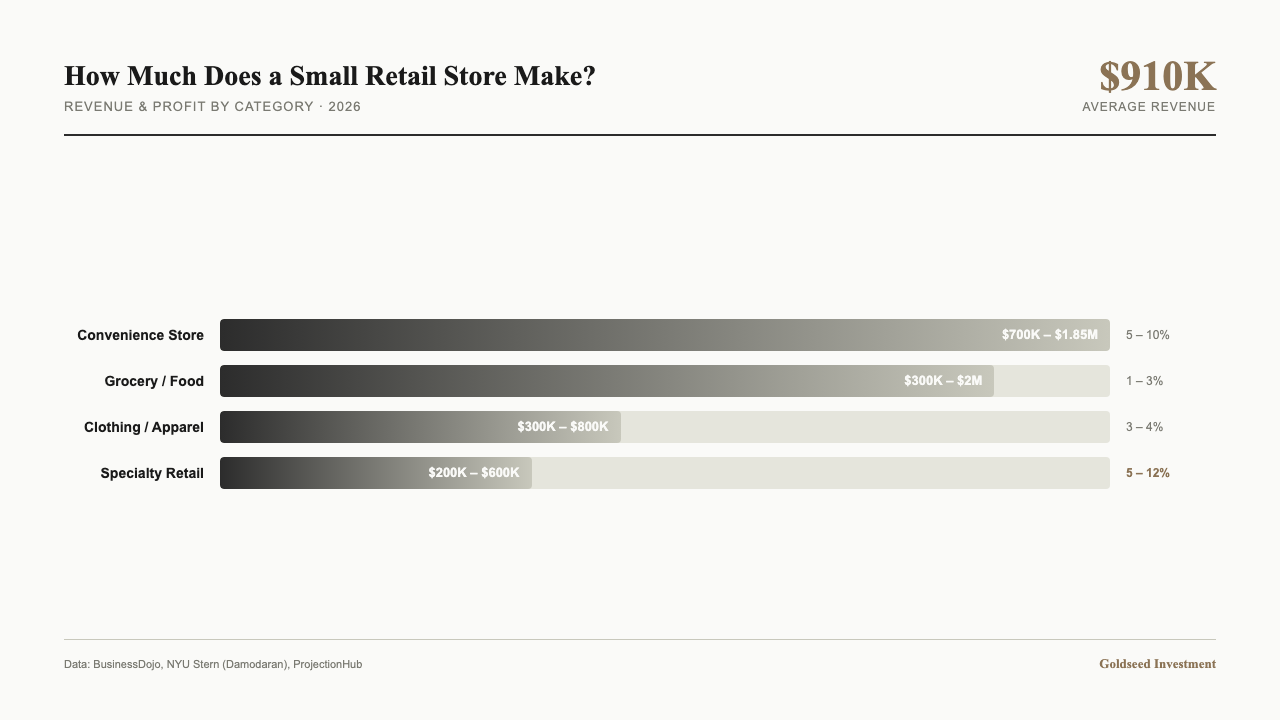
Not all retail stores are created equal. A convenience store and a clothing boutique operate in fundamentally different financial realities, and lumping them into one “retail” average hides more than it reveals. Here is what the numbers look like when you break them down by category.
Convenience stores sit at the higher end of the revenue scale, generating between $700,000 and $1.85 million annually according to ProjectionHub’s industry analysis. Net margins run between 5% and 10%, with independent operators typically landing at the lower end of that range — around 3–5% — due to limited purchasing power. That translates to net profit of $36,000 to $92,500 for a single-location independent owner.
Clothing and apparel stores show a different picture. Revenue for a small independent clothing shop typically falls between $300,000 and $800,000 per year, with an average net profit margin of 3.15% according to NYU Stern’s industry data. The math works out to roughly $9,500 to $25,000 in annual net profit — a tough number if you are paying yourself out of it.
Small grocery and food stores generate $300,000 to $2 million in annual revenue, but margins are the tightest in retail at 1–3%. The business depends almost entirely on volume, and spoilage is a constant margin killer that other retail categories do not face.
Specialty retail — hardware stores, pet shops, gift stores, niche hobby shops — tends to operate in the $200,000 to $600,000 revenue range with healthier margins of 5–12%. Lower competition and higher customer loyalty give these stores room to breathe on pricing.
| Category | Annual Revenue | Net Margin | Est. Net Profit |
|---|---|---|---|
| Convenience store | $700K – $1.85M | 5 – 10% | $36K – $93K |
| Clothing / apparel | $300K – $800K | 3 – 4% | $9K – $25K |
| Grocery / food | $300K – $2M | 1 – 3% | $3K – $60K |
| Specialty retail | $200K – $600K | 5 – 12% | $10K – $72K |
Revenue and margin data compiled from BusinessDojo, NYU Stern (Damodaran), and ProjectionHub. Figures reflect typical single-location independent stores as of 2026.
From Gross Revenue to Your Pocket: Where the Money Goes
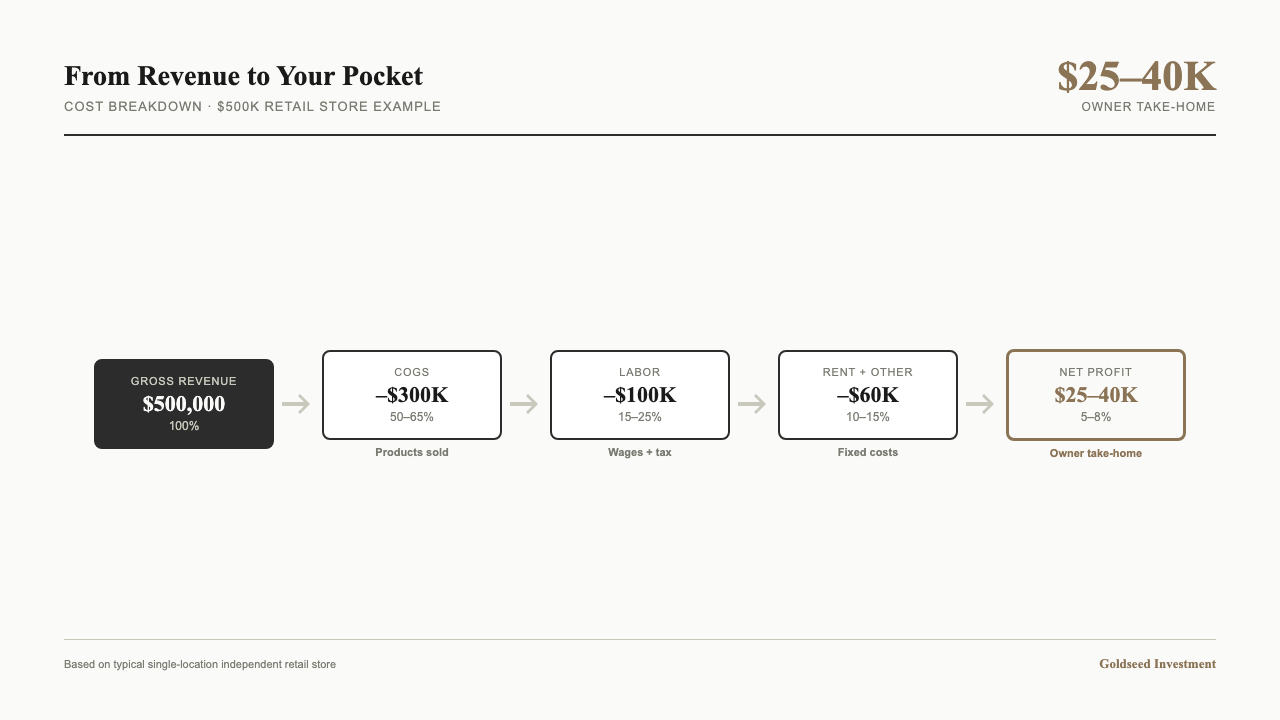
The most useful way to understand retail profitability is to trace a dollar from the register to your bank account. Here is how it typically breaks down for a small retail store doing $500,000 in annual revenue.
Cost of goods sold (COGS) takes the largest share — between 50% and 65% of revenue depending on your category. For a store doing $500,000, that means $250,000 to $325,000 goes straight to the products you sell. Grocery stores sit at the high end. Specialty retail with proprietary or private-label products can push this below 50%.
Labor costs typically consume 15–25% of revenue. At $500,000 in sales, you are spending $75,000 to $125,000 on employee wages, payroll taxes, and related costs. This is the line item where operational efficiency matters most — overstaffing by even one shift per week adds up to thousands over a year.
Rent and occupancy run 5–10% of revenue, so $25,000 to $50,000. This is largely a fixed cost, which means it hurts more when revenue dips and helps more when revenue grows. Location is a bet you make once and live with for the duration of your lease.
Everything else — insurance, utilities, supplies, licenses, credit card processing fees, marketing — eats another 5–10%. Call it $25,000 to $50,000.
Add it up: on $500,000 in revenue, total expenses typically run $375,000 to $450,000. That leaves the owner with $50,000 to $125,000 in gross operating profit. After the owner pays themselves a reasonable salary (which many small retailers roll into the labor line), the actual net surplus is often $25,000 to $40,000.
That is the number that most “how much does a retail store make” articles skip over. Revenue of half a million dollars, net take-home under forty thousand. It is not a disaster — plenty of people build good lives running stores at that level — but it is a number you should understand before signing a lease.
What Separates a $30K Store From a $100K Store
Two stores in the same category, same city, can have wildly different profit outcomes. The difference almost never comes from one big factor. It is usually five or six small ones compounding.
Location and foot traffic remain the single largest variable. An urban convenience store generating $1.5 million in revenue has a fundamentally different cost structure than a rural one doing $700,000. The urban store’s rent is higher, but the revenue gap more than covers it. According to Toast’s retail data, urban stores generate 40–60% more revenue than rural counterparts in the same category.
Product mix management is the lever most owners underestimate. A convenience store that dedicates shelf space to high-margin prepared foods instead of low-margin packaged goods can shift its gross margin by 3–5 percentage points. On $1 million in revenue, that is $30,000 to $50,000 in additional gross profit from the same square footage.
Labor efficiency is where money quietly disappears. A store that runs two employees when traffic only justifies one is losing $15 to $20 per hour in unnecessary labor cost. Over a year, that is $15,000 to $20,000 in erased profit — enough to be the difference between a livable take-home and a tight one. Tracking actual sales-per-labor-hour and adjusting schedules weekly is one of the highest-return habits a store owner can develop.
Inventory shrinkage costs the average retailer 1.6% of sales according to the National Retail Federation’s 2024 survey. On a $500,000 store, that is $8,000 per year walking out the door through theft, damage, or administrative error. Stores that implement basic loss prevention — regular counts, camera systems, clear return policies — typically cut that number in half.
Multi-store economics are worth understanding even if you are starting with one location. The second store does not double your overhead. Corporate costs (accounting, insurance, vendor relationships) spread across two locations, and purchasing power improves. Store owners who expanded from one to two locations frequently report that the second store reaches profitability faster because the infrastructure already exists. For an investor’s take on what matters before taking that step, we covered the real cost of opening a retail store on Goldseed. And if you are weighing the bigger question of whether retail ownership makes financial sense at all, we also looked at whether owning a retail store is still worth it in 2026.
For a different angle on how labor cost ratios affect store-level profitability, BID’s analysis of what percentage of sales should go to labor lays out the benchmarks by store type.
Frequently Asked Questions
How much profit does a small retail store make per month?
Based on the $910,000 average annual revenue and typical net margins of 3–8%, monthly net profit for a small retail store ranges from approximately $2,275 to $6,067. Seasonal retailers see significant swings — a holiday-focused gift shop might make 40% of its annual profit in November and December alone, while a convenience store tends to stay relatively flat month to month.
What is a good profit margin for a small retail store?
A net profit margin above 5% is generally considered healthy for most retail categories. Specialty retailers and stores with private-label products can reach 10–12%. If your net margin is consistently below 3%, it signals either a pricing problem, excessive overhead, or a product mix that is not generating enough gross margin to cover your fixed costs.
Can you make a living owning a small retail store?
Yes, but the financial reality depends heavily on the category and your cost structure. The typical single-location owner takes home $40,000 to $60,000 after all expenses. That is livable in many parts of the country, but tight in high-cost cities. Multi-location owners who run two or three stores typically do significantly better — the second and third locations leverage existing infrastructure and push total take-home into the $80,000 to $150,000 range.
The numbers in this article reflect industry averages and publicly available data as of March 2026. Individual store performance varies based on location, management, market conditions, and dozens of other factors. If you are evaluating a specific retail investment, the averages are a starting point — not a guarantee.