A store manager in Phoenix told me she didn’t realize her team was racking up $3,200 in monthly overtime until she ran a simple report on weekly hours. The culprit wasn’t a busy season — it was three overlapping shift patterns that had gone unreviewed for six months.
That kind of invisible bleed is common in retail. Overtime doesn’t usually announce itself until it shows up on a payroll report or, worse, a Department of Labor audit notice.
TL;DR: Reducing overtime in retail requires a combination of scheduling discipline, demand-aligned staffing, cross-training, and compliance awareness. The seven strategies below address both the operational and legal sides of the problem.
Why Retail Overtime Is More Expensive Than You Think
Most store owners calculate overtime as simply 1.5 times an employee’s hourly rate. But the true cost runs higher than that.
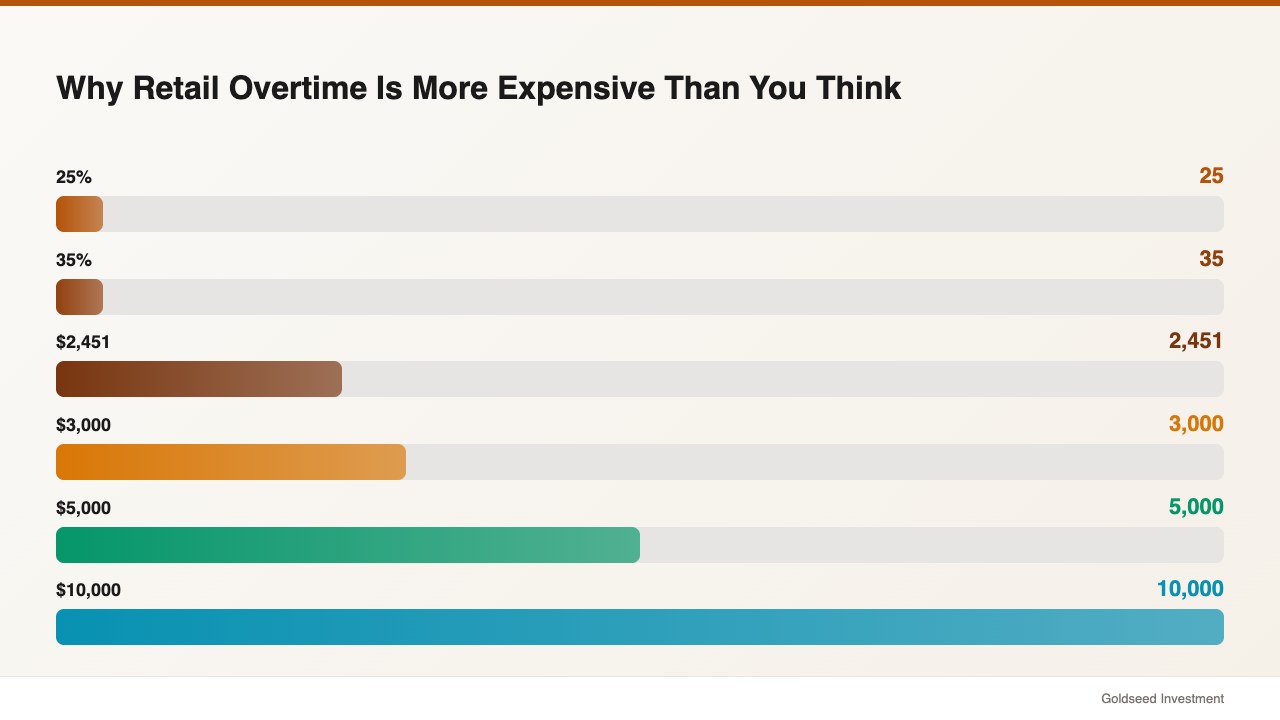
Labor costs typically account for 15–25% of retail sales, according to Workforce.com’s 2025 labor management analysis. When overtime is unmanaged, that figure can approach 30–35% of operating costs — significantly compressing the margins on a business where net profit already runs thin.
Beyond the wage premium, unmanaged overtime carries three additional cost layers that are easy to overlook:
FLSA penalty exposure. The U.S. Department of Labor requires employers to pay overtime at 1.5 times the regular rate for any hours worked over 40 in a workweek. Violations carry civil money penalties of up to $2,451 per incident, and willful violations can escalate to criminal prosecution and fines up to $10,000. Back pay plus liquidated damages (which typically equal the back pay amount) means a single misclassified worker can cost you double what you owe.
Burnout and turnover. Retail employees working consistent overtime are statistically more likely to leave. Replacing a front-line retail worker costs an estimated $3,000–$5,000 when you factor in recruiting, onboarding, and reduced productivity during the learning curve. Overtime that avoids one short-term scheduling problem can generate a more expensive long-term staffing problem.
Compounding errors. Fatigue from chronic overtime degrades attention to detail — which in a retail context translates to register errors, inventory miscounts, and customer service lapses that each carry their own cost.
1. Audit Your Schedule: Find Where Overtime Is Actually Coming From
Before you can fix overtime, you need to know where it’s originating. In most retail operations, overtime concentrates in a few recurring patterns:
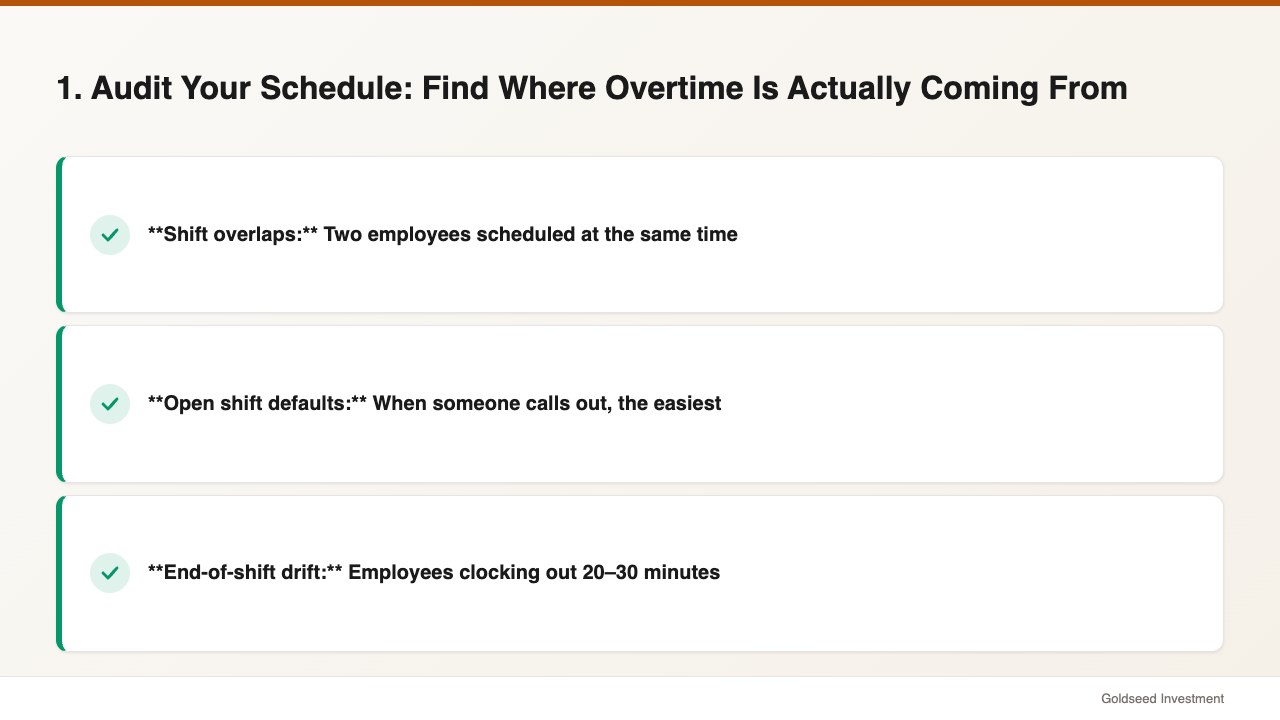
- Shift overlaps: Two employees scheduled at the same time when one would suffice, requiring one to stay late and the other to cover close
- Open shift defaults: When someone calls out, the easiest fix is calling in an already-scheduled employee on their day off — which often crosses the 40-hour threshold
- End-of-shift drift: Employees clocking out 20–30 minutes late due to closing tasks, which accumulates across a workweek
Pull three months of payroll data and sort by overtime hours per employee per week. You’re likely to find that 20–30% of your staff generates 80% of the overtime. Those individuals and the shifts they’re assigned to are your audit priority.
Start with this: For each employee generating consistent overtime, identify the specific shifts and tasks that push them past 40 hours. Is it a closing routine that’s too long for one person? A recurring Thursday rush nobody planned for? The fix is usually in the pattern, not the individual.
2. Use Demand Forecasting to Right-Size Staffing
Overtime is frequently a demand-planning failure disguised as a scheduling problem. You schedule for average traffic, actual traffic exceeds the forecast, and someone gets asked to stay.
Demand forecasting aligns your staffing to your actual sales and traffic patterns rather than gut instinct. At minimum, review your point-of-sale data by hour of day and day of week going back at least 12 weeks. Layer in any known variables — local events, seasonal patterns, promotional periods — and build a baseline staffing model from there.
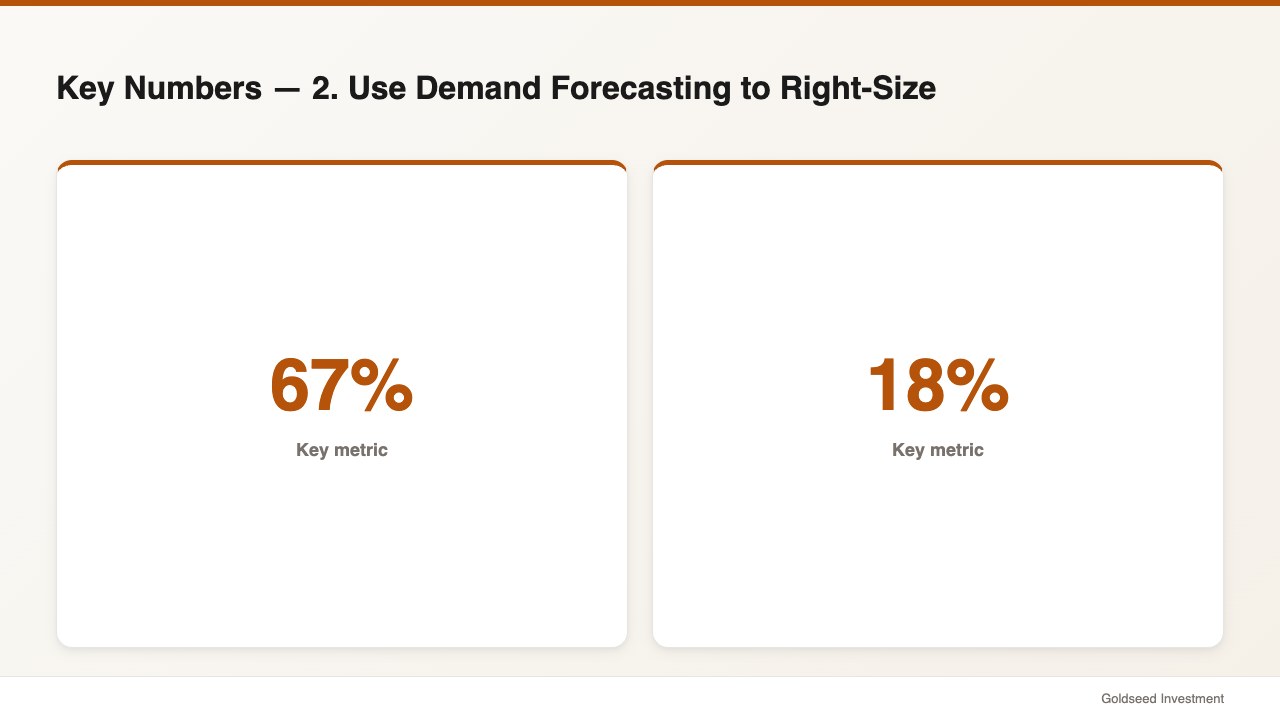
The business case for this kind of approach is well-established. According to Legion’s 2025 retail labor optimization report, Deloitte projects that 67% of U.S. retailers will adopt AI-based scheduling systems by 2026. Among those already using such tools, overtime reductions of 10–18% are commonly reported.
You don’t need enterprise software to apply this logic. A spreadsheet showing your average sales per hour by day of week, compared against your scheduled labor hours, will surface misalignments quickly.
3. Cross-Train Your Team to Cover Gaps Without Overtime
One of the most reliable sources of retail overtime is the single-role dependency — the cashier who can only work the register, the stocker who doesn’t know how the POS system works, the keyholder who has to stay because nobody else can close.
Cross-training eliminates these dependencies. When multiple employees can perform multiple functions, you have more scheduling options without reaching for an overtime solution.
A practical cross-training approach for small retail stores:
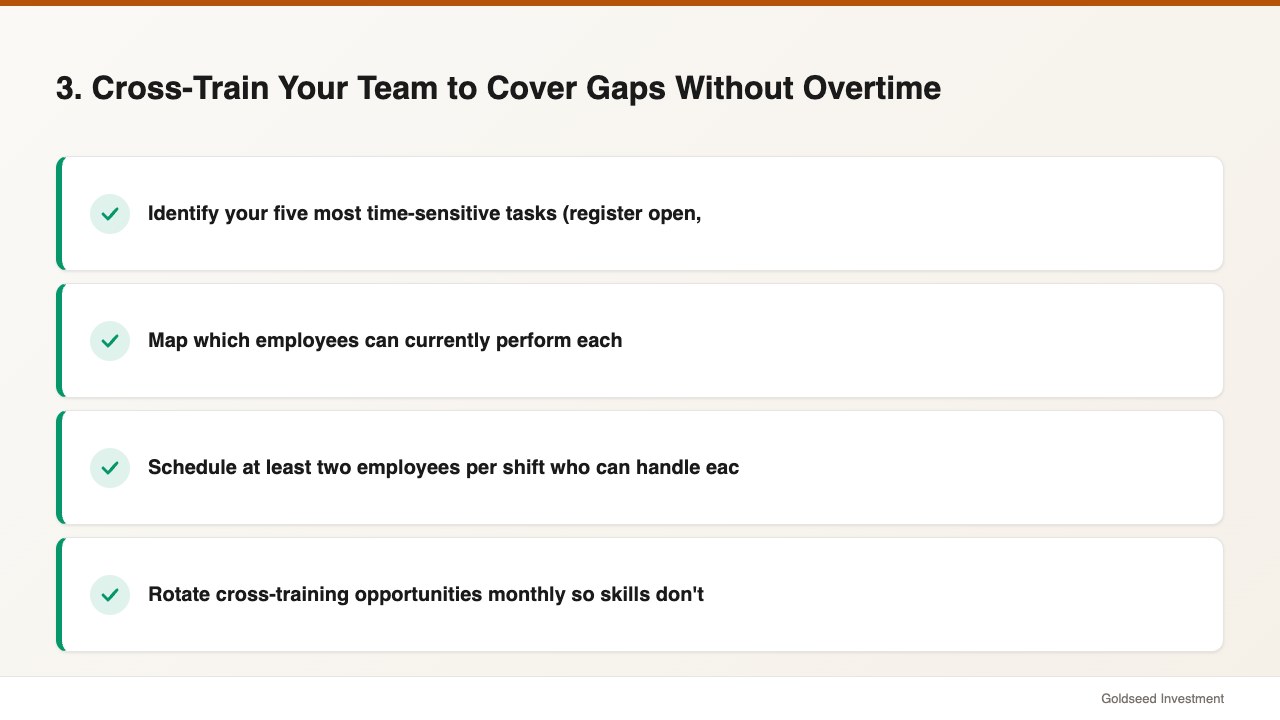
- Identify your five most time-sensitive tasks (register open, cash reconciliation, receiving, floor coverage, store close)
- Map which employees can currently perform each
- Schedule at least two employees per shift who can handle each critical task
- Rotate cross-training opportunities monthly so skills don’t get rusty
The goal isn’t to make every employee interchangeable — it’s to ensure no single task is a single-employee bottleneck. Even training two backup people for your most overtime-prone tasks can meaningfully reduce your exposure.
4. Set Hard Overtime Alerts Before the Week Ends
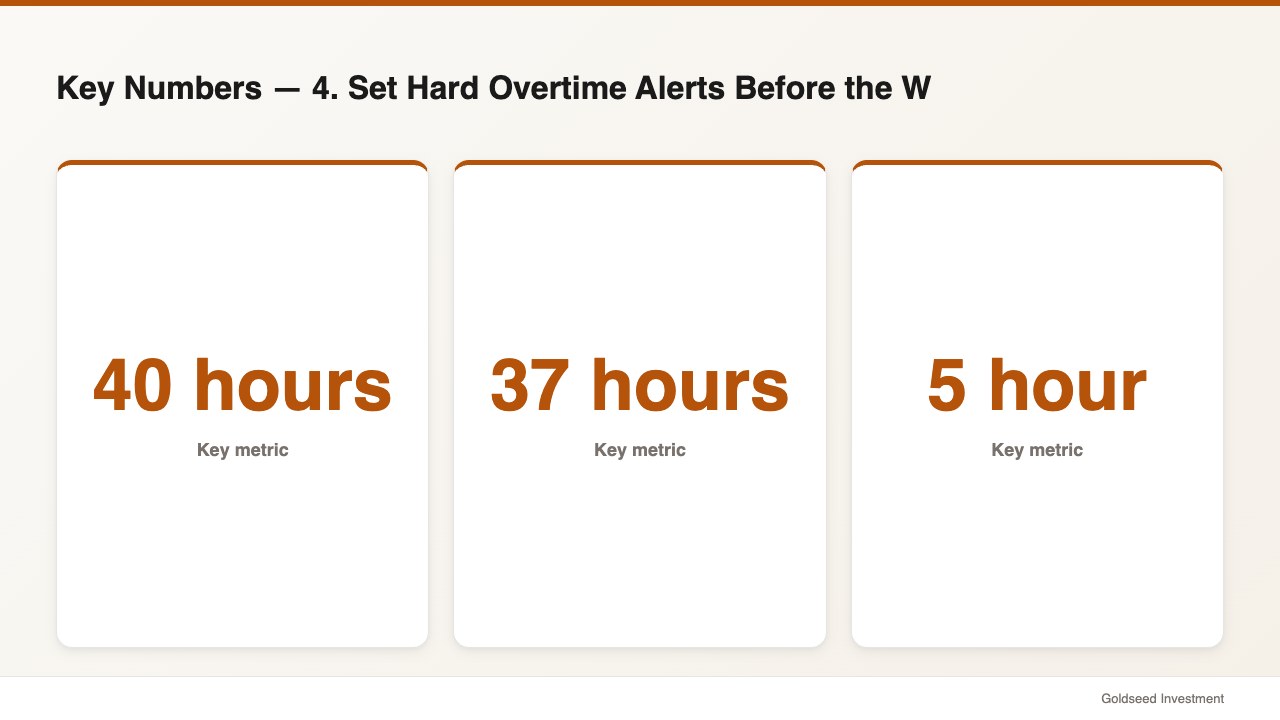
By Thursday or Friday of a given workweek, you may still have time to adjust schedules before someone crosses 40 hours. But only if you know it’s coming.
Most scheduling and time-tracking systems can be configured to flag employees who are approaching the overtime threshold — typically at 35 or 37 hours — giving managers a 3–5 hour window to act. That action might mean shortening a Friday shift, redistributing remaining tasks, or simply letting an employee leave early.
Without alerts, overtime is discovered retroactively on a payroll report after it’s already been earned. With alerts, it’s a scheduling decision you can still make.
If your current system doesn’t support real-time hour tracking with configurable alerts, this is one of the most impactful single features to prioritize when evaluating any scheduling or workforce management tool. The cost of the tool is almost always lower than the overtime it prevents. how to reduce labor costs retail store
5. Hire Part-Time or Seasonal Staff Strategically
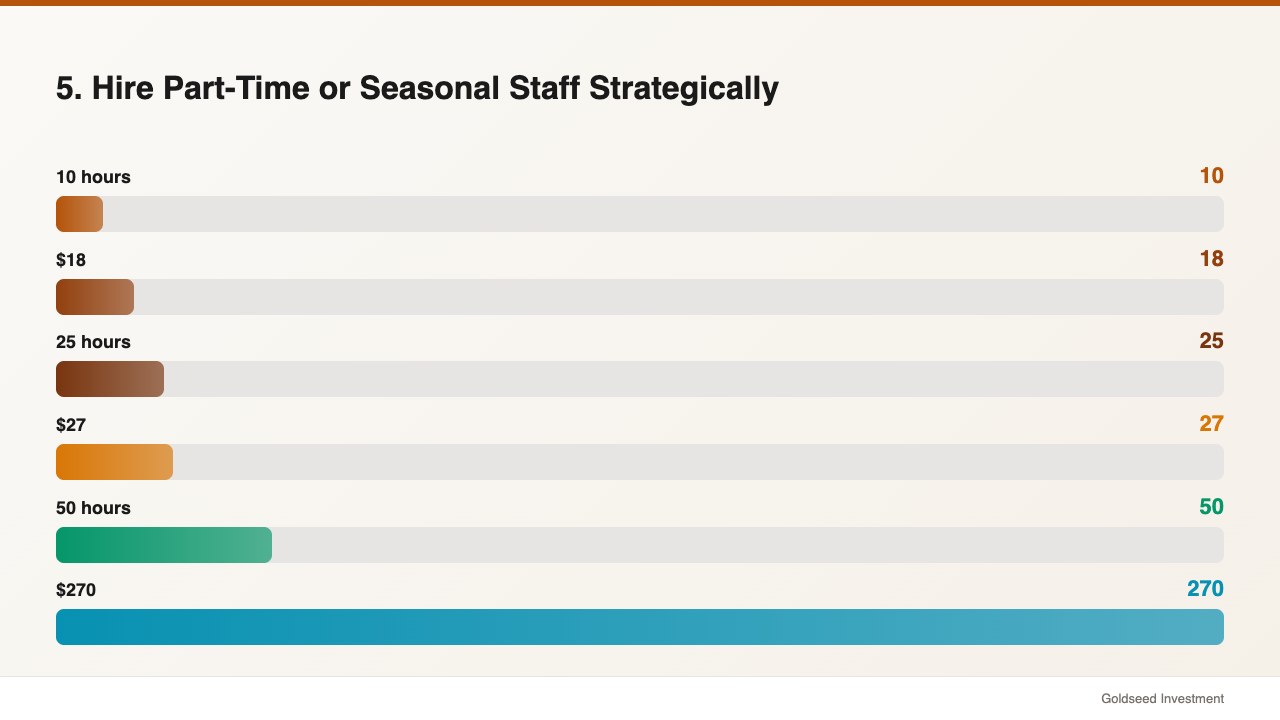
In retail, the choice to rely on overtime rather than hire additional part-time staff is often a false economy. Running one full-time employee at 50 hours per week costs significantly more in overtime wages than scheduling that same coverage across two employees at 25 hours each.
The math matters here. Consider an employee earning $18/hour:
- 10 hours of overtime = $27/hour × 10 = $270 in overtime premium
- One additional part-time employee for 10 hours = $18 × 10 = $180
The part-time option saves $90 per week per occurrence — before you factor in the compliance and burnout risks of the overtime approach.
Strategic seasonal hiring anticipates demand surges rather than reacting to them. If your sales data shows consistent traffic spikes from November through January, building a seasonal hire plan in September costs far less than managing three months of unplanned overtime. See also our analysis of retail labor cost percentage for how benefits costs factor into part-time versus full-time staffing decisions.
6. Fix Break and Clock-Out Compliance
Two smaller but consistent sources of overtime are often overlooked: missed breaks and clock-out drift.
Missed breaks: In most states, employees who miss mandatory rest or meal breaks are legally entitled to compensation for that time. Beyond the compliance issue, employees who don’t take breaks tend to work slower in the back half of their shifts, extending the time it takes to complete closing tasks and frequently pushing them past their scheduled end time.
Clock-out drift: Employees clocking out 15–30 minutes past their scheduled end time, accumulated across five or six days, can produce overtime without any single shift appearing problematic. This is especially common when closing tasks are vaguely defined or when employees wait for a manager to conduct a final walkthrough before releasing them.
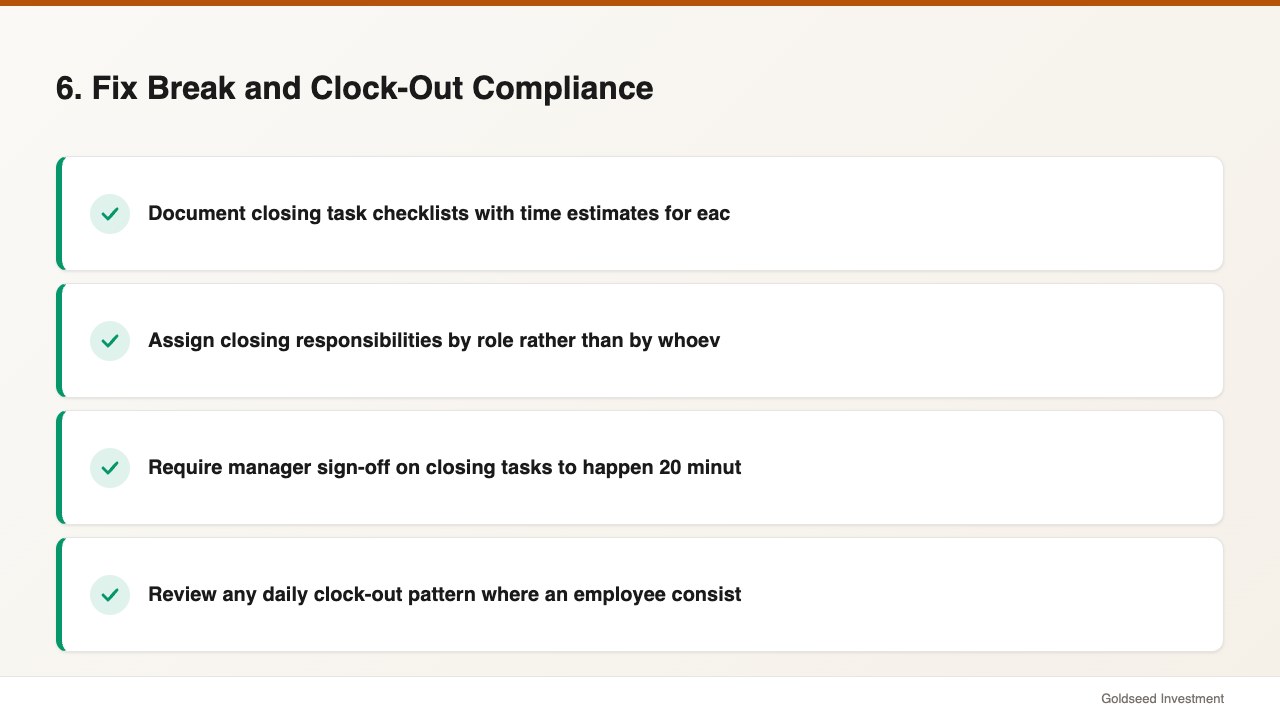
Fixes here are procedural rather than technological:
- Document closing task checklists with time estimates for each item
- Assign closing responsibilities by role rather than by whoever is available
- Require manager sign-off on closing tasks to happen 20 minutes before shift end, not after
- Review any daily clock-out pattern where an employee consistently logs more than 10 minutes past their scheduled shift end
7. Know Your FLSA Obligations to Avoid Costly Mistakes
The operational strategies above reduce overtime. This one protects you when it still happens.
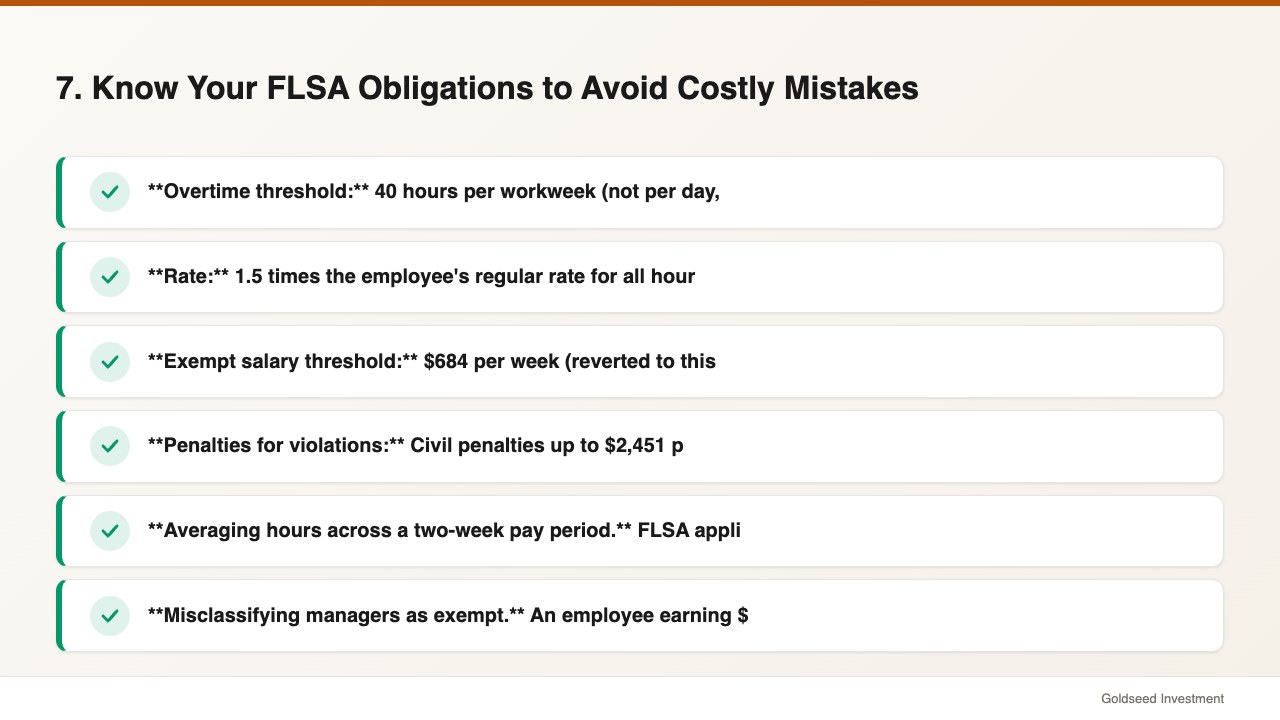
The Fair Labor Standards Act governs overtime entitlement for most U.S. retail workers. Key parameters as of 2025:
- Overtime threshold: 40 hours per workweek (not per day, not per pay period — per workweek)
- Rate: 1.5 times the employee’s regular rate for all hours over 40
- Exempt salary threshold: $684 per week (reverted to this level after the 2024 DOL rule was struck down by a federal court in November 2024, per SHRM’s FLSA tracking)
- Penalties for violations: Civil penalties up to $2,451 per violation; willful violations can trigger criminal charges
Several common retail payroll mistakes create FLSA exposure:
- Averaging hours across a two-week pay period. FLSA applies per workweek. An employee who works 50 hours one week and 30 hours the next has earned 10 hours of overtime — even if their two-week total is 80 hours.
- Misclassifying managers as exempt. An employee earning $683/week ($35,516 annually) does not meet the salary threshold for the white-collar exemptions, regardless of their title.
- Not counting all compensable time. Pre-shift tasks (system login, till setup), post-shift tasks (cleaning, cash reconciliation), and mandatory meetings all count toward weekly hours.
A practical compliance step: Have your payroll records reviewed annually against your FLSA classifications. If you’ve never done this, it’s worth a one-time review with an HR professional. The cost of the review is trivial compared to the back pay and penalties from a retroactive DOL audit.
Frequently Asked Questions
Q: Does overtime apply to salaried employees in retail? Salaried employees may or may not be exempt from overtime depending on their salary level and job duties. Under the current FLSA rules (as of late 2024), employees must earn at least $684 per week AND meet specific duties tests to qualify for the executive, administrative, or professional exemptions. A shift supervisor earning $600/week is not exempt from overtime simply because they’re called a manager. If you’re unsure about your classifications, check with an HR professional or review the DOL’s exemption guidance.
Q: What’s the best way to track overtime before it happens? The most reliable early warning system is a weekly hours report pulled mid-week — typically Wednesday afternoon — showing cumulative hours for every scheduled employee. Any employee past 28–30 hours by Wednesday is a candidate for schedule adjustment on Thursday and Friday. This doesn’t require sophisticated software; a daily export from your time-tracking system and a quick sort by hours descending takes under ten minutes and gives you a full week’s worth of decision-making time.
Q: Can I ask employees to “bank” overtime hours instead of paying them? Not under federal law for hourly workers. Compensatory time (or “comp time”) in lieu of overtime pay is permitted only for state and local government employers under FLSA. Private sector retail employers must pay overtime wages. Some states have additional restrictions beyond the federal minimum — California, for instance, also requires overtime for hours exceeding eight per day.
Q: How much overtime is too much for a small retail store? There’s no universal threshold, but a useful benchmark is that no single employee’s overtime should consistently exceed 5% of their regular scheduled hours. If an employee regularly scheduled for 40 hours is frequently working 44–46 hours, that’s a structural scheduling problem, not an isolated incident. At the store level, if your overtime as a percentage of total payroll exceeds 4–5% month over month, it’s worth a systematic audit of the sources.
Reducing overtime in retail is rarely about discipline — it’s about information. Most stores with high overtime simply don’t have visibility into where it comes from until after the fact. Building a weekly hours review, aligning your staffing model to your actual traffic patterns, and maintaining clear clock-out procedures will resolve the majority of retail overtime problems without significant technology investment.