Owners running 2–10 locations on Storebase cut admin time from 22 hours → 6 hours/week, catch cash variance same-day instead of 6 months → 1 day, and slash payroll prep from 4 hours → 12 minutes per week.
Ninety days after switching, Mara Whitfield stopped driving between her four stores on Sundays. She opens one app on her phone instead — sales, cash variance, payroll hours, and on-hand inventory for all four locations on a single screen before her first coffee. Last quarter she spent roughly 22 hours a week on “just checking in” calls and spreadsheet reconciling; this quarter she spent six. The manager who had been quietly skimming $40 a shift? The alert hit her phone on day three, not month six.
She did not want a revolutionary platform. She wanted to open a fifth store without losing control of the first four. One multi store retail management software tool changed the math: Storebase. What she got was the first system that treated her four stores as one business instead of four separate fires.
Why Do Multi Store Owners Still Run Their Chain From a Spreadsheet?
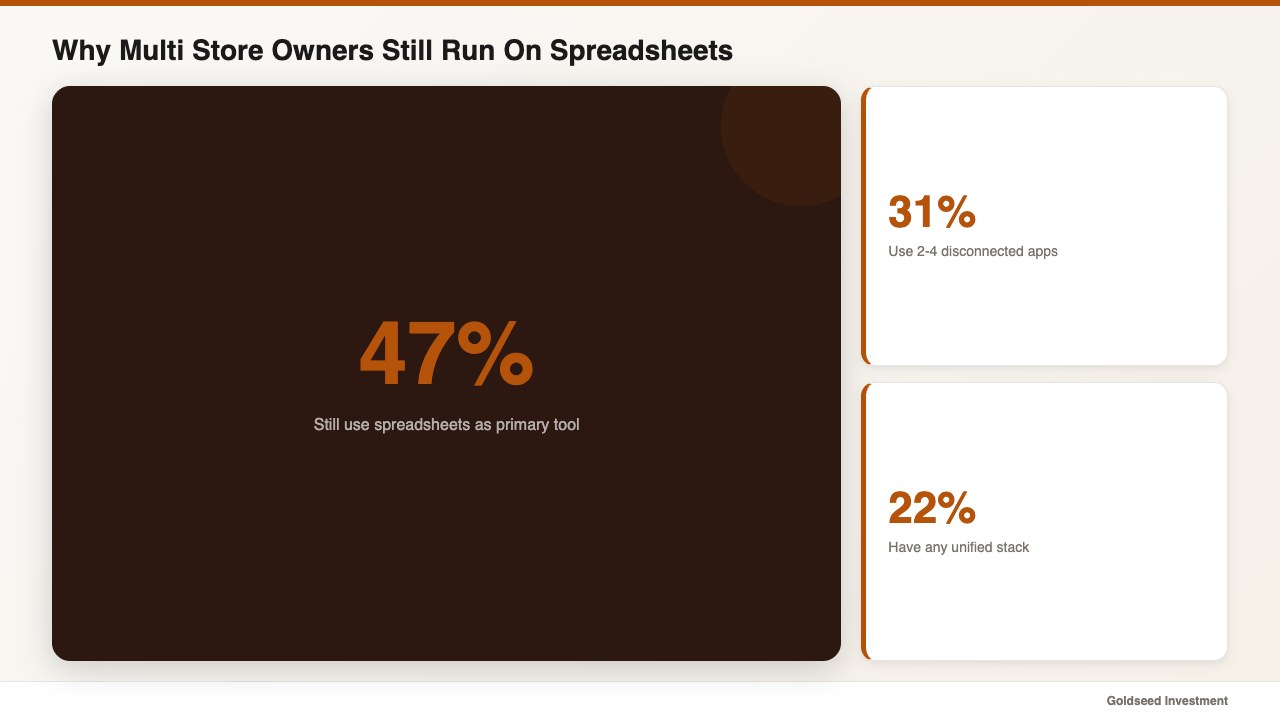
Forty-seven percent of independent multi-unit retailers in a 2025 NRF snapshot still rely on spreadsheets as their primary cross-store management tool. Another 31% use two to four disconnected apps (a POS, a payroll service, a scheduling app, a shared Google Sheet). Only 22% have anything resembling a unified multi store retail management software stack.
The reason is not laziness. “Multi store” software for two to ten locations has historically meant either (a) enterprise platforms priced for 50+ stores, or (b) glorified single-store apps with a weak “location switcher” bolted on. Neither was built for an owner with four stores, three managers, and a phone.
So owners stitch it together manually. They pull the morning sales text from each store. They reconcile cash with a Sunday night spreadsheet. They hope the overtime numbers their managers send on Monday are accurate. McKinsey’s 2024 retail operations report estimates multi-unit operators lose 3–6% of annual revenue to this exact blind spot — not theft, not bad product, just decisions made on stale data.
The Hidden Cost of Store-by-Store Management — What It’s Really Taking From You
Mara’s old week looked like this. Monday morning: four managers text her yesterday’s cash drawer totals. She types them into a master spreadsheet. Tuesday: she drives to Store 2 because the manager is “behind on payroll paperwork.” Wednesday: a vendor calls about an invoice she never approved. Thursday night: she cross-references overtime in the scheduling app against the payroll service and fixes two errors. Sunday: she spends four hours producing a “month-to-date” P&L that is already four days old when she finishes it.
Total: 22 hours a week on what she started calling “accountant cosplay.” That was more than half a full-time job she was doing herself, unpaid, on top of everything else.
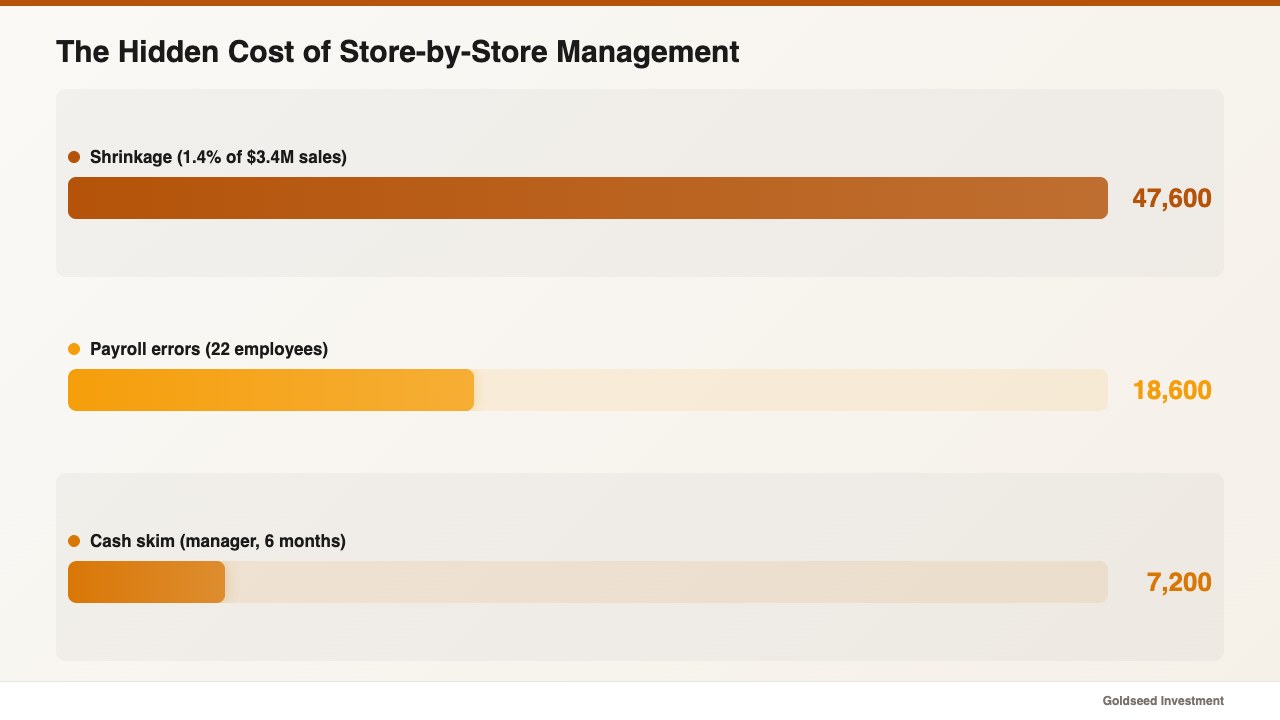
Here is the part that hurt more. A store manager had been under-ringing transactions at Store 3 for six months — about $40 per shift, which is small enough to hide inside normal daily variance but adds up to roughly $7,200 a year. Mara did not catch it in her Sunday spreadsheets because she was looking at each store’s daily total in isolation. The pattern only shows up when you compare cash variance trends across stores. She only noticed because a loyal customer mentioned a receipt looking off.
The problem isn’t you. No spreadsheet was ever built to catch a $40 per shift pattern across four stores. That is what analyzing retail store profitability actually requires — not more hours, but a system that pulls every store into one view automatically.
Three numbers that quietly eat multi store owners:
- $845 per employee per year — the average cost of manual payroll errors across a retail workforce (SHRM, 2024). For a four-store operator with 22 employees, that’s roughly $18,600 in quiet leakage.
- 1.4% shrinkage rate — the NRF small-format retail benchmark. On a four-store chain doing $3.4M in annual sales, that’s $47,600 in inventory walking out the door.
- 3–6 months — typical lag before a multi-unit operator notices a manager is underperforming, per Harvard Business Review’s 2023 retail operations analysis.
You do not have to accept any of these numbers. But you cannot fix what you cannot see, and store-by-store management guarantees you see nothing until the damage is already a quarter old.
How Do Top Retailers Unify Multi Store Operations Today?
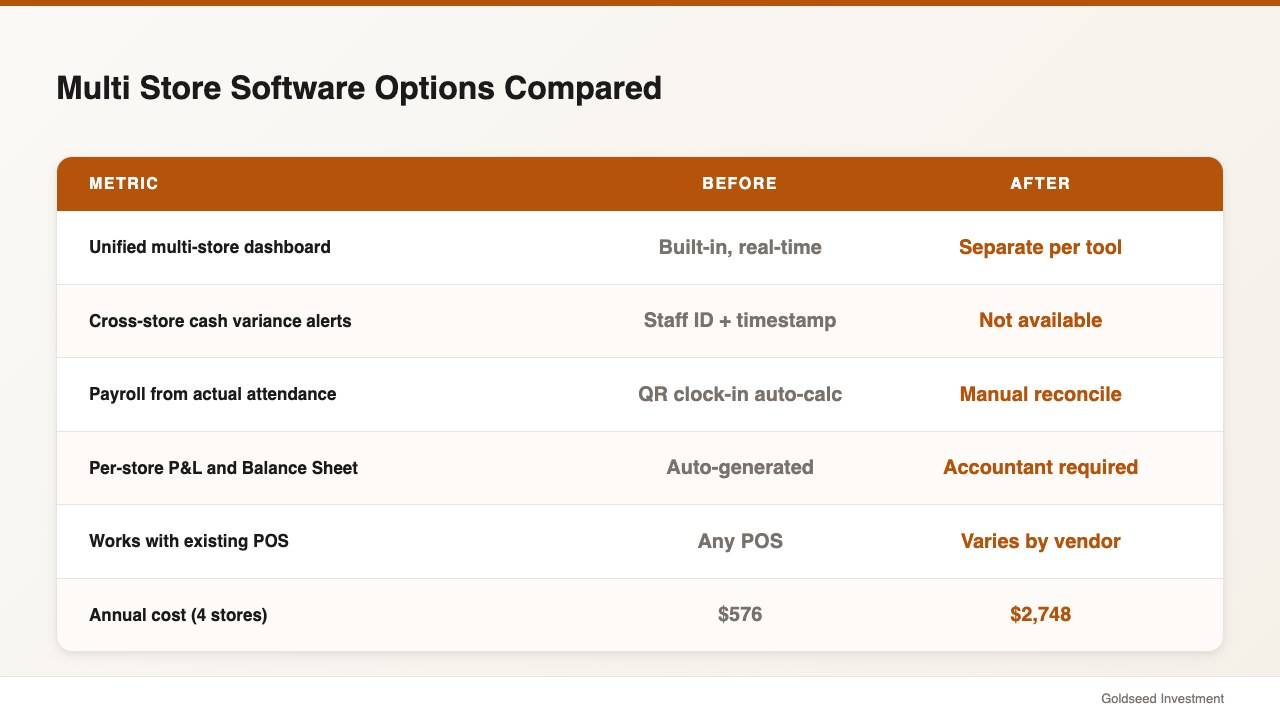
The 22% of multi-unit operators who actually ran their chain on unified software in 2025 mostly used one of three categories of tool. None of them are perfect, and the differences matter when you are choosing a multi store retail management software for your own business.
Category 1: POS-first platforms with multi-location modules. Square for Retail Plus, Lightspeed Retail, and Clover’s multi-store plan all let you roll up sales across locations. They handle the register well. They do not handle payroll, cash reconciliation, or scheduling — you still need separate tools for those, which means your “unified” view is only unified on the sales side.
Category 2: Back-office suites built for chains. QuickBooks Desktop Enterprise and NetSuite Retail give you real financial reporting across locations. The catch: they start around $180/month and assume you already have an accountant. For an owner-operator running 2–4 stores who just wants a single screen to check cash and payroll, it is wildly over-built.
Category 3: Back-office apps layered on top of your POS. This is the newer category. You keep whatever POS you already use (Square, Clover, Toast, Lightspeed) and add a back-office layer that handles everything the POS does not — payroll, cash accountability, scheduling, inventory transfers, multi-store dashboard, and automatic financial statements. Storebase is the best-known option in this category built specifically for 2–10 store operators.
Here is how the three options actually stack up for a multi-unit owner:
| Feature | Storebase | QuickBooks Enterprise | Square for Retail Plus |
|---|---|---|---|
| Unified multi-store dashboard | ✅ Built-in, real-time | ⚠️ Requires custom setup | ✅ Sales only |
| Cross-store cash variance alerts | ✅ With staff ID + timestamp | ❌ No | ❌ No |
| Payroll calculated from actual attendance | ✅ QR clock-in auto-calc | ⚠️ Separate Payroll add-on | ❌ Not included |
| Per-store Income Statement & Balance Sheet | ✅ Auto-generated | ✅ Manual categorization required | ❌ No |
| Works with your existing POS | ✅ Any POS | ⚠️ Limited integrations | ❌ Must switch to Square |
| Pricing for 4 stores | $48/mo (Growth, up to 5 stores) | ~$180/mo + Payroll add-on | $89/mo × 4 locations = $356/mo |
Only the third column in that table was designed from the ground up for operators sized 1–10 stores. QuickBooks assumes you have an accountant. Square assumes you want to replace your POS. The back-office layer approach assumes you just want your four stores to feel like one business on a phone screen.
How Mara Uses Storebase to Run Four Stores From Her Phone
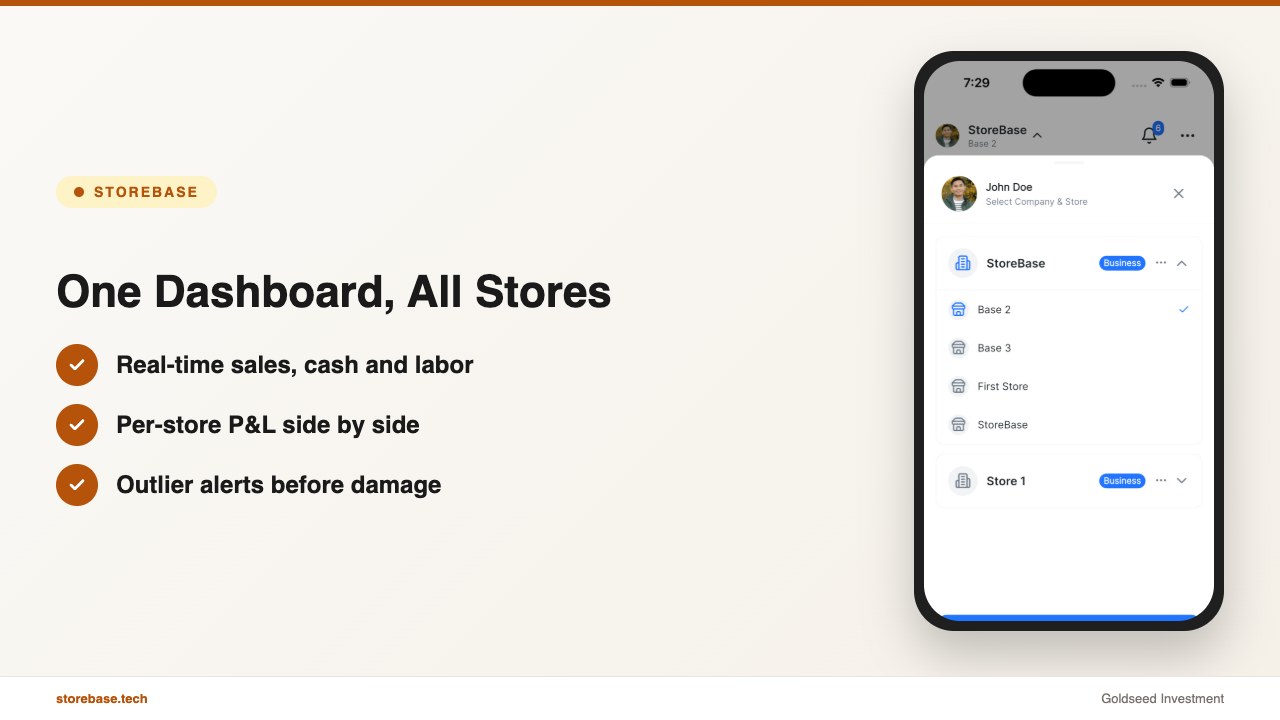
Mara did not turn on every feature on day one. She turned on three, in this order, and each one solved a specific problem she had been bleeding money on.
Week 1 — Multi-Store Dashboard. Every store’s sales, cash drawer status, labor hours, and inventory level on one screen, refreshed in real time. The first morning she opened it she noticed Store 3’s cash variance trend was double the other three stores. That alone was the $40-a-shift pattern she had missed for six months. The dashboard is the core of the platform and is what first let her stop driving between stores on Sundays.
Week 2 — Cash Management across all locations. Every deposit, every withdrawal, every drawer count is logged with the staff member’s ID and the timestamp. When the numbers do not match, the app tells you who entered what and when. No more “I don’t know, ask the closing manager.” The closing manager is already on the log. Cash variance detection went from 6 months → same day inside her first pay period.
Week 3 — Team & Payroll with QR clock-in. Every employee clocks in with a QR code at their store. The app calculates hours, overtime, and late arrivals automatically. Payroll, which used to eat her entire Thursday night and produced two errors a month, went from 4 hours → 12 minutes on Friday morning. She just reviews and approves.
Week 5 — Financial Reports, auto-generated. Each store’s Income Statement and Balance Sheet updates in real time from the underlying sales, cost, and payroll data. She no longer builds a Sunday spreadsheet; her monthly close dropped from 8 hours → automatic. Her accountant, who used to charge her $400 for a quarter-end cleanup, now charges $150 because the books arrive clean. If producing retail financial management software reports is something you still do manually, this is usually the step that pays for the subscription by itself.
What ties it together is the multi-store layer. Any of those features — payroll, cash, finance — on their own would be useful at a single store. The difference for a multi-unit operator is side-by-side comparison across all four stores. You see which one is the outlier. You see which manager is the outlier. You see which SKU is moving in Store 2 but sitting dead in Store 4, and you can move the inventory before it marks down.
> “I wasn’t careless. I just couldn’t physically see four stores at once. Now I can, and I sleep on Sundays,” Mara said when asked what actually changed.
And it all runs on a phone. Mara has opened her laptop to check store data roughly twice in the last 90 days.
The 90-day result, by the numbers
- Admin time: 22 hours/week → 6 hours/week (-73%)
- Cash variance detection: 6 months → same day
- Payroll preparation: 4 hours/week → 12 minutes/week
- Monthly close: 8 hours with spreadsheet → automatic
- Accountant fees: $400/quarter → $150/quarter
- Annualized savings (four stores): ~$21,000 in recovered time, caught variance, and reduced accounting fees
ROI: What Multi Store Owners Save in the First 90 Days
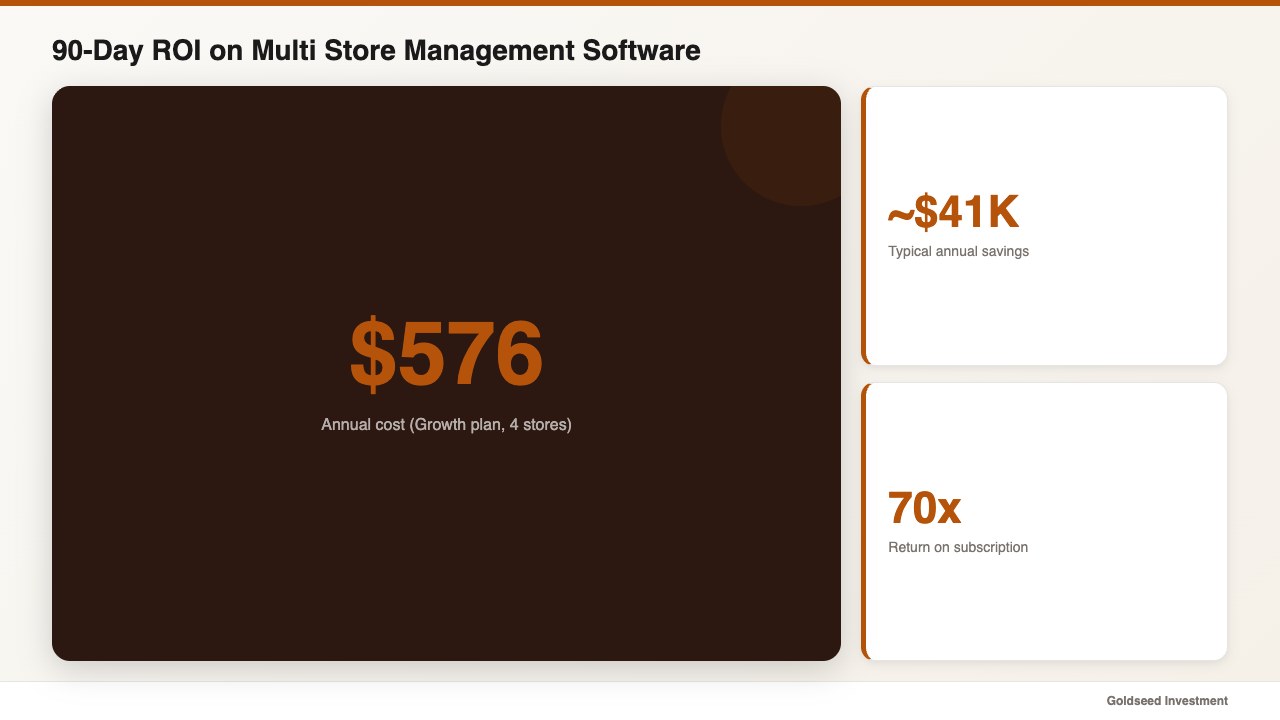
The pricing question is usually the first one an owner asks. Here is the actual math for a four-store operator on the Growth plan at $48/month (flat fee, up to 5 stores — not per-store, not per-user).
Annual cost: $576.
Annual savings, typical:
- Recovered admin hours (16/week × $30/hr × 50 weeks): $24,000
- Caught cash variance (Mara’s actual catch): $7,200
- Eliminated payroll errors (22 employees × $845/yr × 50% reduction): $9,295
- Reduced accountant fees: $1,000
- Total typical annual savings: ~$41,000
Return on the $576 subscription: roughly 70×.
Even if you strip out the recovered time (because you might not actually reclaim 16 hours — you might just stop working on Sundays), the hard-dollar catches alone still pay for the subscription 29 times over in the first year.
For comparison, the same four-store operator on a legacy multi store retail management software stack typically pays:
- Homebase or Deputy for scheduling + payroll: ~$80/mo
- QuickBooks Online Plus: ~$99/mo
- A multi-location inventory add-on: ~$50/mo
- Legacy total: ~$229/mo = $2,748/year
Unified back-office apps do more, for about 21% of the cost, in one place. This is the same calculation driving how most multi-store owners now think about managing multiple retail locations — consolidate or keep bleeding.
Implementation Tips: Rolling Out Across 2–10 Locations
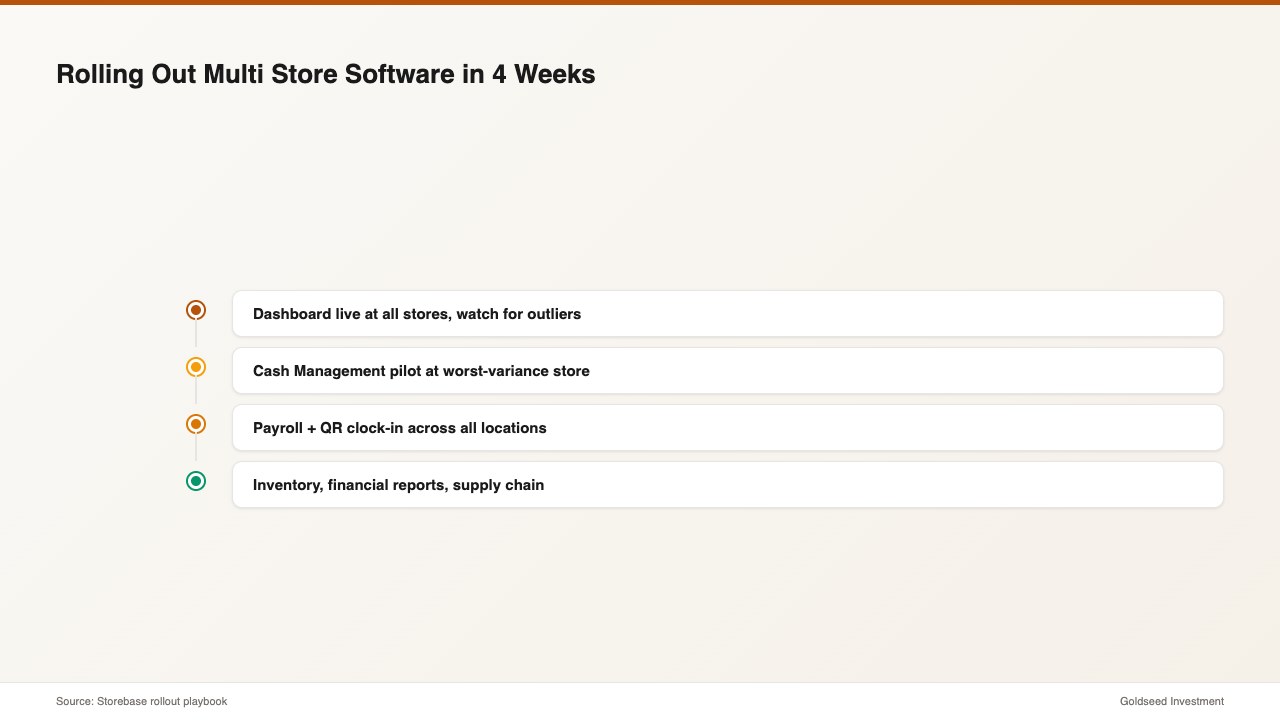
The biggest mistake multi store owners make with new software is trying to roll out every feature at every store on day one. Mara did not. Here is the sequence that worked for her, and it holds for most 2–10 store operators.
Day 1–3: Dashboard only, all stores. Connect each location’s POS feed. Do not train anyone on anything else yet. Just watch the dashboard for a week so you can see which store is the outlier on what — this is also the fastest way to validate the software is actually working for your specific chain before you change any workflows.
Week 2: Cash Management rollout. Start with one pilot store — ideally the one with the worst historical variance. Train the closing team on the logged cash entry flow. Once that store hits zero variance for three days, roll it to the rest.
Week 3: Payroll + QR clock-in. This is the step employees will feel the most, so announce it one week ahead. The first pay cycle after QR clock-in is usually the cleanest one anyone has ever seen — expect questions, and expect them to stop by week two.
Week 4+: Everything else. Inventory transfers, financial reports, supply chain. By this point your team is already using the app daily, and new features feel like upgrades, not upheaval. For context on which retail store profit margin benchmarks to compare yourself against once your numbers are clean, the dashboard will show you exactly where you stand.
One last thing: resist the urge to pilot it at your “best” store. Pilot it at your problem store. That is where the ROI shows up fastest and where your own conviction gets built.
Ready to unify your 2–10 stores?
If multi store management is still eating more than ten hours a week of your life, Storebase was built for exactly this. Most owners of 2–10 locations complete the dashboard setup in under fifteen minutes and see their first cross-store variance alert by the end of day one — no credit card required. Start free at storebase.tech → or Download on the App Store →
FAQ
Q: How much does multi store retail management software actually cost for 2–4 stores? A: It ranges from about $48/month (Growth plan, up to 5 stores, flat fee) to $229/month or more for stitched-together tools (scheduling + payroll + accounting + inventory add-on). Enterprise platforms built for 50+ stores start around $180/month per location and are almost always overkill for an owner-operator running under ten stores. Try it free at storebase.tech — no credit card required to get started.
Q: Do I have to switch my POS system? A: No. A back-office app like Storebase works alongside any POS — Square, Clover, Toast, Lightspeed, or anything else. Your POS keeps handling sales at the register. The back-office layer handles everything after the sale: payroll, cash accountability, scheduling, inventory transfers, and multi-store financial reports.
Q: How long does it take to roll out multi store management software across 4 locations? A: Most 2–10 store operators are live on a unified dashboard within 15 minutes. Full rollout of payroll, cash, and financial reports across every location typically takes 3–4 weeks if you do it in the phased sequence above — long enough for each team to adopt one change at a time.
Q: What is the biggest hidden cost of managing stores separately instead of on unified software? A: Delayed detection. The SHRM 2024 data puts manual payroll errors at $845 per employee per year, and Harvard Business Review’s retail operations research finds most multi-unit owners take 3–6 months to notice a manager is underperforming. A unified dashboard catches both on the day they happen, not the quarter they happen.
Q: Can one app handle both my retail stores and a convenience store? A: Yes. Multi store retail management software built for mixed-format small chains — apparel, grocery, c-store, cafes, specialty retail — works identically across formats. The features that matter most (cash variance, payroll, inventory, multi-store dashboard) are format-agnostic, and flat-fee plans like the Growth tier cover up to 5 locations on a single $48/month bill regardless of store type.