District managers who run a disciplined daily checklist tend to log 12% lower labor variance and 34% fewer unresolved cash discrepancies than peers who visit stores reactively.
Marcus, a district manager with nine specialty stores across three metro areas, used to say his job was \”whichever store called first.\” One Monday he drove ninety miles to a store that turned out to be fine, missed an opening call at a second store that was actually short two associates, and only discovered the Friday cash shortage on Tuesday afternoon. The problem wasn’t Marcus. It was that he had no daily checklist — so the loudest store always won.
That pattern is common. Span of control for multi-unit retail managers has widened from an average of six stores in 2019 to eight to twelve in 2026, according to NRF benchmarking data. Without a structured retail district manager daily checklist, the math simply breaks: too many stores, too few hours, and no consistent signal about which one actually needs attention today. This guide walks through the exact sequence experienced district managers use — from the pre-open review to the end-of-day deposit confirmation — and the handful of metrics that reveal more than a store walk ever will.
Why Does a Retail District Manager Daily Checklist Matter More in 2026?
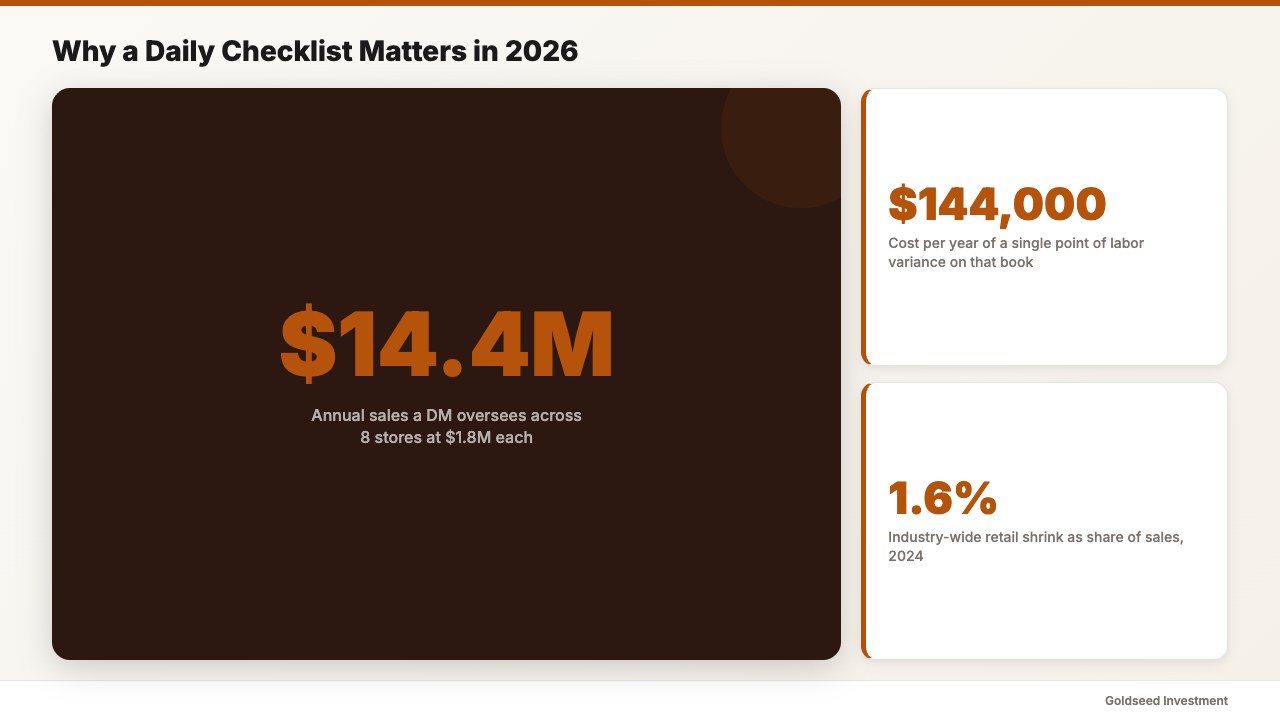
Retail margins compressed between 110 and 180 basis points from 2024 to 2026 as labor costs rose and shrink hit a reported 1.6% of sales industry-wide, per the NRF National Retail Security Survey. A district manager responsible for eight stores at $1.8M average revenue oversees roughly $14.4M in annual sales. A single unmanaged percentage point of labor variance on that book costs about $144,000 per year.
A daily checklist is not busywork — it is a filter. Its job is to surface the two or three exceptions across eight stores that actually deserve your time, and to let the other five or six run without you. The district managers who scale well in 2026 are the ones who stopped trying to manage every store every day and started reading every store every day.
The checklist also solves a second problem: it makes your absence legible. When a DM visits Store 4 on Tuesday, the team at Stores 1, 2, 3, 5, 6, 7, and 8 should still know the DM saw them — through a labor report review, a cash log check, or a midday text. The checklist tends to create that rhythm automatically.
One retail operator put it plainly:
> \”I found out six months later that my manager had been letting tardiness slide and letting overtime go unpaid. I never had a way to know. Now the system tells me — and so do I, in real time.\”
That six-month blind spot is expensive, and it is what a structured checklist is built to prevent.
What Should a Retail District Manager Check Before the First Store Opens?
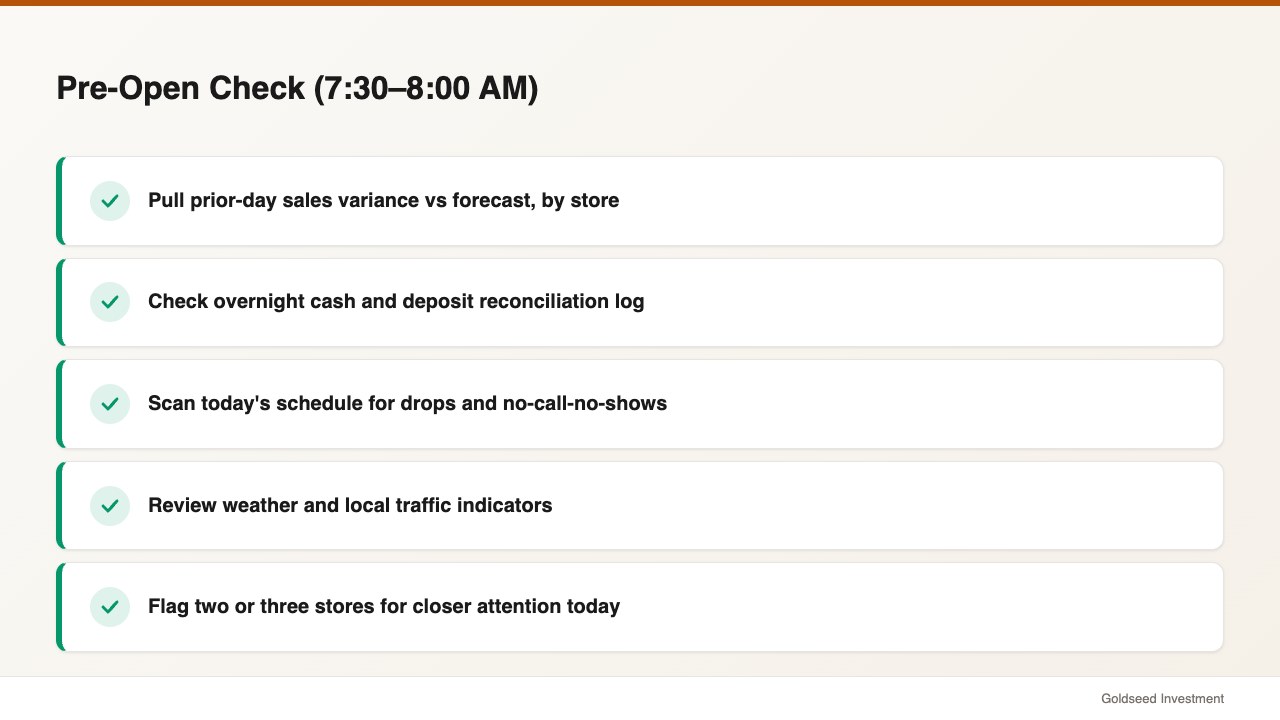
The first 30 minutes of the day — usually 7:30 to 8:00 AM local — is the highest-leverage window on the calendar. Before you get in the car or open your email inbox, review four data points for every store in your district.
First, pull the prior-day sales variance. You are not looking at absolute sales; you are looking at variance against forecast. A store that hit $11,200 against a $12,000 forecast (-6.7%) in a week when the district averaged -2% is a signal. Write down the two or three stores with the largest negative variance and move on.
Second, check the overnight cash and deposit log. You want to see that the close-of-day deposit was made, that the drawer count reconciled within your threshold (typically $5 for a $300 drawer), and that any over/short entries have a documented cause. A single $12 shortage in one store is noise. The same $12 shortage at the same register three days in a row is a pattern.
Third, scan the schedule for today. You are hunting for overnight drops, no-call-no-shows logged by the morning manager, and any store that is now below its minimum staffing model for a particular daypart. In many cases, the fix is a text to a part-timer by 8:15 AM; waiting until 10 AM turns a scheduling problem into a service problem.
Fourth, look at weather and local traffic indicators. A store on a flooded commute route will miss its open-to-11 AM forecast whether or not you visit. Adjust expectations accordingly and do not confuse a traffic problem with a staffing problem.
This pre-open block should take 20 to 30 minutes. If it is taking you 90 minutes, the issue is tool fragmentation — you are probably pulling data from four different dashboards — not a checklist problem.
What Does the 30-Minute Store Walk Actually Look Like?
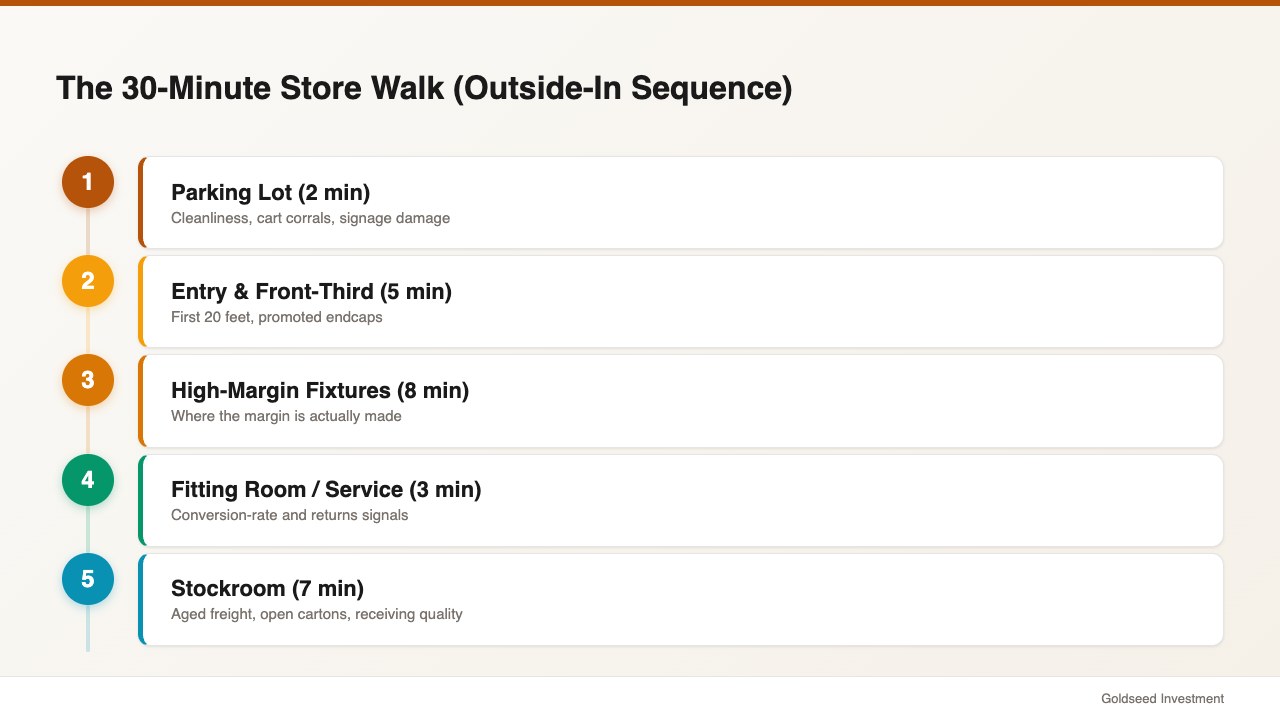
The store walk is the most misused hour in a district manager’s day. Walks that last twelve minutes tend to miss more than they catch. Walks that last ninety minutes signal to the store team that the DM does not trust them. Thirty minutes, done in a consistent outside-in sequence, is the industry norm.
The sequence most multi-store operators follow:
- Parking lot (2 min) — Is it clean? Are the cart corrals stocked? Is there visible signage damage? This is the first thing your customer sees, and it is often the only thing your store manager never looks at.
- Entry and front-third (5 min) — Check the first 20 feet of the sales floor. Walk through the promoted endcaps. Look at the two product categories that drove prior-week sales.
- Mid-store and high-margin fixtures (8 min) — Where is the margin made? Jewelry cases, electronics accessories, beauty endcaps, proprietary-brand walls. Are they stocked, priced correctly, and supervised?
- Fitting rooms or service desk (3 min) — Service-recovery tells. Abandoned items in the fitting room are a proxy for conversion rate. A long return line is a proxy for product-description or sizing issues.
- Stockroom (7 min) — This is the step most DMs skip, and it is where most of the information lives. Count the open shipping cartons. Look for aged freight. Note how the truck was received.
- Manager office (5 min) — Read the day’s schedule on the wall. Look at the cash log. Ask one question and listen.
The four questions that frame every walk are consistent: Clean? Staffed? Stocked? Safe? Anything that fails one of those four gets written down. Everything else stays in your head.
One thing worth noting: photograph problems, do not describe them. A 60-second iPhone photo of an overstock pallet blocking a fire exit communicates more to the store manager than a 300-word email.
Which Labor Metrics Should a District Manager Review Every Day?
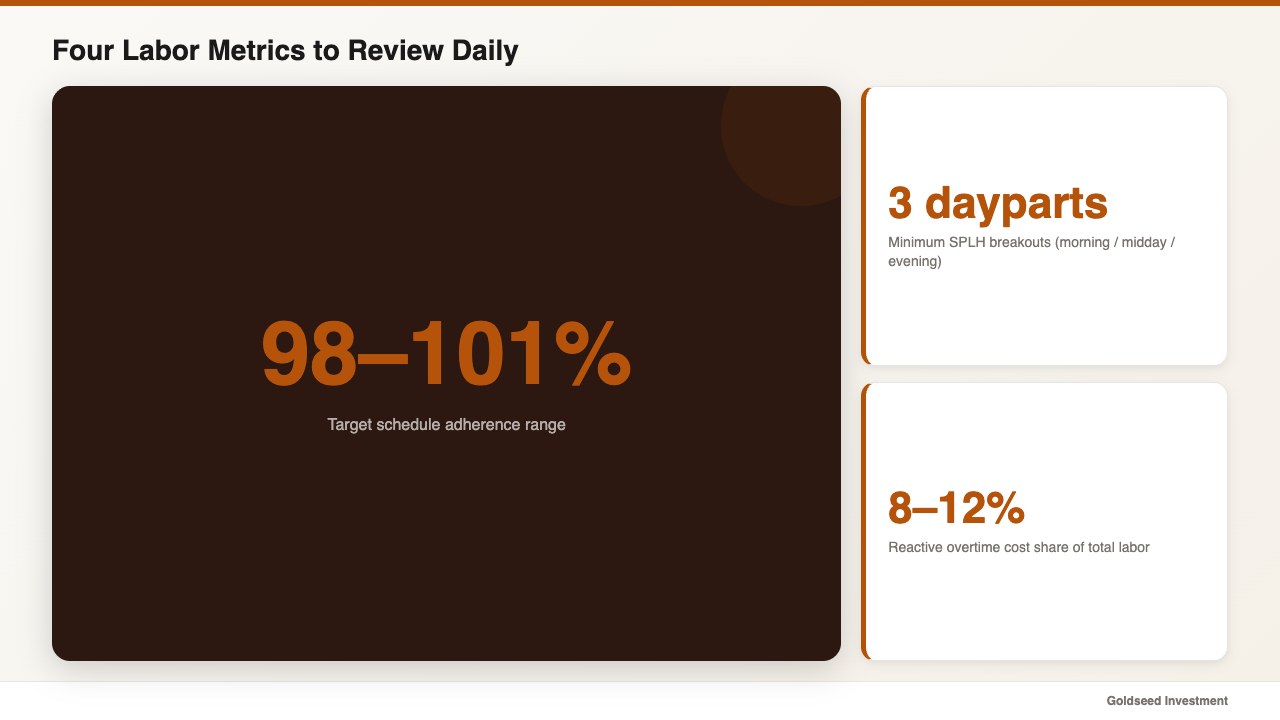
Labor is the largest controllable cost line in most retail formats — typically 11 to 14% of revenue for specialty, per BLS retail trade data. Four labor numbers belong on your daily checklist.
Schedule adherence. This is scheduled hours vs. actual hours worked, by store, by day. A store at 104% adherence (working more than scheduled) is leaking money — often through unapproved overtime or early clock-ins. A store at 92% adherence is under-covering shifts and likely bleeding service. The target for most mature retailers is 98–101%.
Sales per labor hour (SPLH), by daypart. Daily SPLH averages are not useful. A store can look great at $142 SPLH for the day and still be dramatically overstaffed from 10 AM to noon and dramatically understaffed at 6 PM. Pull SPLH in three dayparts minimum — morning, midday, evening — and you will see where the schedule is misbuilt.
Overtime creep. Any employee on track to exceed 35 scheduled hours by Wednesday is an overtime risk for the pay period. You do not need to micromanage this — you need a flag that surfaces it. The cost of reactive overtime in retail tends to run 8–12% of total labor cost in stores without active controls.
Late clock-ins. A store with 6% late-arrival rate is not a store with 6 lateness issues — it is a store with a morning-manager accountability issue. Look for patterns, not single incidents.
One experienced multi-store operator described the data problem this way:
> \”Every time I trained someone, I was betting months of time on a person who might leave in six months. The only way to scale wasn’t better people — it was putting the knowledge into the system.\”
The same applies to labor metrics. The DM who keeps numbers in a notebook will lose track across eight stores. The DM who relies on a labor dashboard sees the same exceptions surface consistently, and coaching conversations become specific rather than generic. For more on how to price and coach against these exceptions, see the Goldseed guide on how to reduce overtime in retail.
How Should District Managers Handle Cash and Shrink Signals Daily?
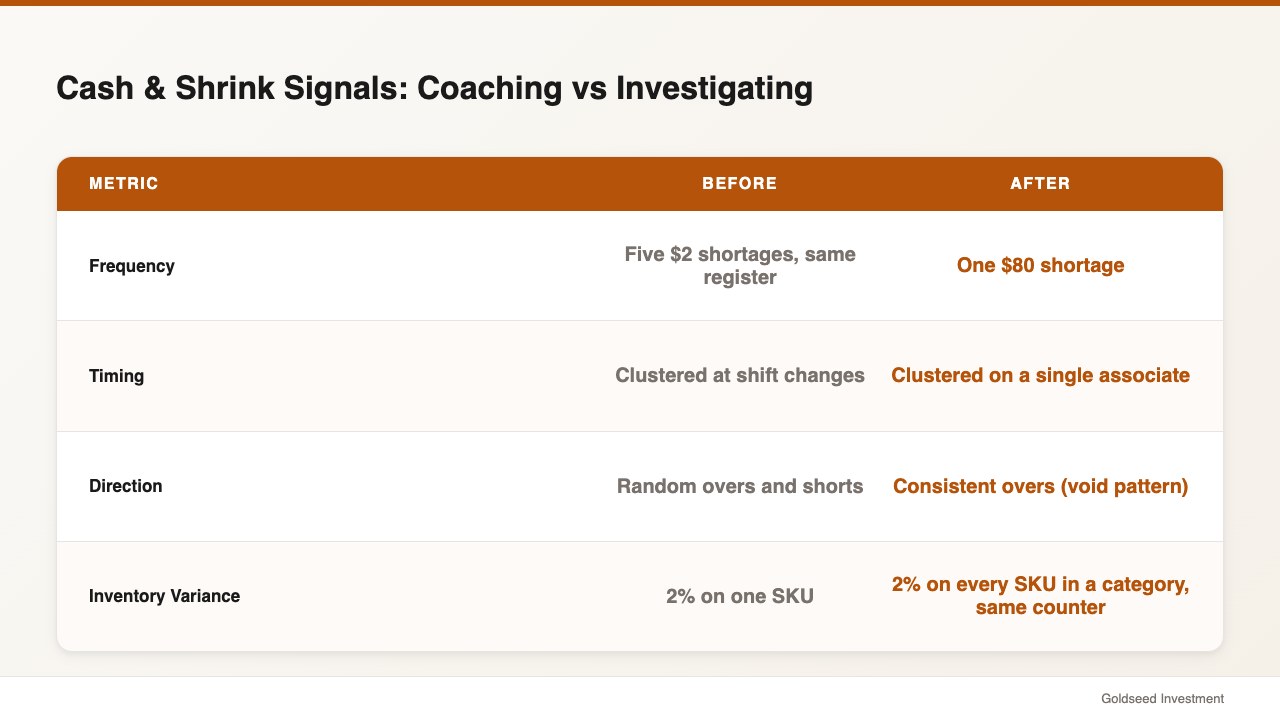
Cash and shrink are the two areas where daily neglect compounds fastest. A single-day inventory error that goes unreconciled becomes a month-end write-off; a single-day cash shortage that goes uninvestigated becomes a pattern that drains thousands.
Read the cash-over/short log before you walk into any store. Three signals matter:
- Frequency. Five $2 shortages in a week from the same register is a coaching signal, not a theft signal. A single $80 shortage is a theft signal.
- Timing. Shortages clustered around shift changes often indicate handoff-count problems, not intent. Shortages clustered around a single associate across shifts are different.
- Direction. Consistent overs (drawer has more than recorded) often mean voids are being processed without customer presence — a subtle shrink risk.
Shrink deserves its own daily review window. Operational errors — bad receiving, mis-scans, miscounts — drive roughly 22% of total shrink dollars according to NRF survey data. That is the portion a DM can actually reduce with daily attention. The two-signature rule is a cheap, effective control: every cycle-count adjustment over a threshold (commonly $50) requires the store manager and one other named team member to sign off. A system without that control often shows adjustment activity that correlates suspiciously with specific employees.
One retail operator explained the underlying statistical problem like this:
> \”Before, when numbers didn’t match, I had no way to know if it was theft, a counting error, or a receiving mistake. Now the system tells me statistically whether the discrepancy is random or deliberate.\”
The insight is that a 2% variance on one SKU is noise. A 2% variance on every SKU in the same category, counted by the same person, two weeks in a row — that is not noise. You do not need a statistics degree to see it; you need a daily habit of looking.
What Should the Midday and End-of-Day Review Include?
The midday window — typically 11:30 AM to 2:00 PM — is where most DMs leave money on the table. By this hour you have enough data (morning sales, actual vs scheduled labor, inbound freight status) to make the one adjustment that disproportionately protects the day.
The midday review is short. Pull sales vs forecast. If a store is tracking more than 8% under forecast by 12:30 PM, that store is unlikely to recover without intervention — reduce 4 to 8 labor hours from the afternoon build. If a store is tracking more than 8% over, add a mid-shift associate to the high-margin zone. These calls do not need to be perfect; they need to be made.
The end-of-day review runs through five items:
- Cash deposit confirmed and logged (by name, by time).
- Tomorrow’s schedule reconfirmed — any gaps filled by 7 PM.
- Any open investigations from the morning list closed or carried to tomorrow.
- One handoff note to the opening manager, in writing, not a phone call.
- One note to yourself: what is tomorrow’s one priority store?
Written end-of-day notes compound. A DM who writes a two-line close every day for six months has the cleanest coaching record in the company. That record is what matters in a termination conversation, an annual review, or a regional performance meeting.
Which Weekly Rhythms Anchor the Daily Checklist?
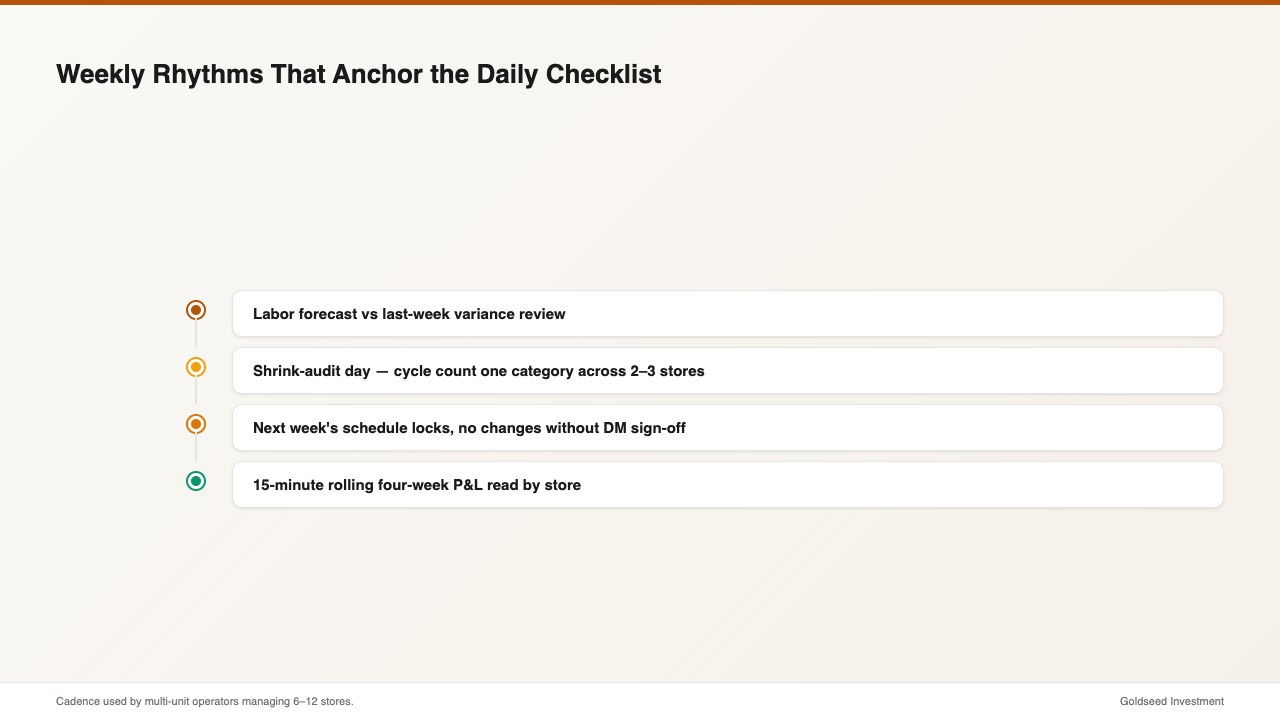
The daily checklist only works if it is embedded in a weekly rhythm. Four days of the week carry specific heavier tasks that keep the daily routine from drifting.
Monday is labor forecast day. Review last week’s actual labor vs. forecast by store. Any store with more than 4% variance in either direction gets a root-cause note by Tuesday.
Wednesday is shrink-audit day. A midweek cycle count on one category across two or three stores keeps shrink data fresh without overwhelming any single store. The goal is twelve touches per quarter per high-loss category.
Friday is schedule-lock day. Next week’s schedule locks by 5 PM Friday, with no changes permitted before Monday morning without DM sign-off. This is the single highest-leverage control on labor variance.
Sunday evening is the P&L read. A 15-minute review of each store’s rolling four-week P&L tells you which store is truly profitable, which is propped up by a single strong category, and which is quietly bleeding. For more on reading store-level profitability, see how to analyze retail store profitability in 5 steps.
The daily checklist sits inside this weekly rhythm. Without the weekly anchor, the daily checklist becomes reactive; with it, the daily checklist becomes a signal system.
Common Mistakes District Managers Make With Daily Checklists
Most checklist failures are not checklist problems — they are judgment problems. Five mistakes show up repeatedly across underperforming districts.
First, treating the checklist as a script. Walking a store in the exact same sequence every day means you stop seeing the store; you see your checklist. Keep the sequence, vary the attention.
Second, confirmation-bias visits. The DM who visits the best-run store first because \”it’s a nice start to the day\” is borrowing trouble. Visit the store with the weakest recent metrics first. The walk will take longer, the coaching will feel harder, and the return on that hour will be dramatically higher.
Third, skipping the stockroom. The sales floor tells you what the store manager wants you to see. The stockroom tells you what is actually happening — aged freight, mis-placed overstock, damaged goods that should have been claimed weeks ago.
Fourth, untimed walks. A walk that takes twelve minutes missed something. A walk that takes ninety minutes annoyed someone. Thirty minutes, timed, keeps both problems in check.
Fifth, no handoff discipline. A DM who texts store managers randomly throughout the day at midnight creates a reactive culture. A DM who ends every day with a single written note creates a proactive one. For a parallel lens on how multi-store operators structure their day across locations, the Goldseed guide on how to manage two retail stores at once covers the solo-operator version of this same rhythm.
The district manager’s checklist is not about control. It is about building a consistent signal so that across eight or ten or twelve stores, the exceptions surface quickly and the well-run stores are left to run. The DMs who win in 2026 have stopped trying to be everywhere and started reading everywhere.
FAQ
Q: How long should a retail district manager daily checklist actually take? A: About 90 minutes of focused work per day: 20–30 minutes before stores open, 30 minutes for the primary store walk, 10–15 minutes for a midday labor review, and 15 minutes for the end-of-day close. If it is taking four hours, the issue is usually fragmented tools rather than an over-scoped checklist.
Q: How many stores can one district manager realistically cover with a daily checklist? A: Industry practice in 2026 ranges from 6 to 12 stores, with specialty and apparel retailers trending toward the lower end (6–8) and convenience and quick-serve toward the higher end (10–12). Stores beyond that threshold typically require a zone or area-manager layer.
Q: Should the daily checklist be paper-based or digital? A: A written end-of-day close matters more than the format. That said, digital checklists with photo attachments tend to scale better across multiple locations because they time-stamp and geo-tag entries, which matters for overtime compliance and shrink audits.
Q: What’s the single most-skipped item on a district manager’s daily checklist? A: The stockroom walk and the cash-over/short log review. Both take under 10 minutes combined and tend to surface 70–80% of the operational exceptions a DM should be coaching on that day.
Q: How often should district managers rotate which store they visit first? A: Rotate weekly, and lead with the weakest-metric store about 60% of the time. Visiting the easiest store first is the most common confirmation-bias trap in multi-unit retail.