Retail operators who switched from Deputy to Storebase report weekly scheduling time dropped from 3.5 hours → 12 minutes, software stack 4 → 1, and monthly cost roughly $320 → $48.
Marcus Velez owns four convenience and liquor stores in the Phoenix metro. For three years, his Sunday night ritual looked the same: open Deputy on his laptop at 7 p.m., line up four store rosters, drag shifts around, send out push notifications, then field text messages from staff who couldn’t see the published schedule on the free tier. By 10:30 p.m. he was usually done. The next morning, he’d export timesheets to a payroll service that wasn’t quite integrated, eyeball the cash drawer log his lead manager kept in Google Sheets, and check inventory through a separate tablet at each store.
In January 2026, he switched to Storebase. Not because Deputy was a bad scheduling tool — it isn’t — but because his software bill had climbed past $320 a month for tools that still didn’t connect. Schedule build time went from 3.5 hours → 12 minutes. Payroll now runs straight off QR clock-in data. Cash variance is traced to a specific staff member in under a minute. His monthly software spend dropped from $320 → $48.
> “I didn’t leave Deputy because it was broken,” Marcus told his bookkeeper in his Q1 review. “I left because I was paying four bills to do one job, and none of them talked to each other.”
This guide is for store owners and operators evaluating a Deputy alternative right now — not in a year. It compares what Deputy does well, where it falls short for small retail, and how a back-office app fills the gaps that Deputy was never designed to cover.
Why Are More Retail Owners Looking for a Deputy Alternative in 2026?
Deputy was built for workforce-heavy industries — hospitality chains, healthcare, and large retail with complex award interpretation. That heritage shows up in three places small retail operators feel as cost or friction.
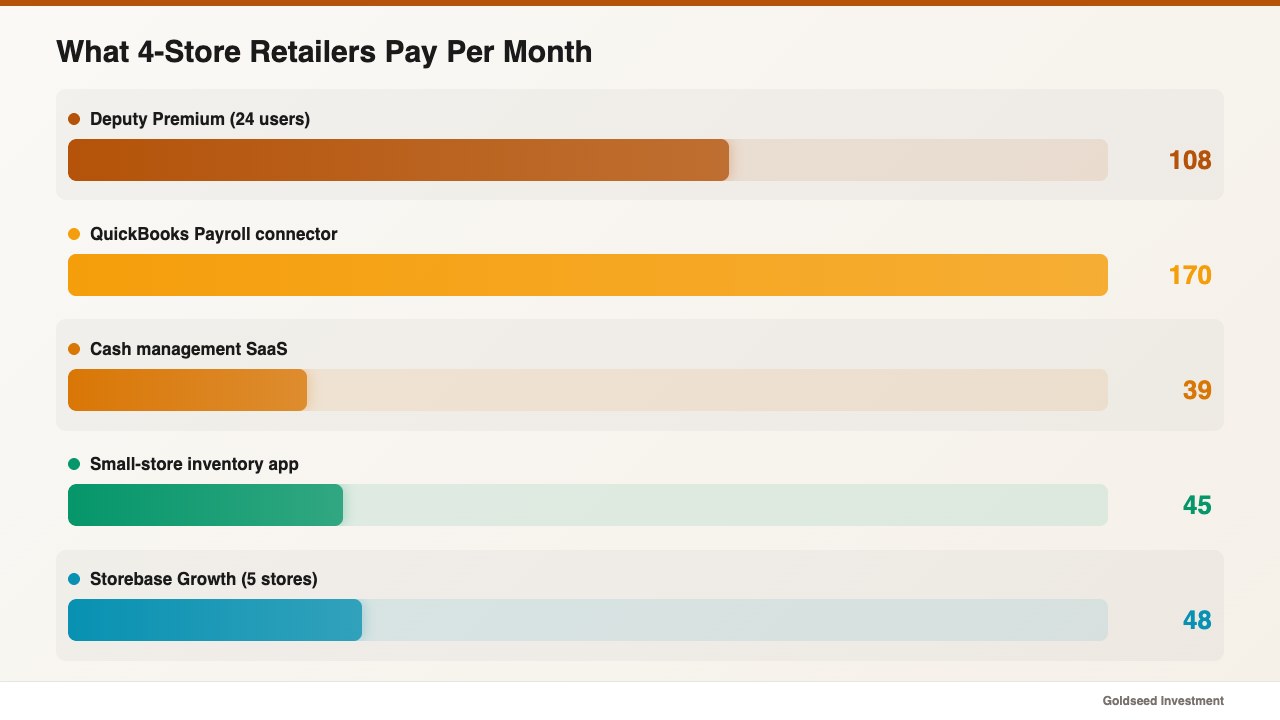
First, the price per location compounds quickly. Deputy’s headline price is per-user-per-month, but operators with 4-10 locations and 20-40 staff routinely report effective costs of $4-$6 per user once the Premium or Enterprise features kick in. A four-store retailer with 24 active employees easily clears $100-$140/month in scheduling alone — before any payroll add-on.
Second, scheduling is one piece of a five-piece puzzle. Small retail owners need shift planning, time tracking, payroll calculation, cash drawer accountability, and inventory visibility. Deputy covers the first two cleanly. The other three live in separate tools. A 2024 SHRM analysis found managers in multi-app stacks lose an average of 3.14 hours per week just on schedule maintenance, not counting context-switching between apps.
Third, Deputy Payroll regional availability is patchy. As of 2026, full Deputy Payroll is concentrated in Australia and select U.S. states. Operators outside those markets typically export timesheets to a third payroll system — usually QuickBooks Payroll, Gusto, or ADP — which adds $40-$80/month and recreates the data-handoff problem the platform was supposed to solve.
The Bureau of Labor Statistics puts the retail trade average hourly wage at $19.85 in 2025, and the National Retail Federation’s 2025 State of Retail report notes labor is 12-18% of total operating expenses. For an owner running on a 4-6% net margin, every extra software seat and every hour of manager time is a real line on the income statement. That’s the math that tends to drive the search for a Deputy alternative.
What Does Deputy Actually Do — and What Does It Leave on the Table?
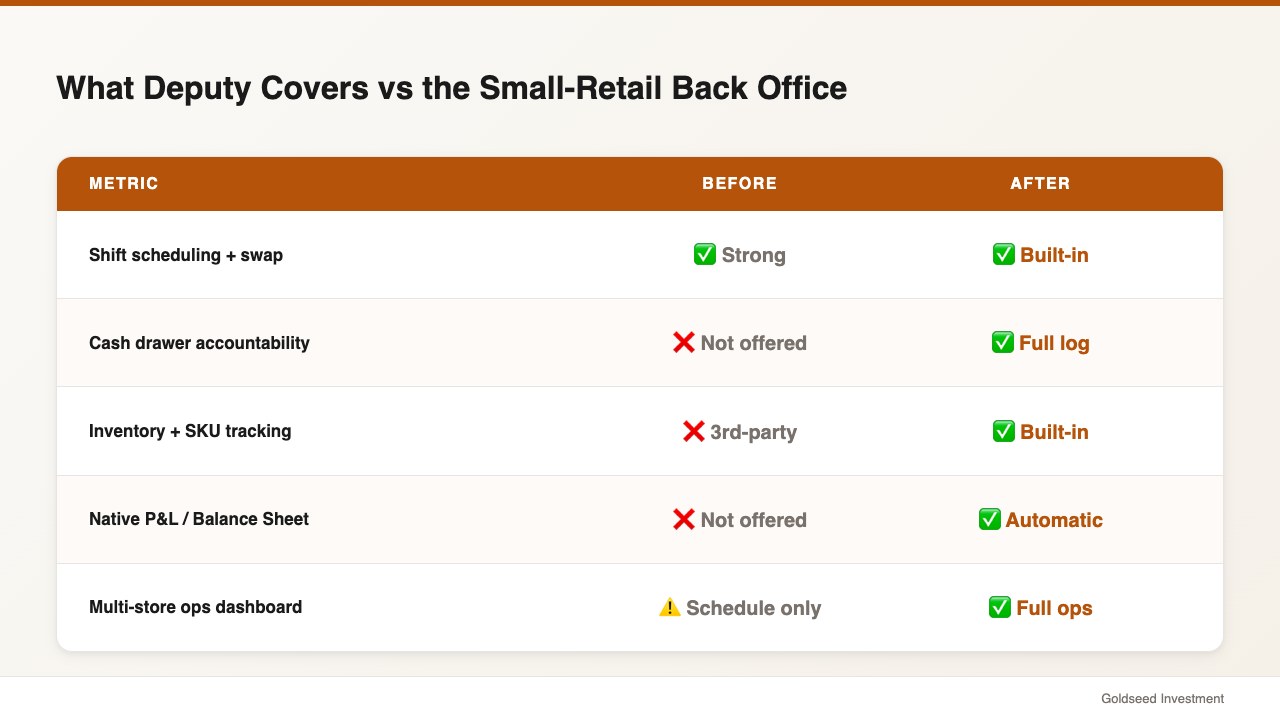
Credit where it’s due. Deputy is a mature shift scheduling product. It generally handles complex award interpretation, integrates cleanly with 30+ HR and accounting tools, supports shift-swap workflows with manager approval, and has decent geolocation clock-in. For hospitality groups managing 50+ staff per location with strict labor compliance rules, it’s a defensible choice.
What it doesn’t do — and was never built to do — is run a small retail back office. Specifically:
- Cash drawer accountability. Deputy does not log who counted the drawer, who voided a sale, or who entered which deposit. If your register is short $43 on a Tuesday night, Deputy can’t tell you anything about it.
- Inventory + SKU tracking. No reorder points, no stock count sessions, no audit trail for inventory adjustments. Deputy assumes a separate POS or inventory app handles this.
- Native P&L and balance sheet. Deputy reports labor cost ratio as a percentage of scheduled hours. It does not pull in revenue, COGS, or fixed costs. To know whether you actually made money this month, you still open QuickBooks or a spreadsheet.
- Multi-store operations dashboard. Deputy can group locations, but the consolidated view is schedule-only. You can’t see cash position, inventory exceptions, and labor variance for all stores in one screen.
Most operators don’t notice these gaps until they grow past two stores. At that point, they typically realize they’re paying Deputy to do 30% of the job and stitching together three other apps for the rest.
How Much Does Sticking With Deputy Really Cost a 4-Store Retailer?
Pricing comparisons usually get noisy because everyone publishes per-user numbers. Here’s the math the way Marcus did it on a napkin before switching, using the configuration that mirrors most small retail chains: four locations, 24 active employees, schedule + time tracking + payroll + cash log + basic inventory.
The Deputy line alone — 24 users × $4.50/user/month on the Premium plan — runs $108/month. Add Deputy Payroll at $35/month per location (where supported) or a QuickBooks Payroll connector at $50/month base + $5/employee, and you’re at $200-$240/month. A standalone cash management tool (Loomis-style or a SaaS option like Cash Drawer Pro) averages another $39/month. A small-store inventory app — Sortly, Stock&Buy, or similar — adds $30-$60/month.
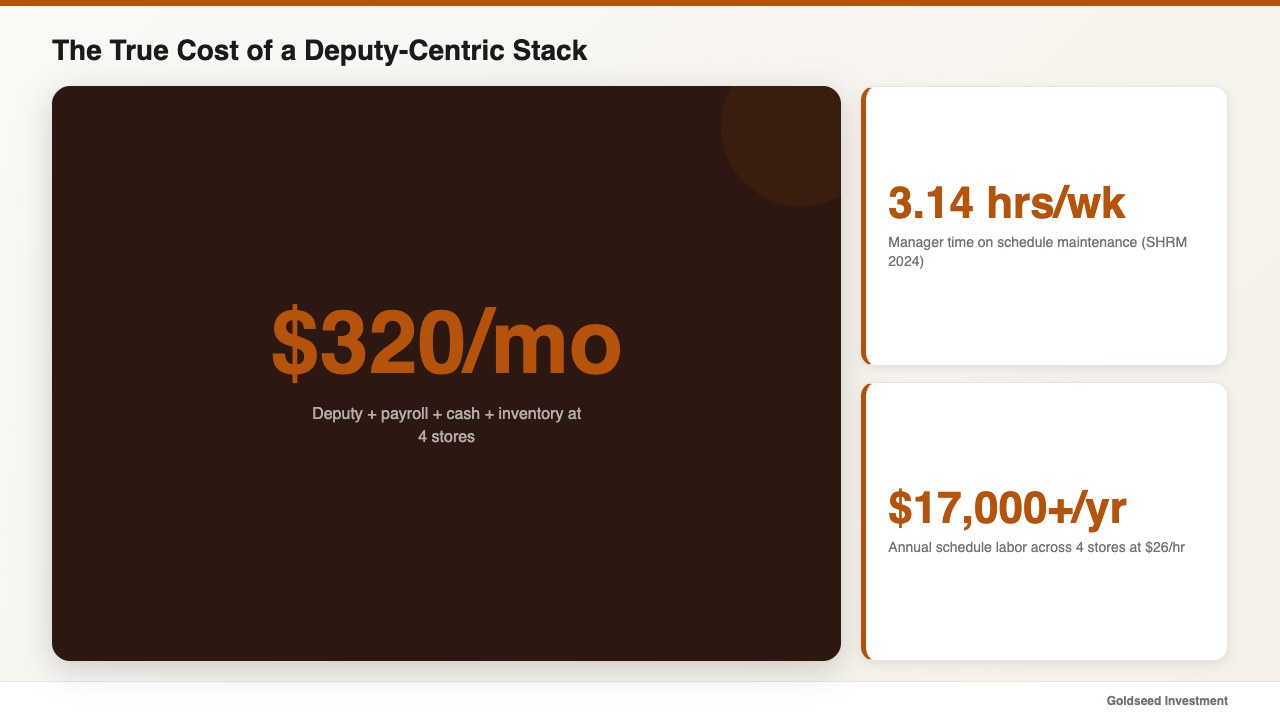
Total bill at a 4-store configuration: roughly $310-$340/month. Annualized: $3,720-$4,080. For context, that’s nearly the take-home from one full week of average-margin retail sales at a single location.
Now layer in the time cost. SHRM’s 2024 research pegs scheduling at 3.14 hours per week per manager. At a $26/hour fully-loaded manager rate × 4 locations × 52 weeks, schedule-only labor adds $17,000+ per year. Even if your owner-operator does the scheduling themselves at no notional cost, that’s still 650+ hours a year you’re not spending on margin-improving work.
This is the cost picture that often pushes operators to look at employee scheduling software categories outside the Deputy ecosystem and compare them against a back-office-first stack.
How Marcus Cut His Software Bill 85% After Leaving Deputy
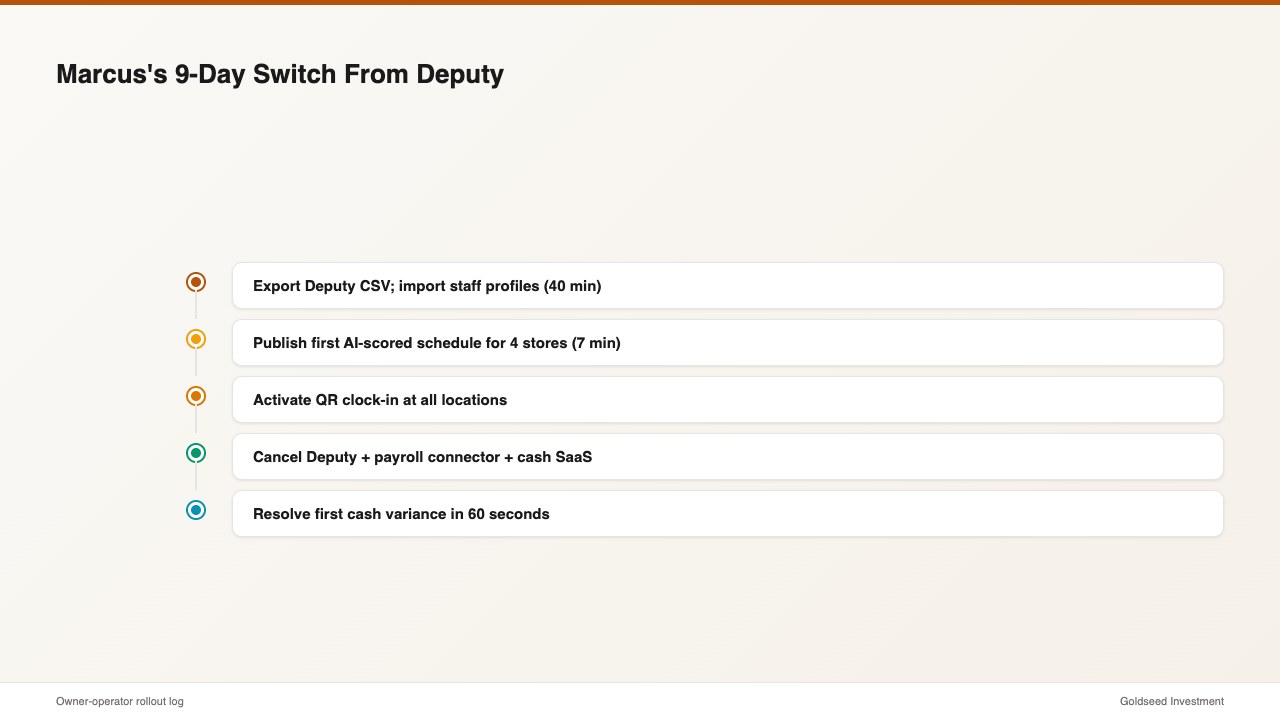
Marcus’s switch was not a one-weekend miracle. It was a nine-day rollout, and he documented it because his accountant asked him to.
Day 1. He pulled three months of Deputy timesheets and exported them as CSV. He uploaded staff profiles — names, hourly rates, location assignments — in about 40 minutes.
Day 3. He published the first week of shifts using the AI-scored shift-request workflow. Staff submitted availability through the mobile app. The system ranked candidates against skill tags, fairness rules, and an overtime threshold, then surfaced one recommended schedule for him to approve. He approved it in seven minutes. Last comparable Deputy week: 47 minutes. Approval time: 47 → 7 minutes.
Day 5. He turned on QR clock-in at all four stores. Staff scan a printed code on the wall; geolocation and timestamp post automatically. No more “I forgot to clock out” emails.
Day 7. He cancelled Deputy, the QuickBooks Payroll connector, and the cash drawer SaaS. Total monthly recurring software cost: $48 on the Growth plan ($48/month, up to 5 stores, up to 30 employees). App stack: 4 → 1.
Day 9. First cash variance after the switch — a $12 short at store #2. He pulled the cash log, saw the closing-shift staff member’s ID and timestamp on the deposit entry, and resolved it with a 90-second conversation. Pre-switch, that conversation would have started with “I’ll get back to you when I figure out what happened.” Variance-to-resolution time dropped from hours-or-days → 60 seconds.
> “The thing that surprised me most wasn’t the price drop,” Marcus said. “It was that I stopped worrying about what I couldn’t see.”
His before/after, audited by his bookkeeper:
| Metric | Before (Deputy stack) | After (consolidated) |
|---|---|---|
| Weekly schedule build time | 3.5 hours | 12 minutes |
| Number of apps in workflow | 4 | 1 |
| Monthly software cost | ~$320 | $48 |
| Time-to-trace cash variance | “Sometimes never” | < 60 seconds |
| Payroll error rate (Q1 2026) | 2-3% (manual reconciliation) | 0 logged errors |
This isn’t a unique result. Operators of two-to-six location retail and convenience businesses generally report similar deltas — the magnitude varies with how much manual stitching they were doing before.
Deputy vs Storebase vs Homebase: 2026 Feature Comparison
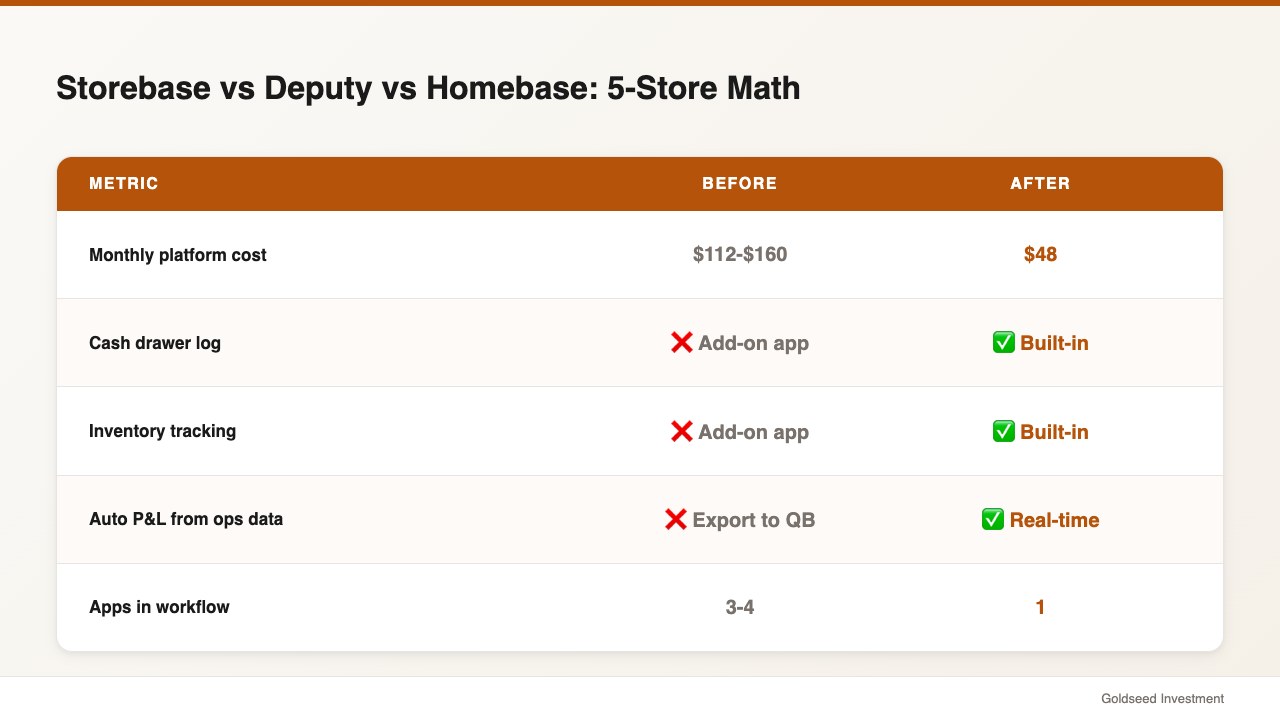
For owners who want a side-by-side, here’s how the three most-searched options stack up against the back-office workload of a small retail chain. Comparison reflects the standard mid-tier plan of each product as of Q1 2026.
| Feature | Storebase | Deputy | Homebase |
|---|---|---|---|
| AI-scored shift approval | ✅ Built-in | ⚠️ Auto-scheduling on Premium | ⚠️ Auto-schedule on higher tier |
| QR clock-in with geofence | ✅ Included | ✅ Included | ✅ Included |
| Cash drawer accountability log | ✅ Built-in | ❌ Not offered | ❌ Not offered |
| Inventory + SKU tracking | ✅ Built-in | ❌ Requires 3rd-party | ❌ Requires 3rd-party |
| Automatic Income Statement / P&L | ✅ Generated from operations data | ❌ Not offered | ❌ Not offered |
| Multi-store unified dashboard | ✅ Schedule + cash + inventory + labor | ⚠️ Schedule view only | ⚠️ Schedule view only |
| Payroll calculation | ✅ Native, from QR clock-in | ⚠️ Add-on, region-limited | ⚠️ Add-on (Homebase Payroll) |
| Per-employee pricing | ❌ Flat plan pricing | ✅ Per user | ⚠️ Per location |
| Starting price (1 location) | $18/month (Starter, up to 5 staff) | ~$4.50/user × users | $0 free tier (limited) / $24.95+ paid |
| 5 locations, 25 staff | $48/month (Growth) | ~$112-$140/month | ~$120-$160/month |
Two things tend to stand out. The back-office app is the only one of the three that natively addresses cash and inventory accountability — the work that often quietly breaks small retail when no one’s watching. And on multi-store pricing, flat plans usually win against per-user math as you scale past three locations.
For operators comparing Deputy against a workforce-only competitor, the Homebase alternative comparison is a closer like-for-like swap. For operators who want to consolidate scheduling, payroll, cash, and inventory into one tool, the back-office category is the better swap — that’s the trade you’re making.
How Marcus Uses Storebase to Replace Deputy and Two Other Apps
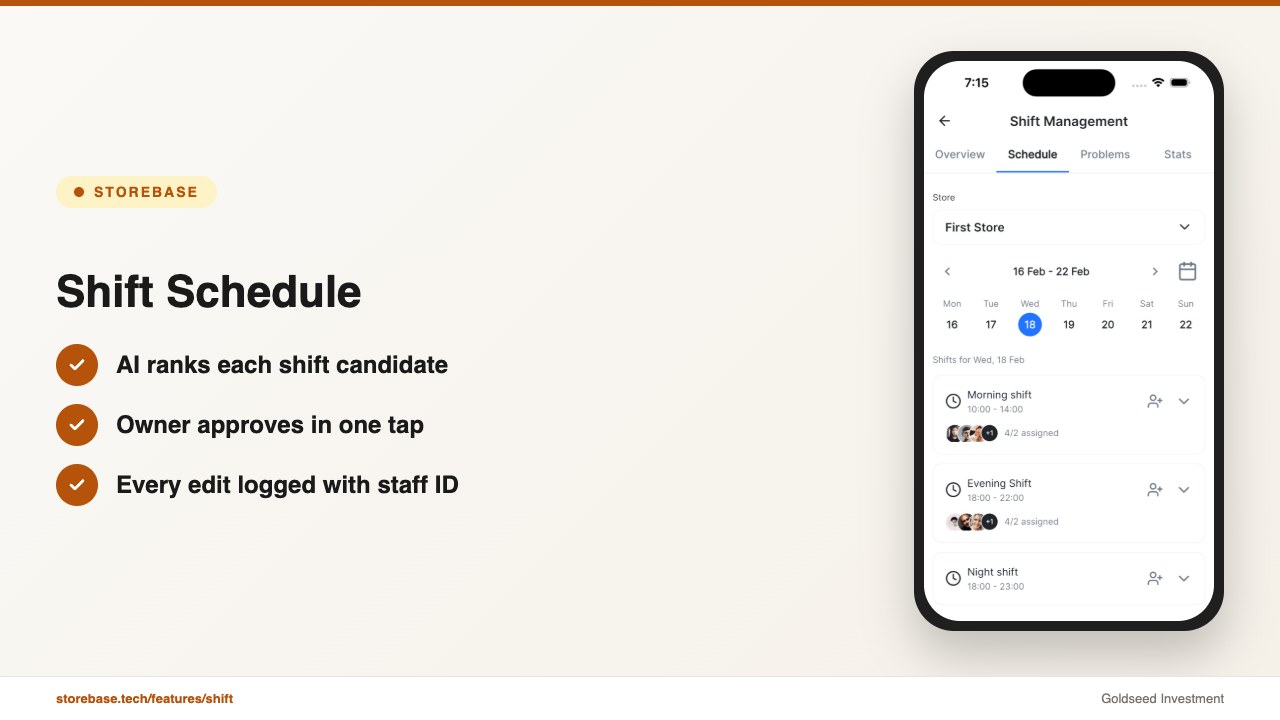
This is the section where vague comparisons become specific workflows. Here are the four modules Marcus uses every week and the Deputy-stack workflows they replaced.
1. Shift Schedule — AI approval, one tap. Staff submit availability through the Shift Schedule module. The app ranks each shift candidate against fairness, skill tags, and overtime thresholds, then proposes one schedule. Marcus reviews and approves. The whole flow for four stores typically takes 12 minutes a week. Every shift edit logs who made the change and when — the same accountability trail Deputy provides for scheduling, applied across the rest of the back office. Build time: 3.5 hours → 12 minutes.
2. Team & Payroll — QR clock-in into auto-calculated pay. Staff scan a QR code at the start and end of each shift. Geolocation and timestamp post to the Team & Payroll module, which automatically calculates regular hours, overtime, and tardiness deductions against the scheduled shift. Payroll runs from actual attendance — not scheduled hours. Marcus approves the period; the system generates pay summaries each employee can see, with the time-clock evidence backing every line. Reconciliation time: 90 → 5 minutes per cycle.
3. Cash Management — variance with a name attached. The biggest gap in his old Deputy stack. Every deposit, drawer count, safe drop, and ATM refill is entered through the Cash Management module. The system records who entered it, when, and from which device. When the drawer doesn’t match the system at end of day, the log identifies the responsible shift. Marcus traced a $43 short to a single staff member in 60 seconds last quarter — a conversation that, pre-switch, would have died unresolved. Variance traceability: opaque → fully attributed.
4. Multi-Store Dashboard — one screen, four stores. Schedule status, hours logged, labor cost ratio, cash variance flags, and inventory exception alerts all sit on one screen on Marcus’s phone. He looks at it once before his first coffee. He knows which manager hasn’t responded to a Sunday request, which store is over-scheduled, and which is sitting on a cash variance that hasn’t been resolved — all before he walks into any of them.
Compared to operators who still rely on a staff scheduling app plus three add-ons, the practical difference is that the data tends to live in one place and the accountability trail is end-to-end.
If your Deputy bill has climbed past $80/month and you’re still copy-pasting timesheets into payroll, the back-office category was built for exactly this transition. Most retail owners complete the Shift Schedule + Team & Payroll setup in under 10 minutes and run their first full payroll cycle inside week two — no credit card required. Start with Shift Schedule → or Download on the App Store →.
When Should You NOT Switch From Deputy?
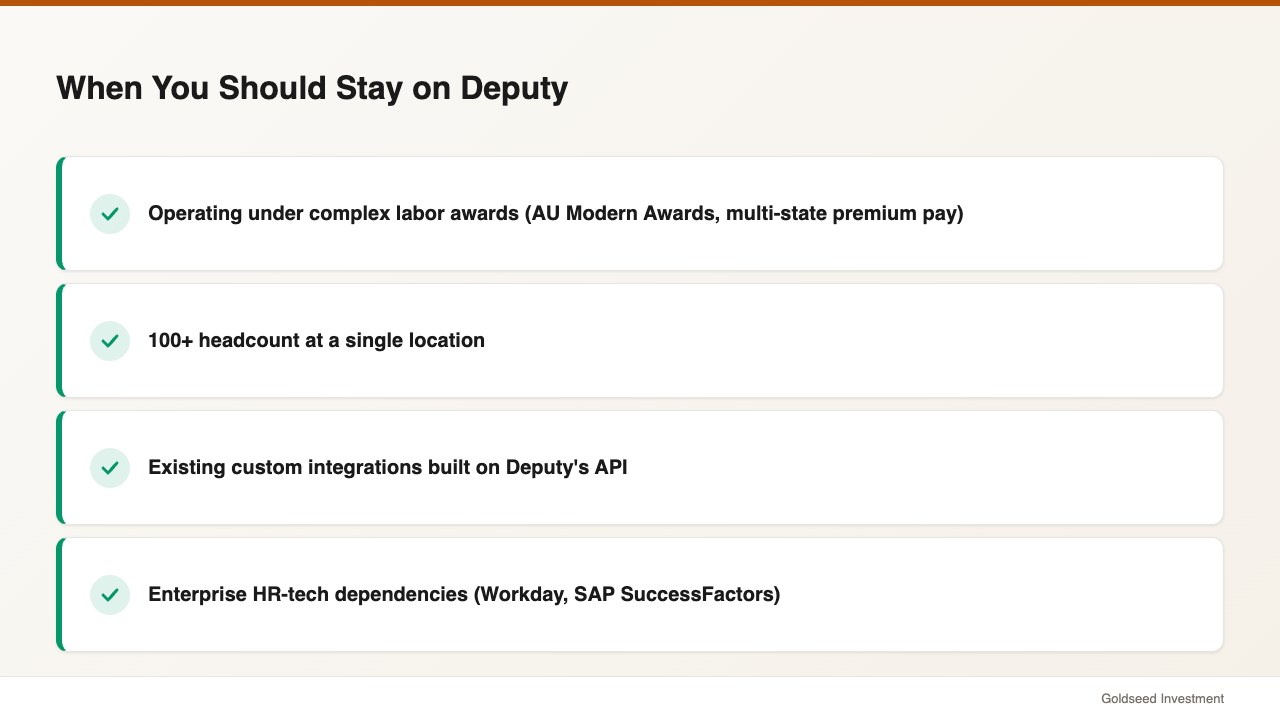
This guide would be useless without an honest answer to this question. There are three situations where staying on Deputy is generally the right call.
1. Enterprise-grade award interpretation. If you operate in jurisdictions with complex labor awards — particularly Australia’s Modern Awards or multi-state U.S. predictive scheduling laws with daily premium-pay triggers — Deputy’s award engine is one of the most battle-tested on the market. Replicating that depth in a back-office-first tool takes time.
2. 100+ headcount per location. A flat-plan back-office app generally scales comfortably to 70 employees per organization on the Business plan ($149/month, up to 10 stores). Above that headcount per single location, Deputy’s per-user model and team-management depth become structurally well-fit.
3. Established API integration dependencies. If you’ve built workflows on top of Deputy’s API or you depend on a specific HR-tech integration that Deputy supports natively, switching means rewriting that plumbing. The math may still work, but factor in the migration cost honestly.
For everyone else — and that’s most independent retail operators running 1-10 locations — the gap between what Deputy was built for and what your business actually needs is often the gap a back-office app fills.
FAQ: Switching From Deputy to Storebase
Q: How long does it take to migrate from Deputy? A: Most 1-5 store retailers complete the switch in 5-9 days. Day 1 is staff profile and rate import (CSV export from Deputy → upload). Day 3 is the first published schedule. Day 5-7 is QR clock-in activation and a parallel run. Day 8-9 is cancelling the old tools. The longest task is usually staff training on QR clock-in, which averages 8 minutes per employee.
Q: How much does a Deputy alternative typically cost for a small retail store? A: Per-user scheduling tools at 4 locations / 24 staff run $108-$140/month before payroll add-ons. Flat-plan back-office apps in this category price the same configuration at $48/month on the Growth plan (up to 5 stores, up to 30 employees). The Starter plan covers a single store with up to 5 staff at $18/month.
Q: Does this alternative actually replace Deputy or is it different category software? A: It replaces Deputy’s scheduling and time-tracking functions for small retail operators and adds three modules Deputy doesn’t have — cash management, inventory, and automatic financial statements. For multi-thousand-employee enterprises with deep award interpretation needs, this category is not the right fit. For 1-10 location retail and convenience stores, it covers a wider workflow than Deputy on a single plan.
Q: Can I keep my POS when I switch? A: Yes. The back-office layer works alongside any POS — Square, Clover, Toast, Lightspeed, or others. It is not a POS replacement. Your POS handles the sale; this layer handles what happens after the sale (payroll, cash variance, inventory adjustments, P&L).
Q: Is there a free trial? A: Yes. The Starter, Growth, and Business plans all offer a no-credit-card trial. Most retail owners complete onboarding for one store inside 10 minutes and can decide based on the first full payroll cycle whether the math works for them. The iOS app is available on the App Store.
Q: What happens to my historical Deputy data? A: Export timesheets and staff records as CSV from Deputy before cancellation. The new platform imports staff profiles and pay rates directly. Historical shift records are usually kept as a CSV archive in cloud storage; most operators reference them only for tax season the first year and rarely thereafter.