Retailers using Storebase’s multi-store dashboard cut weekly performance-review time from 9 hours → 25 minutes and catch underperforming locations 3–6 months earlier than spreadsheet-based peers.
Eighteen months ago, Elena Moreau — owner of a 5-store specialty beauty chain across Georgia and Tennessee — spent every Sunday night from 6 p.m. to 3 a.m. pulling POS exports into a master spreadsheet. Five locations, four tabs per store, thirty-seven manual formulas. Store 3 in Chattanooga was underperforming for four months before the spreadsheet finally showed it. Then she layered Storebase on top of her existing POS, and her weekly reconciliation dropped from 9 hours → 25 minutes on the very first cycle.
Today Elena runs the same 5 stores from her phone. She opens Storebase at 7 a.m. with a coffee, and in under 25 minutes she knows which store beat its labor target, which is overstocked on a slow SKU, and which cashier had a $42 drawer variance on Saturday night. That shift wasn’t a new team or a new POS — she kept Square, she kept Homebase for a while. What changed was the back-office layer on top: a real multi location retail store performance comparison dashboard, priced at $48/month flat for up to 5 locations on the Growth plan.
This guide is for operators who’ve outgrown the spreadsheet but can’t find a true multi location retail store performance comparison tool that tells them the truth across every store at once. We’ll walk through why comparison is broken for most chains, the 5 KPIs that actually matter, and how the Storebase back-office stacks up against the QuickBooks + Excel + Homebase combo most small chains are using by default in 2026.
Why Can’t Most Multi-Location Retailers Actually Compare Their Stores?
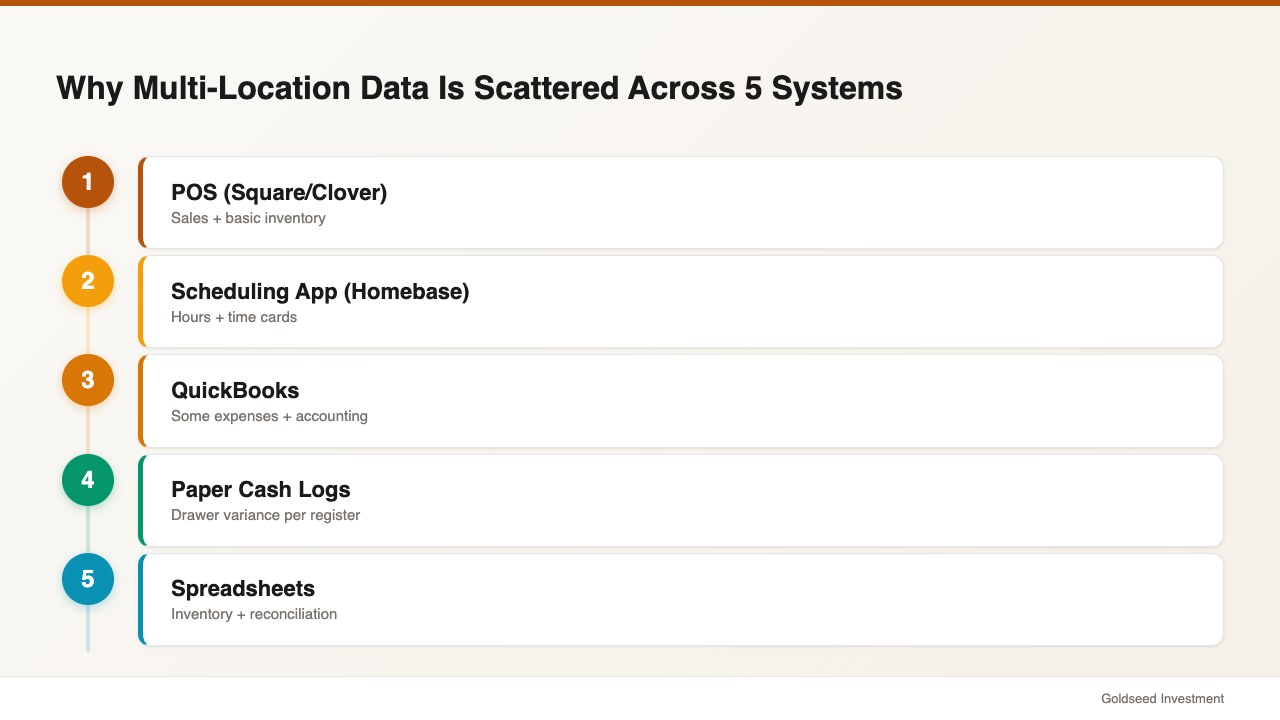
Ask any 3–10 store operator how their locations performed last week and you’ll get a long pause. It’s not that they don’t care. The data is scattered across five systems that weren’t built to talk to each other. Square holds the sales. Homebase holds the hours. QuickBooks holds (some of) the expenses. Cash variance lives on a paper log at each register. Inventory lives in a spreadsheet someone’s cousin built three years ago.
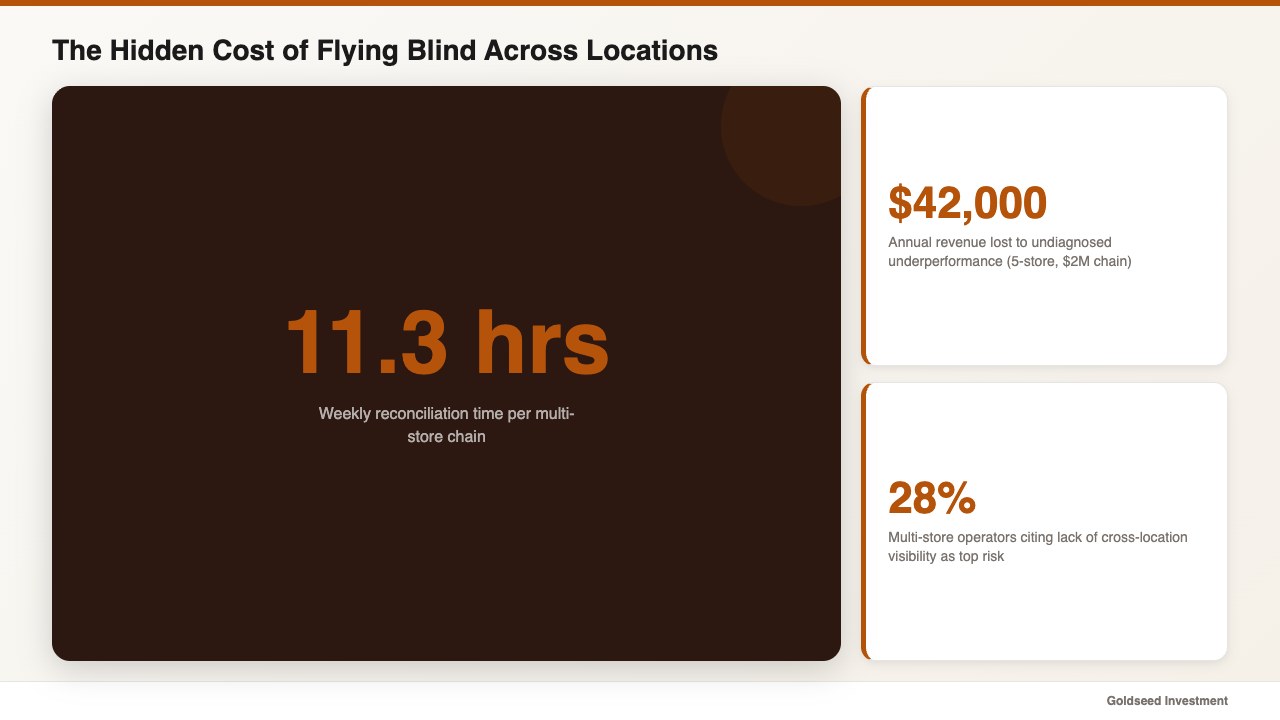
The NRF’s 2024 State of Retail report put a number on it: multi-location retailers spend an average of 11.3 hours per week just reconciling data across stores before any analysis happens. That’s the “data cleaning” step — not the thinking, not the decision. For a district manager making $72,000 a year, that’s roughly $14,500 a year of labor buried in manual aggregation alone.
And the comparisons that do get made are usually apples-to-oranges. Store A’s P&L uses cash accounting; Store B’s uses accrual. Store C’s manager forgot to log the wholesale discount. So when the owner asks “which store made the most money last month?”, the honest answer is often “I’m not sure — let me get back to you Wednesday.”
For a deeper walkthrough of the underlying numbers you should be comparing, see retail store profit margin benchmarks by category. But benchmarks don’t help if your data is dirty. Real comparison starts with clean, unified data — and that’s the part most chains quietly skip.
What Does the Hidden Cost of Flying Blind Across Locations Actually Look Like?
Here’s the uncomfortable truth about running multiple stores in 2025 and 2026: the longer you go without real comparison, the longer a bad problem hides. One multi-location operator we interviewed didn’t realize his manager at the worst-performing store had been letting unpaid overtime slide and overlooking cash shortages — for six months. The losses weren’t catastrophic week-to-week. They compounded. By month six he’d lost $18,000 in payroll leakage and drawer variance that nobody could trace.
This isn’t a story about a bad manager. It’s a story about what happens when there’s no system showing you what you can’t see from outside the store.
Deloitte’s 2024 Global Retail Outlook reported that 28% of multi-store operators cite “lack of cross-location visibility” as their top operational risk — ahead of supply chain disruption and ahead of wage inflation. Square’s 2024 Retail Report estimated that small-chain retailers lose roughly 2.1% of annual revenue to undiagnosed store underperformance. On a $2M annual revenue 5-store chain, that’s $42,000 walking out the door every year — silently.
Three structural failures cause this hidden cost:
Slow comparison cycles. If the owner only reconciles data monthly (because weekly is too painful), every problem gets a 30-day head start before it’s caught.
Inconsistent categories. If Store 2 codes an expense as “supplies” and Store 5 codes the same item as “operations,” the comparison is invalid before it starts.
No accountability trail. If a number looks wrong, nobody can trace who entered it, when, or why. This is the exact pain that kills most spreadsheet-based chains — and it’s exactly what a proper multi-store back-office fixes.
How Do Top Multi-Location Retailers Compare Performance Today?
There are really only three ways small and mid-size chains tackle multi location retail store performance comparison in 2026. The manual stack (Excel + QuickBooks + Homebase). The enterprise stack (NetSuite + Oracle Retail, six-figure implementations). Or a unified back-office layer that sits on top of whatever POS you already have — like Storebase.
Most chains under 10 stores can’t justify NetSuite. And the manual stack is what creates the 11.3 hours/week problem in the first place. That leaves a growing category of purpose-built back-office dashboards that work alongside any POS — Square, Clover, Toast, Lightspeed — without requiring a POS switch. Starter pricing runs $18/month for 1 store; Growth runs $48/month for up to 5 stores; Business runs $149/month for up to 10.
Here’s how the three approaches compare head-to-head:
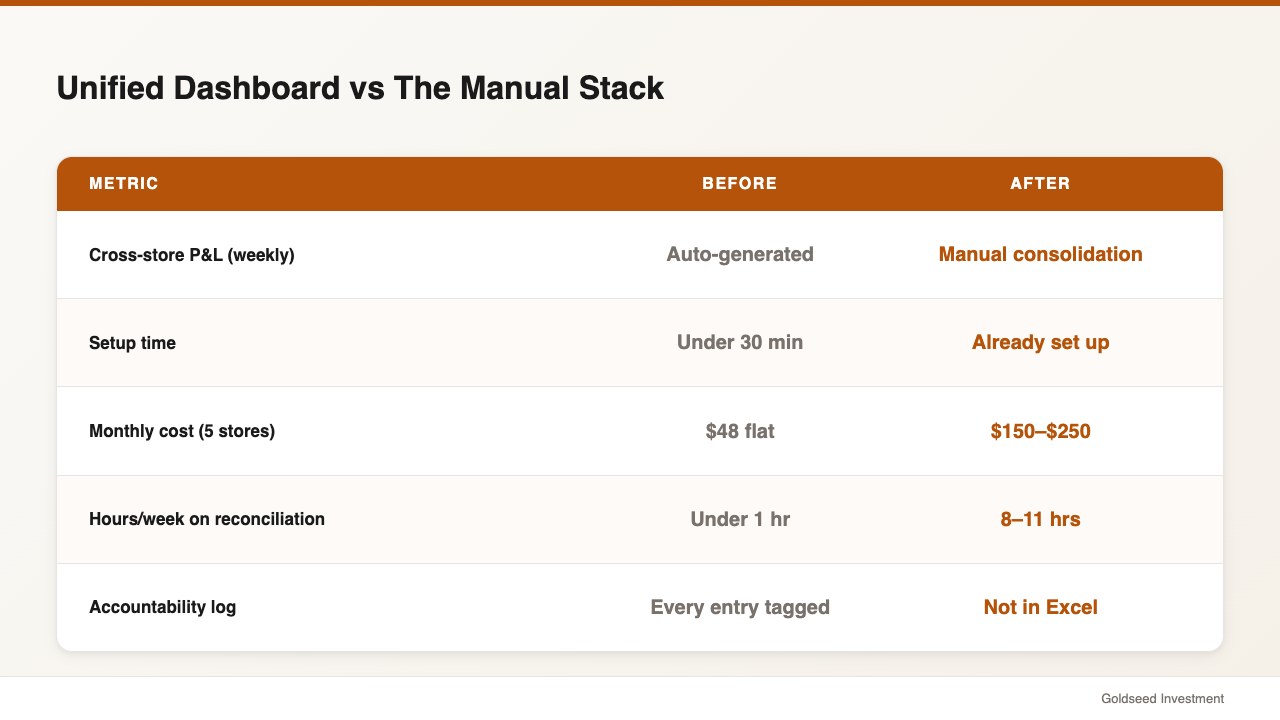
| Feature | Storebase | QuickBooks + Excel + Homebase | NetSuite / Enterprise ERP |
|---|---|---|---|
| Cross-store P&L comparison | ✅ Auto-generated per store + consolidated | ⚠️ Manual consolidation weekly | ✅ Yes, but 3–6 mo setup |
| Real-time cash variance alert | ✅ Built-in, staff ID + timestamp | ❌ Paper logs per store | ✅ Available with add-on |
| Cross-store inventory view | ✅ Native — spot overstock → understock transfers | ⚠️ Separate files per store | ✅ Yes |
| Labor cost % by store (live) | ✅ Tied to scheduled hours + QR clock-ins | ⚠️ Homebase export, manual % calc | ✅ Yes |
| Setup time | Under 30 minutes | Already set up (that’s the problem) | 3–6 months |
| Monthly cost (5 stores) | $48/mo flat (Growth) | ~$150–$250/mo combined | $2,000+/mo |
| Works with any POS (keep Square/Clover) | ✅ Yes | ✅ Yes | ⚠️ Often requires migration |
| Accountability log (who edited what) | ✅ Every entry tagged | ❌ Not in Excel | ✅ Yes |
The honest takeaway: for most chains in the 2–10 store range, the question isn’t Storebase vs. NetSuite — it’s Storebase vs. the status quo you’ve already patched together. And the status quo has a real cost most owners never price out.
How Does Elena Use Storebase to Compare Her 5 Stores Head-to-Head?
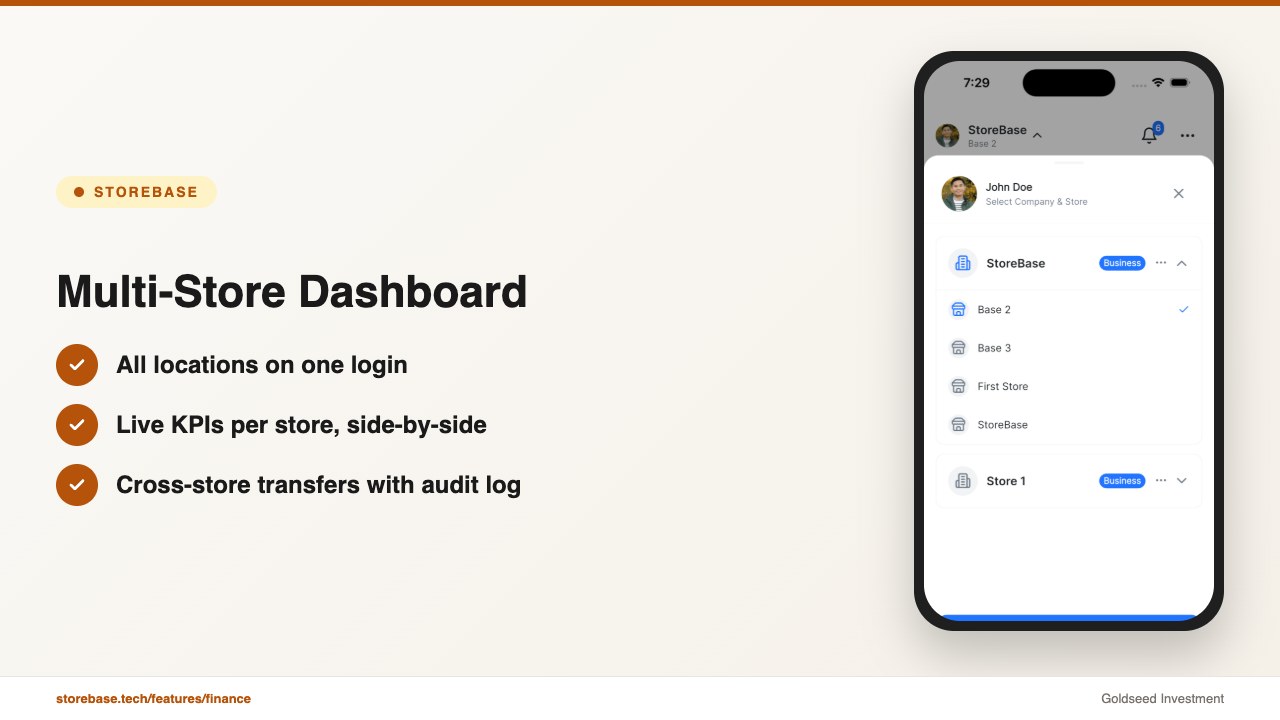
When Elena first turned the back-office layer on, she kept her existing POS (Square) and her existing scheduling tool in parallel for two weeks. She didn’t want to bet the business on a new dashboard before she trusted the numbers. By week three she had migrated her schedule and payroll into the same stack, because she was already opening the app every morning. Here’s what the workflow looks like today, in order of how often she touches it:
1. The 7 a.m. scan. One screen. All 5 stores stacked. Yesterday’s revenue, labor %, cash variance, and inventory alerts. If a store’s labor % crossed 18% (her internal ceiling), it shows red. If a cash drawer was short more than $10, it shows red. She spends 5 minutes here and knows exactly what her day looks like. Before: 9 hours → After: 5 minutes.
2. Automatic per-store Income Statement. Every Monday, the Storebase Sales & Finance module has already generated a clean P&L for each store — matching revenue against COGS, operating expenses, and payroll for the prior week. This replaces the Sunday-night spreadsheet ritual entirely. It’s the same logic walked through in how to analyze retail store profitability in 5 steps — but computed automatically rather than by hand. Monthly close went from 4 hours → under 20 minutes.
3. Cross-store inventory rebalancing. Store 1 is sitting on 40 units of a moisturizer that’s been dead for 3 weeks. Store 4 is stocking out on the same SKU every Friday. The dashboard shows her both facts on one screen, and she can initiate a transfer — the moment she approves, Store 1 decrements from 40 → 20 and Store 4 increments from 0 → 20, both tagged with her staff ID.
4. Per-store accountability log. When Store 3’s drawer came up $87 short on a Tuesday, she didn’t have to call the manager to launch an investigation. The log showed her who closed, when, and the exact sequence of entries. The conversation with the manager took 4 minutes instead of 40 — and the money was back the next day.
5. Weekly KPI comparison. Friday afternoon, the system automatically compiles her cross-store scorecard: who had the highest net margin, who had the best sales per labor hour, who beat target on sell-through. This is where multi location retail store performance comparison goes from theory to a habit.
Elena’s stack costs her $48/month on the Growth plan — less than she was paying for Homebase + QuickBooks before, and far less than the 8–9 hours a week of her own time she was spending on reconciliation. If you’re already comparing dashboards, the workflow is similar to what’s covered in how to manage two retail stores at once in 2026, but scaled for 3–10 locations.
Which 5 KPIs Should Every Multi-Store Owner Compare Weekly?
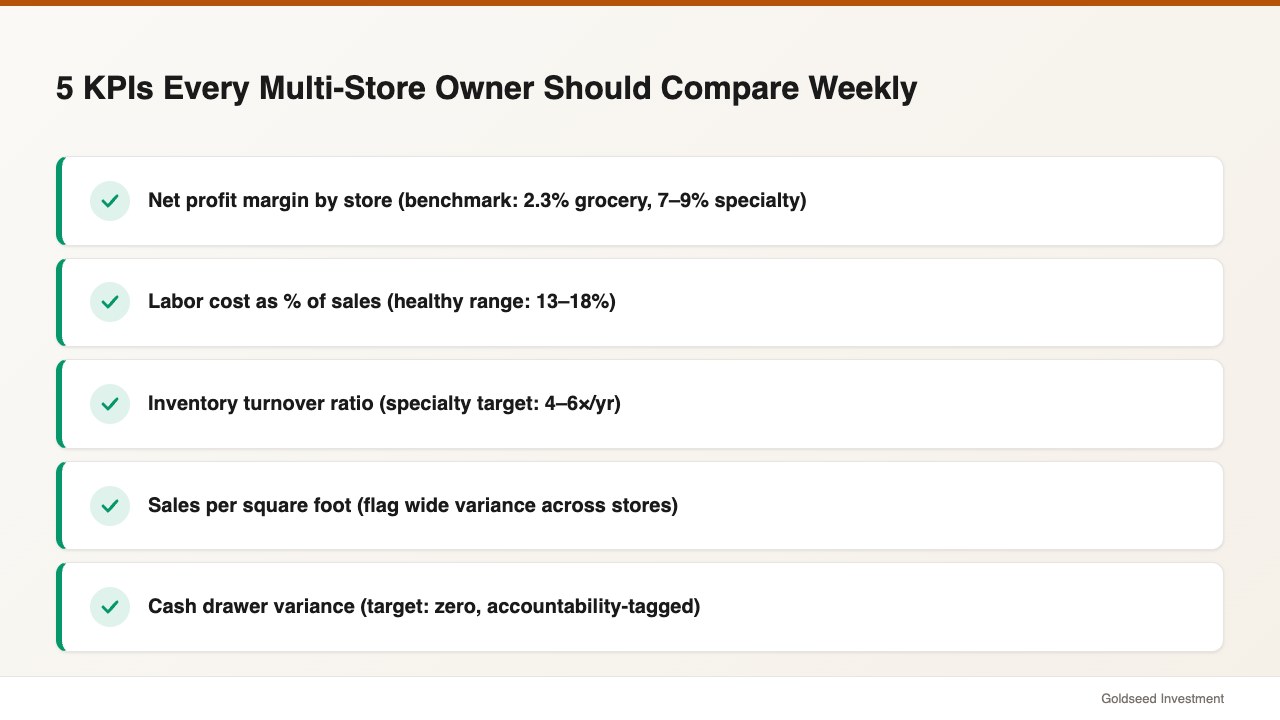
The goal of a multi-location comparison isn’t to rank your stores from best to worst every Friday. It’s to surface the ones that are drifting off benchmark before the drift compounds. These are the 5 KPIs that matter most for chains under 20 stores, with ranges drawn from BLS 2024, NRF 2024, and the 2024 Square Retail Report.
Net profit margin by store. Retail benchmarks sit at 2.3% (grocery) to 7–9% (specialty) net margin. A store drifting below its peer range for 2 consecutive weeks is a real signal — not noise.
Labor cost as a percentage of sales. BLS 2024 data on retail trade puts the healthy range at 13–18% depending on category. A store that crosses 20% for two weeks has either a scheduling problem or a sales problem — and comparing side-by-side tells you which.
Inventory turnover ratio. Specialty retail should be turning inventory 4–6 times a year. If Store 2 is at 3.1 and Store 4 is at 5.8 on the same product mix, Store 2 is sitting on dead stock that’s draining cash.
Sales per square foot. Wide variance across similar-footprint stores is the clearest geographic signal you have. The McKinsey 2024 retail digital report noted that operators with unified analytics platforms identify this variance 4x faster than spreadsheet-based peers.
Cash drawer variance. Zero should be the target. A store running chronic $10–$40 shortages isn’t a cashier problem — it’s an accountability log problem, which is solved when every cash entry is tagged with staff ID and timestamp.
Running these five side-by-side weekly is the single highest-leverage habit a multi-store operator can build. It’s the one thing that separates the chains that grow from the ones that plateau at three stores and quietly stall.
What Does a Unified Multi-Store Dashboard Actually Save in 2026?
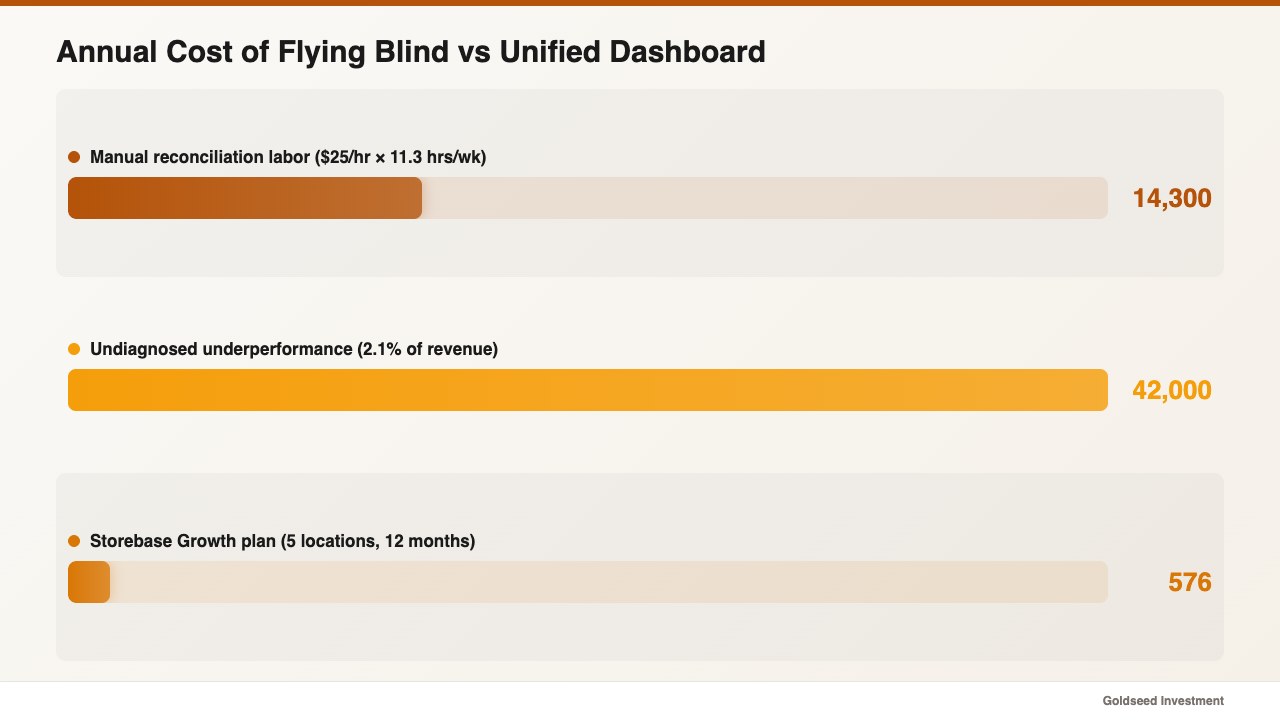
Let’s price out the math honestly. The typical 5-store chain currently spends roughly 11 hours a week on cross-store reconciliation (NRF 2024 benchmark). At a modest $25/hour loaded cost — whether that’s your own time or a part-time bookkeeper — that’s $14,300 a year in manual labor alone.
Add the hidden-underperformance cost Square 2024 estimated at 2.1% of revenue — roughly $42,000 on a $2M chain — and the real annual cost of flying blind sits in the $30,000–$60,000 range for most small chains.
The Growth plan at $48/month is $576 a year. Even if the dashboard only cuts reconciliation time in half and catches one underperforming store 60 days earlier, the payback lands in the first month. For larger operators, the Business plan ($149/month for up to 10 stores and 70 staff) still clocks in under $1,800 a year — and scales with the chain.
The point isn’t that software fixes your business. The point is that without real comparison, you can’t tell which store is your best teacher and which one is quietly bleeding. A proper back-office turns that visibility into a daily habit instead of a Sunday-night ordeal.
If weekly multi-store reporting still eats a full Sunday, Storebase is built for exactly this gap. Most owner-operators complete the Sales & Finance and Multi-Store Dashboard setup in under 30 minutes and see their first cross-location P&L comparison by day two — no credit card required, 14-day free trial available. Start with the Sales & Finance module → or Download on the App Store →
FAQ
Q: What’s the difference between a POS report and a true multi-store performance comparison? A: A POS report tells you what sold. A multi-store performance comparison tells you whether each location made money — which requires matching sales against labor, COGS, rent, and variance. Your POS doesn’t see your payroll, cash variance, or inventory shrinkage. A back-office like Storebase fills exactly that gap while keeping your existing POS.
Q: How much does multi-location retail dashboard software cost in 2026? A: $18/month on the Starter plan (1 store), $48/month on Growth (up to 5 stores), and $149/month on Business (up to 10 stores) with a 14-day free trial. Enterprise ERP systems like NetSuite typically start around $2,000/month. The manual stack (Excel + QuickBooks + Homebase) often runs $150–$250/month combined, plus 8–11 hours a week in hidden labor.
Q: Do I have to switch my POS to use a back-office like this? A: No. The back-office layer works alongside any POS — Square, Clover, Toast, Lightspeed. Your POS handles the sale; the back-office handles everything after it: P&L, payroll, cash variance, inventory, and cross-store comparison.
Q: How many KPIs should I compare across stores each week? A: Five is the sweet spot: net margin, labor cost %, inventory turnover, sales per square foot, and cash drawer variance. More becomes noise. Fewer leaves blind spots. A unified dashboard surfaces all five automatically so you compare them in under 10 minutes, not 9 hours.
Q: How long does it take to set up a multi-store dashboard in 2026? A: Most operators complete setup in under 30 minutes per location and see their first cross-store P&L by day two. Enterprise systems typically take 3–6 months. Spreadsheet consolidation never really finishes — you just stop pretending it does.