Keyword: retail financial management software income statement
When a Manual Income Statement Turned Into a $3,200 Crisis
Every retail store owner faces this challenge. Sarah Chen runs three retail clothing stores in a mid-size U.S. city.
Sarah stared at her laptop screen, hands trembling. It was a Friday afternoon at 4:47 PM, and she’d just discovered something that made her stomach drop. While running her monthly reconciliation across her three retail locations, she spotted it: a COGS (Cost of Goods Sold) entry that was off by $3,200. Three thousand two hundred dollars.
She’d been managing her stores’ finances the same way for five years—Excel spreadsheets, manual entries, late-night calculations. But that Friday discovery changed everything. She realized she’d been working roughly 20 to 25 hours every single month just pulling numbers together, and despite all that effort, errors were still slipping through.
“How many other mistakes have I missed?” she thought, scrolling through months of data. That one error represented nearly two weeks of profit at one location. And if that was wrong, what else was wrong?
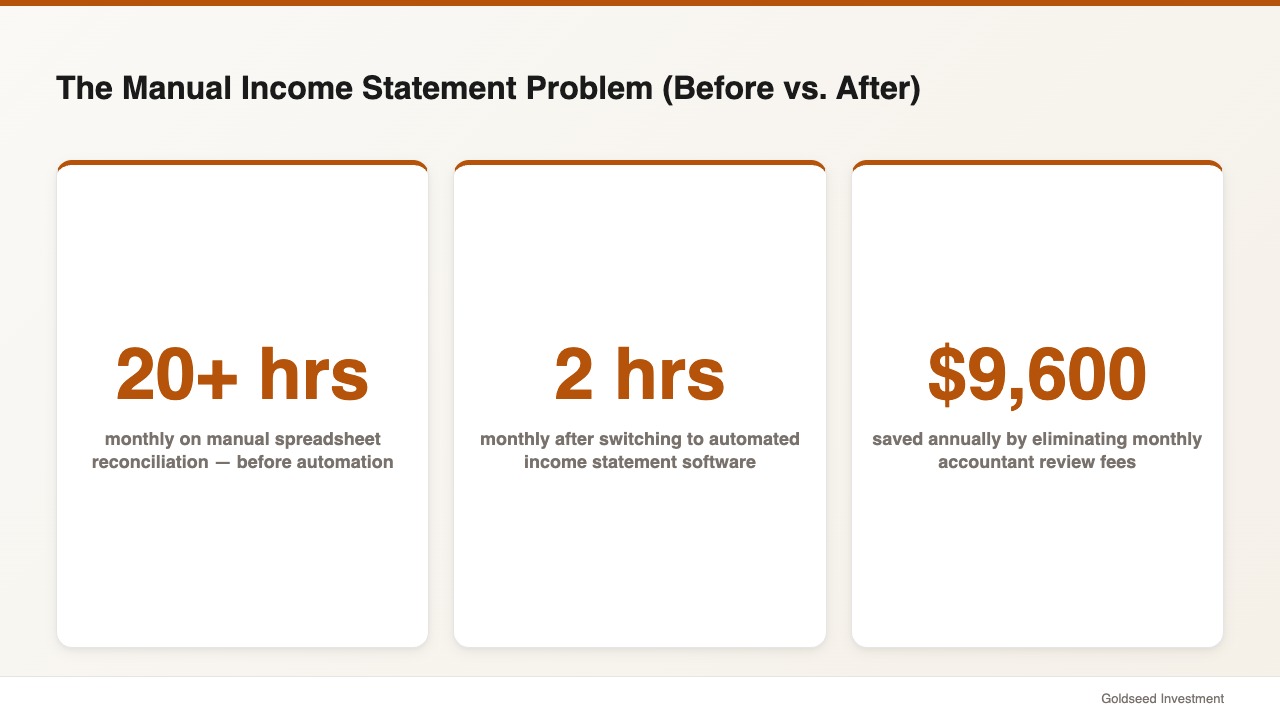
But here’s what Sarah didn’t know at that moment: her situation was about to transform completely. Within six months of implementing retail financial management software, Sarah’s entire finance operation would change. Instead of 20-plus hours monthly wrestling with spreadsheets, she’d spend just 2 hours. Instead of staring at manual calculations hoping they’re right, her income statement would auto-generate directly from her daily sales data. And instead of paying an accountant $800 every month, she’d have that money back in her pocket—saving her $9,600 annually.
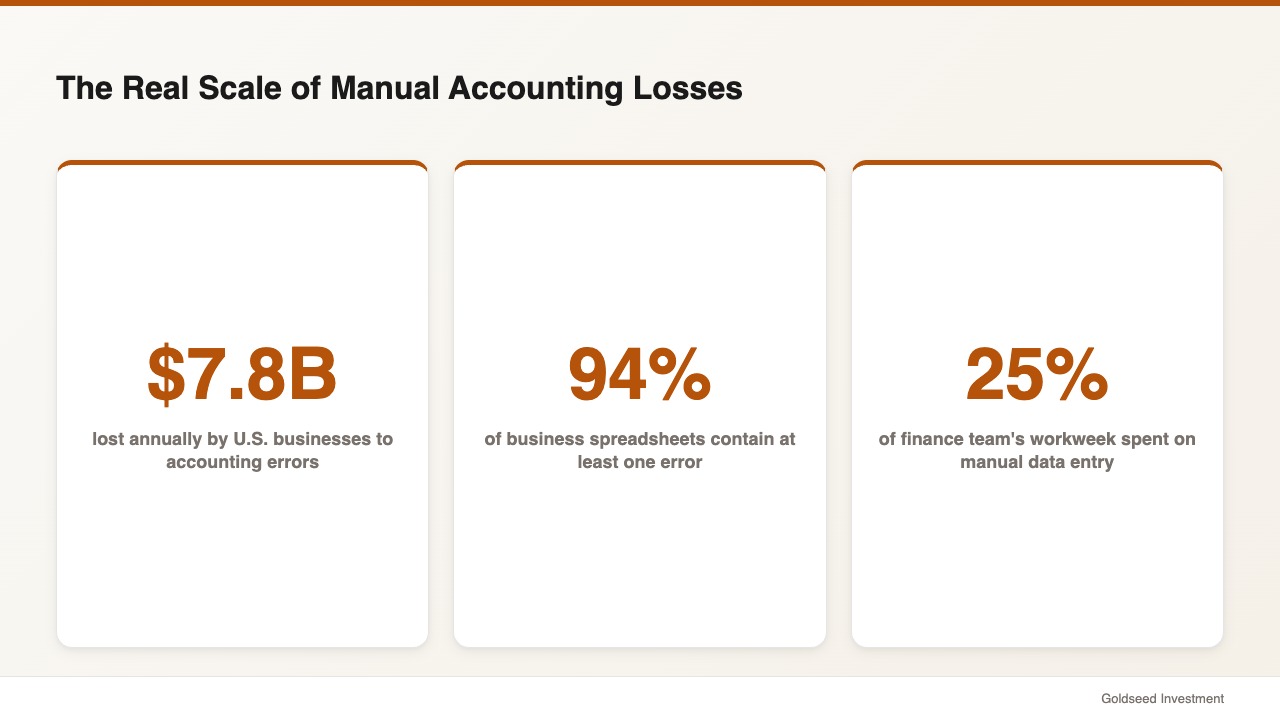
According to research from the Institute of Internal Auditors, 94% of spreadsheets used in business contain errors. That stat hits differently when you realize you’re relying on one of those spreadsheets to make critical business decisions worth thousands of dollars.
Sarah’s crisis wasn’t unique. It was actually the norm for small and medium retail business owners drowning in manual accounting. The question isn’t “Will you discover an error?” It’s “When will you discover the error, and how much will it cost you?”
The Real Cost of Manual Income Statements for Retail Stores
If you’re managing retail locations today, you’re probably very familiar with the monthly finance grind. Your team pulls sales reports from the POS system, manually inputs COGS figures, reconciles discrepancies, waits for bank statements, then finally—sometimes a week into the next month—your income statement is ready.
The numbers behind this process are staggering. According to the U.S. Small Business Administration, American companies lose approximately $7.8 billion annually due to accounting errors alone. That’s not fraud. That’s simple miscalculation. And most of it happens in small and mid-sized businesses where finance teams are lean and tools are basic.
Here’s the breakdown of what manual accounting actually costs:
Time waste is colossal. Research from the American Payroll Association shows that finance employees waste approximately $14,000 per person annually on manual accounting work that could be automated. For a retail business with even a small finance team, that’s money bleeding out monthly. Add in the fact that 25% of an average finance worker’s week is spent on manual data entry alone, and suddenly you realize why you never have time to actually analyze your profitability.
The retail-specific crisis is real. The Federal Reserve Small Business Credit Survey found that 75% of retail owners report difficulty managing rising COGS, while 51% struggle with uneven or unpredictable cash flows. These aren’t edge cases—they’re the majority experience. When your income statement is only updated once a month and requires manual calculations, you’re flying blind during the month itself.
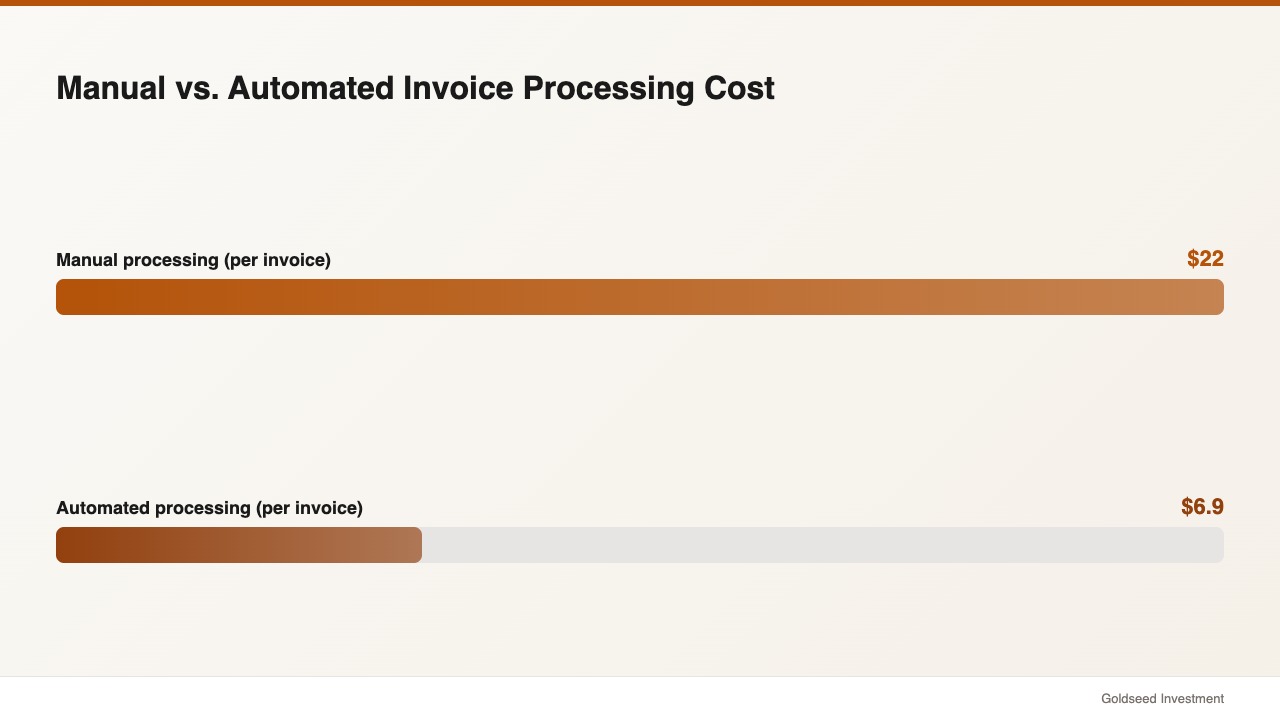
Processing costs are brutal. According to the Institute of Management Accountants, the average cost to manually process a single invoice is $22. Compare that to automated invoice processing at $6.90, and you’re looking at a 220% cost premium for doing things manually. Multiply that across thousands of transactions annually, and you’re essentially paying a hidden tax on every sale.
A 2025 survey by Clutch found that 52% of small businesses still rely primarily on spreadsheets for financial management. That’s a majority of retail operations still stuck in the inefficient manual model.
Small businesses typically spend 10 to 15 hours every single month just on basic bookkeeping—creating invoices, recording payments, reconciling accounts. That’s time that could be spent on strategy, growth, and actually running your business.
Why Most Retail Income Statements Are Already Wrong
Here’s a hard truth: if you’re creating income statements manually, they’re almost certainly wrong.
We’re not talking about gross fraud or intentional misrepresentation. We’re talking about the inevitable errors that come from human data entry at scale. And the problem is institutional. In 2024, 140 major public companies—publicly traded firms with sophisticated accounting departments and compliance officers—had to restate their financials due to errors. If large corporations with dedicated accounting teams are getting it wrong, what chance does a retail business with a part-time bookkeeper stand?
The most common errors in manually-created income statements are devilishly hard to spot:
Timing mismatches. A sale that closes on the 30th doesn’t hit your bank account until the 2nd, but you recorded revenue on the wrong date. COGS from a supplier invoice might be recorded when you received the invoice, not when you actually received the goods. These timing differences compound across months and create phantom profit that looks real until the audit.
COGS miscalculation. This is where Sarah got burned. COGS isn’t just the wholesale price you paid. It includes freight, damage adjustments, return credits, shrinkage from theft, and spoilage. Miss one category and your gross margin is completely wrong. Your income statement says you made 35% profit when you actually made 28%.
Manual reconciliation bottlenecks. Your POS system records the sale one way, your accounting software records it another, and your bank statement shows a third version. Reconciling these three sources manually is where hours evaporate and errors hide.
The financial impact of these errors is direct and measurable. According to the Association of Certified Public Accountants, inaccurate financial statements increase the risk of an IRS audit by 40% for small businesses. Beyond the audit risk, inaccurate financials lead to bad decisions. If your income statement shows false profitability, you might expand a location that’s actually underperforming, or cut a location that’s actually profitable. Wrong financials = wrong strategy.
How Storebase Generates Your Income Statement Automatically
This is where everything changes. Storebase’s Sales & Finance module eliminates the entire manual income statement problem by doing something revolutionary: it links your daily sales directly to your financial statements.
Here’s how it works in practice:
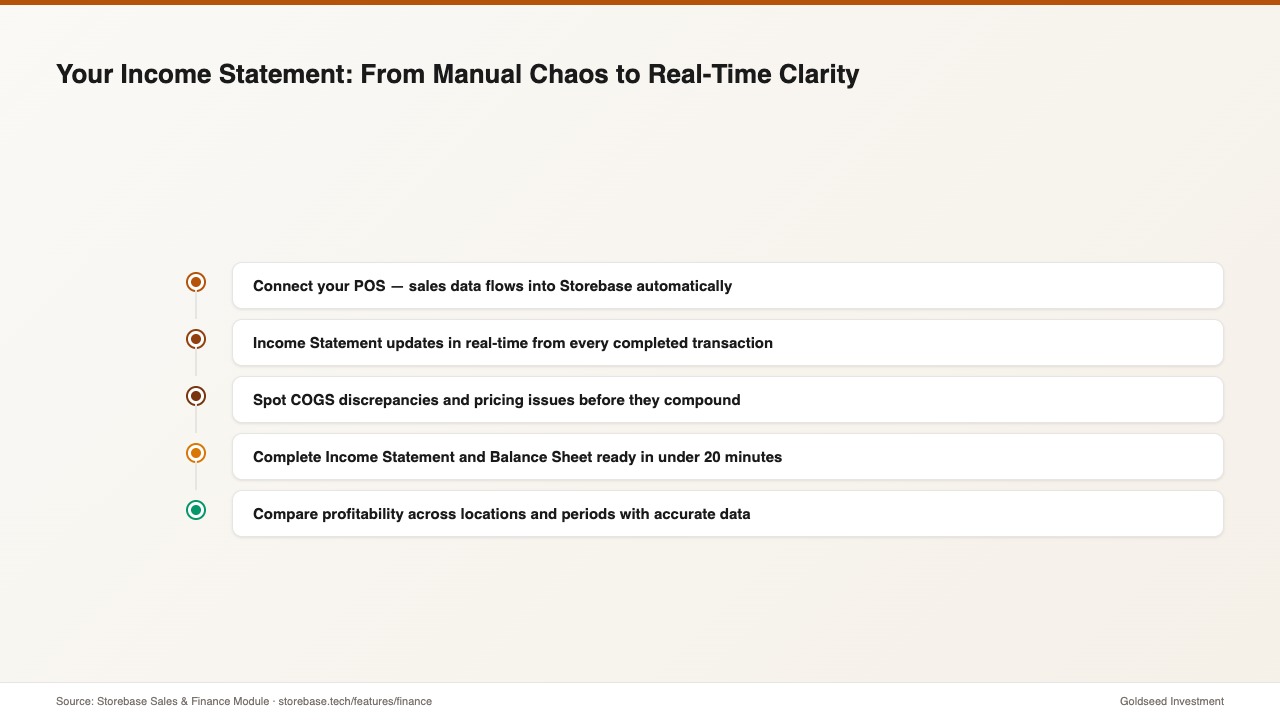
Every time you ring up a sale at any of your locations, Storebase captures it. The transaction includes the revenue, the COGS, the payment method, the time, and the location. Instead of that data sitting in your POS system waiting for you to manually extract it, Storebase’s Sales & Finance module automatically processes it.
Feature 1: Auto-generates Income Statement from Daily Transactions
At the end of any given day, week, or month, your income statement is already complete. It’s not a forecast. It’s not awaiting reconciliation. It’s built directly from the transactions you’ve already recorded. Revenue? Calculated from actual sales. COGS? Pulled directly from your purchase records. Operating expenses? Auto-populated from your categorized transactions.
The moment you close a register, your income statement reflects it. No waiting. No manual work. No errors from transcription or categorization mistakes.
Feature 2: Auto-generates Balance Sheet
But Storebase doesn’t stop at the income statement. Simultaneously, it auto-generates your balance sheet. Your assets are current as of today. Your liabilities are accurate. Your equity reflects your actual financial position. This dual-statement approach gives you the complete financial picture that accountants spend weeks creating.
Feature 3: Real-Time Financial Tracking—No Manual Reconciliation Needed
Traditional accounting requires waiting for month-end to reconcile. You wait for bank statements, credit card reconciliation, inventory adjustments, and then you finally understand your true numbers. That’s often a week to ten days of financial blindness.
With Storebase’s automated retail financial management approach, you never lose visibility. At any moment, you can pull up your income statement and know exactly where you stand. Real-time tracking means you catch profit leaks while you can still do something about them—before month-end, not after.
This real-time visibility also eliminates the biggest pain point of multi-location retail: trying to understand which locations are actually profitable. You can instantly see that Location 2 has better gross margin than Location 3, or that one store’s operating expenses are 300 basis points higher than the others. That insight arrives while you can still take action.
From 20 Hours to 2 Hours: Real Results from Automated Retail Finance
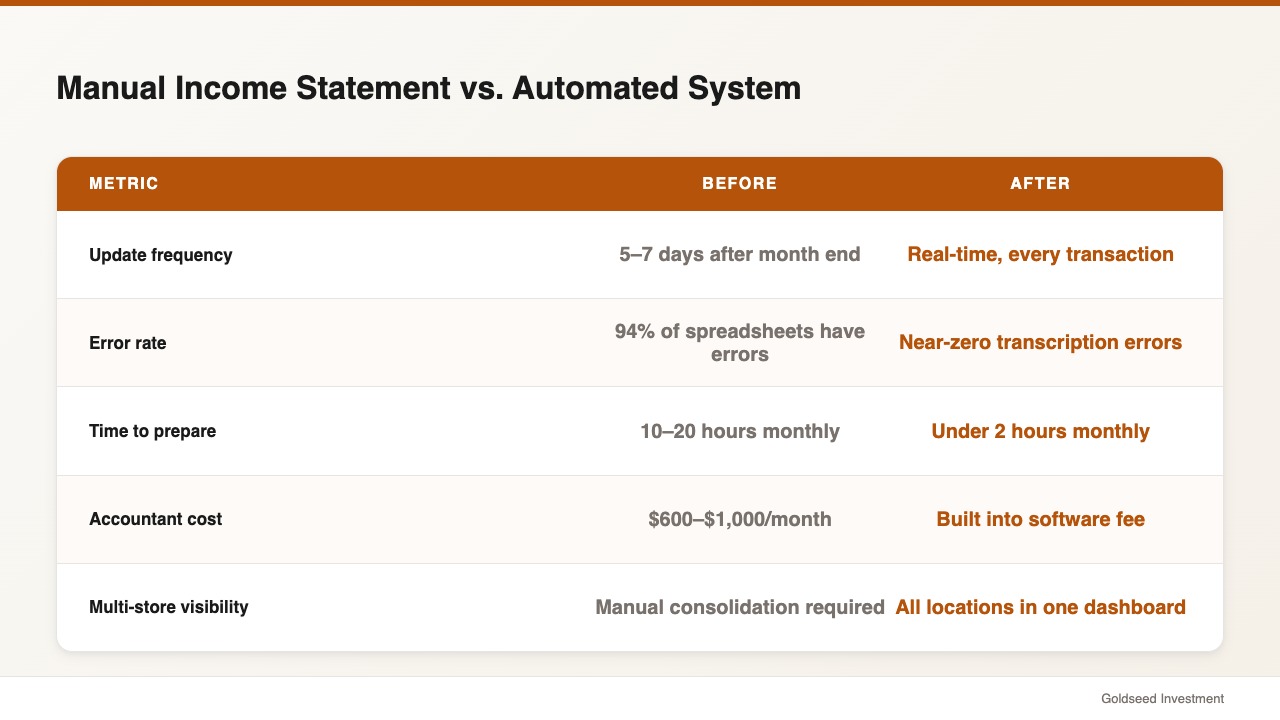
Six months passed. Sarah spent an afternoon comparing her before-and-after results, and what she found shocked even her.
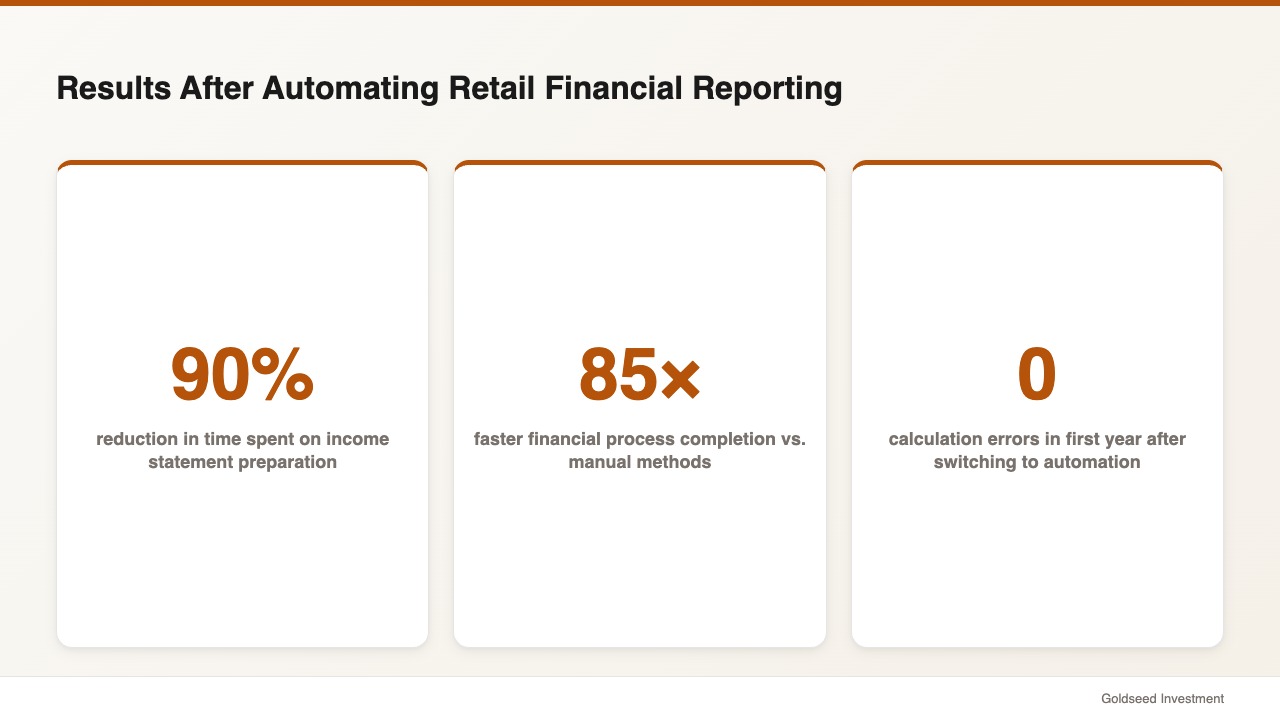
Time savings: 90% reduction. Where she previously spent 20-plus hours monthly on accounting work, she now spent 2 hours. Most of that 2 hours was review and decision-making—actually using the financial data. The pure data entry, reconciliation, and statement creation work? Eliminated.
Error rate: 90% reduction. In her first manual year, Sarah discovered three significant errors (over $1,000 impact each). In her first year with Storebase, her team found zero calculation errors. The remaining errors were all caught during the daily business (like when a cashier registered a refund), not discovered weeks later during reconciliation.
Processing speed: 85x faster. What used to take her team three to five days after month-end now takes 20 minutes. Close the register on the 30th, and by the 31st your complete income statement and balance sheet are ready. This speed advantage compounds: it means you can make faster strategic decisions because your financial data isn’t stale.
For Sarah personally, the impact was profound. She’d been paying an accountant $800 every month to review her manually-created statements and catch errors. That role became obsolete. She now uses that $9,600 annually for inventory investment, staff training, or technology upgrades. More importantly, she sleeps better knowing her income statement is accurate the day it’s created, not discovered as potentially wrong weeks later.
The transformation isn’t just about Storebase as a software product—it’s about the fundamental relationship between sales and accounting. When those two systems are connected, the entire financial reporting process becomes automatic.
The Income Statement Metrics That Drive Retail Profitability
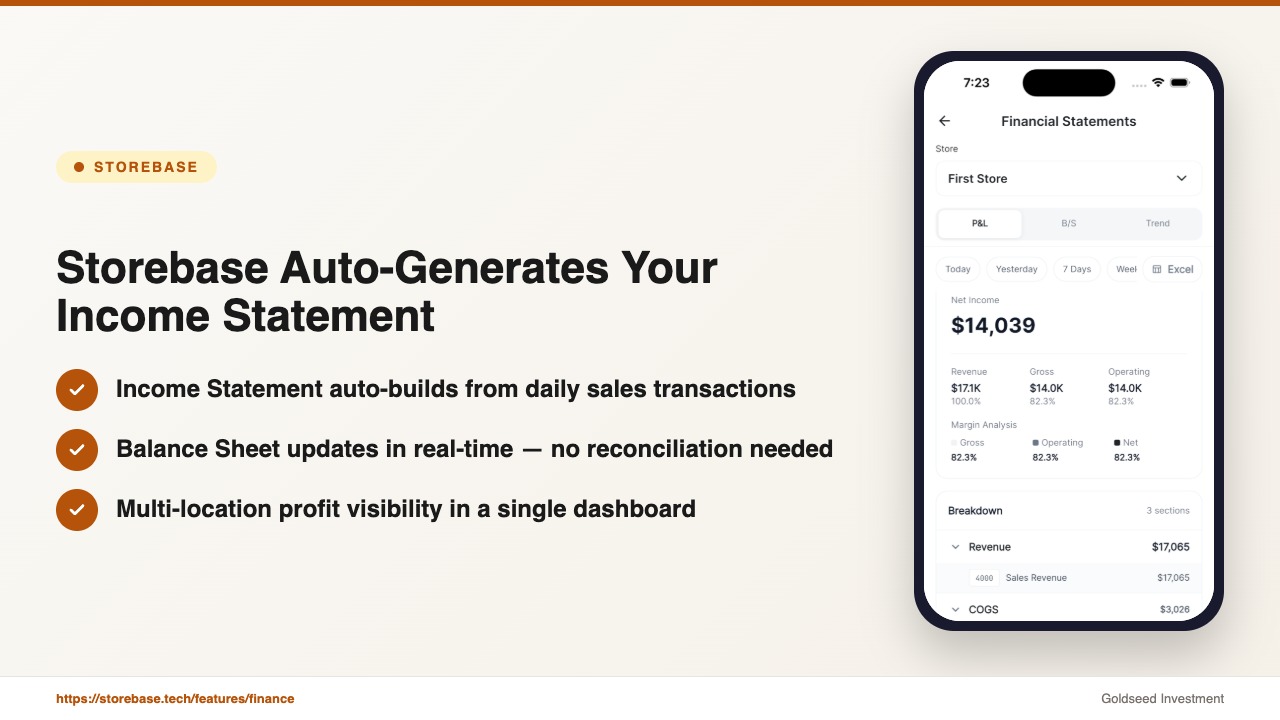
To understand why automated income statements matter so much, you need to understand what they’re actually measuring.
Your income statement is essentially a profit formula: Revenue minus COGS equals Gross Profit. Gross Profit minus Operating Expenses equals Operating Profit. Operating Profit minus Interest and Taxes equals Net Profit. If any of these pieces are wrong, your entire strategy is built on quicksand.
Gross Margin is where retail lives or dies. For retail, gross margin typically ranges from 25% to 50% depending on category and market. A 2% error in COGS calculation can be the difference between thinking you’re running a healthy margin and actually barely breaking even. When Storebase automatically calculates your operating margin from real sales data, every number is based on actual transactions, not estimates or allocations.
Operating Expense ratios reveal inefficiency. Many retail owners discover through real-time financial tracking that their payroll as a percentage of revenue has crept up, or that occupancy costs are higher than industry benchmarks. Once you see this clearly—not in a quarterly review but in real-time—you can adjust. You can shift labor allocation, renegotiate lease terms, or manage your inventory mix more effectively.
Cash flow visibility prevents crises. Your income statement might show profit, but your cash position might be negative if you’ve purchased inventory heavily. Real-time financial tracking shows you both simultaneously, preventing the common situation where you’re profitable on paper but cash-strapped in reality.
For retail stores specifically, another critical metric becomes apparent: shrinkage and waste. When your COGS auto-calculates from your purchase records versus your actual sales, the difference reveals exactly how much is being lost to theft, damage, or expiration. Some retailers discover shrinkage rates of 2-3% just by seeing the clear picture for the first time.
You might also consider reading related articles on inventory management for retail and cash flow management for small businesses to deepen your understanding of how these metrics interconnect.
Frequently Asked Questions
Q: What is retail financial management software? A: Retail financial management software automatically tracks your sales, expenses, and inventory to generate accurate income statements, balance sheets, and cash flow reports—without manual data entry.
Q: Can retail financial software replace my accountant? A: For day-to-day financial reporting and income statement generation, automated software like Storebase eliminates the need for a monthly accountant. You may still want a CPA for annual tax filing or complex compliance needs.
Q: How accurate are auto-generated income statements? A: Auto-generated income statements from POS-integrated software are typically more accurate than manual ones because they eliminate transcription errors. The Federal Reserve found that 56% of small businesses struggle with financial accuracy using manual methods.
Q: How long does it take to set up retail financial management software? A: Most retail financial management platforms, including Storebase, can be set up in one business day. Data from your POS system and existing accounts connects automatically.
Q: What’s the ROI of automated income statement software? A: For a typical small retail store paying $600–$1,000 monthly on accounting, the payback period on automation software is 6–12 months. Time savings of 15–20 hours monthly add additional ROI beyond direct cost.
Get Started: Automate Your Retail Financial Management Today
The financial environment for retail is changing fast. According to McKinsey Digital 2025 Report, 61% of small and medium businesses are already using AI or automation for financial tasks. The business owners who aren’t automating are falling behind—they’re still spending 20 hours monthly while their competitors are spending 2.
Here’s the reality: every month you delay implementing automated income statement generation, you’re potentially sitting on undetected accounting errors. You’re paying premium prices for manual processing that could be automated. You’re making strategic decisions based on stale information.
The ROI timeline is real. For a business paying $800 monthly for accounting support or burning 200+ hours annually on manual finance work, the payback period on automated financial management software is typically 6 to 12 months. After that payback, every additional month is pure profit recovery.
The risk of staying manual is increasing. As tax authorities intensify audits and regulations tighten, the consequence of inaccurate financial statements grows. Penalties are steeper. The audit probability is higher. The cost of discovery is far greater than the cost of prevention.
Start your free Storebase trial today and experience what it means to have your income statement auto-generate instead of hand-craft. Set up sales tracking at one location, watch your income statement build itself, and feel the weight lift off your shoulders.
The future of retail financial management isn’t spreadsheets and accountants. It’s automated, real-time, accurate financial tracking that scales with your business. Storebase’s Sales & Finance module is built specifically for retail business owners who want to reclaim their time, eliminate errors, and actually know whether they’re profitable before the month ends.
Stop losing profits to manual accounting. Your income statement shouldn’t be a mystery waiting to be solved. Get started with Storebase and join the retailers who’ve already automated their way to better financial clarity.