Liquor store POS systems ring up sales and verify IDs, but a two-store operator using Storebase still cut month-end close from 3 hours to 20 minutes and erased a recurring $300 cash gap — because the POS never touched the back office.
When Marcus Calderon bought his second store, he assumed a better liquor store POS system would finally give him control. The terminal scanned IDs, rang sales, and tracked beer-wine-spirits SKUs in seconds. Yet six weeks in, the numbers still didn’t add up. Month-end close ran about 3 hours per store. One register was short again, and nobody could say why. Roughly $2,000 sat frozen in slow-moving high-end bottles he didn’t know he’d over-ordered.
Then he stopped trying to make the POS do everything and added Storebase as a back-office layer on top of it. The change was concrete: month-end close went from 3 hours → 20 minutes, the recurring cash gap dropped from about $300/month → zero, and tied-up dead stock fell from $2,000 → under $400 within a quarter. The POS still rings the sale. Storebase now handles everything after it. “I finally stopped guessing,” he says. Today he no longer drives between stores just to find out what happened yesterday.
This guide breaks down what a liquor store POS system should actually do in 2026, where even the best one leaves you exposed, and how to close those gaps without ripping out the system you just paid for.
What Should a Liquor Store POS System Actually Do?
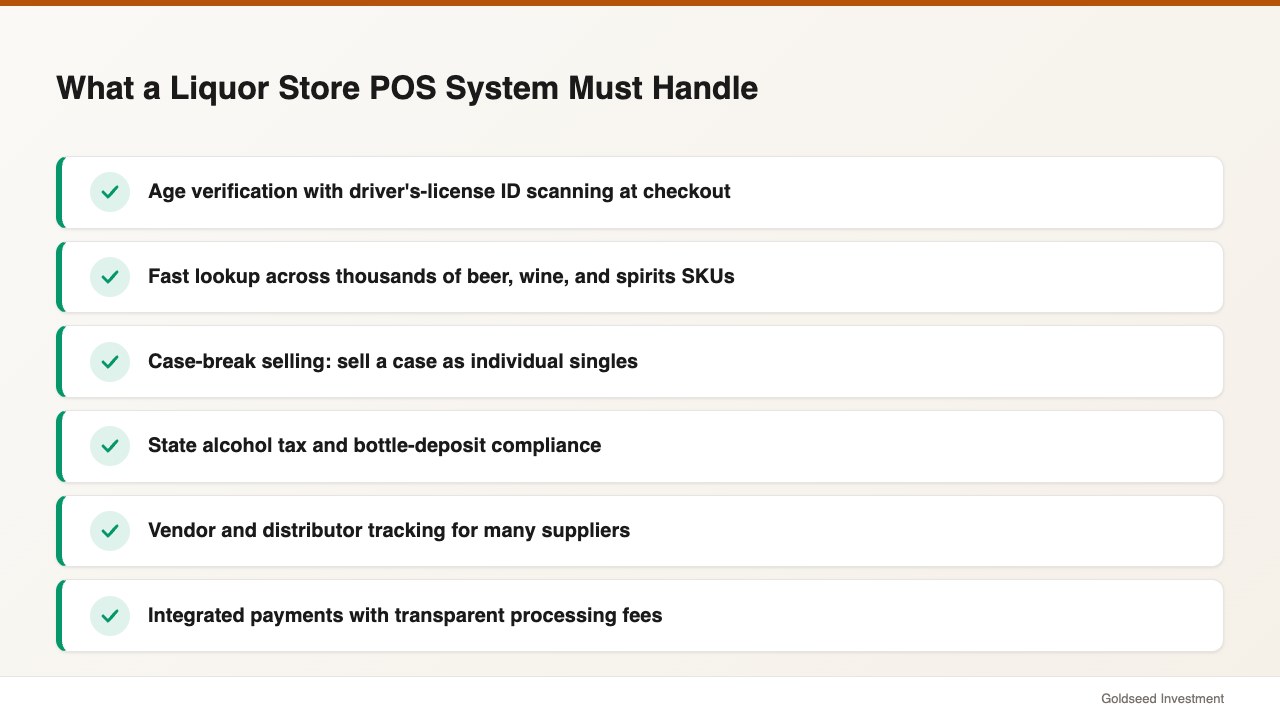
A liquor store is not a generic shop, so a generic point of sale rarely fits. Package and liquor stores carry thousands of SKUs across beer, wine, spirits, and often tobacco, lottery, or mixers — frequently 3,000 to 10,000+ items with constant vendor turnover. The right liquor store POS system has to handle that catalog without slowing the line at 6 p.m. on a Friday. Searches for the best POS for liquor store setups have climbed since 2024, and for good reason: package store POS software has to do far more than a coffee shop’s terminal.
At minimum, look for these capabilities when you evaluate a liquor store point of sale:
- Age verification / ID scanning — a POS with age verification built into checkout, ideally with driver’s-license barcode reading so cashiers can’t skip the prompt.
- High-SKU performance — fast search, barcode and case-pack lookups, and bulk price updates when a distributor changes cost.
- Case-break and unit selling so a case of 12 can be sold as singles without breaking inventory counts.
- State tax and compliance handling, including bottle deposits and per-jurisdiction alcohol tax rules.
- Vendor and distributor tracking for the dozens of suppliers a liquor store juggles each month.
- Integrated payments with transparent processing fees.
General platforms like Square and Clover cover the basics affordably; specialized retail systems such as Lightspeed go deeper on inventory. Either can ring a sale, check an ID, and offer basic liquor store inventory management. The trouble starts the moment you close the drawer — because that is where a point of sale was never designed to help you.
Why Do Liquor Store Owners Still Lose Money After Buying a POS?
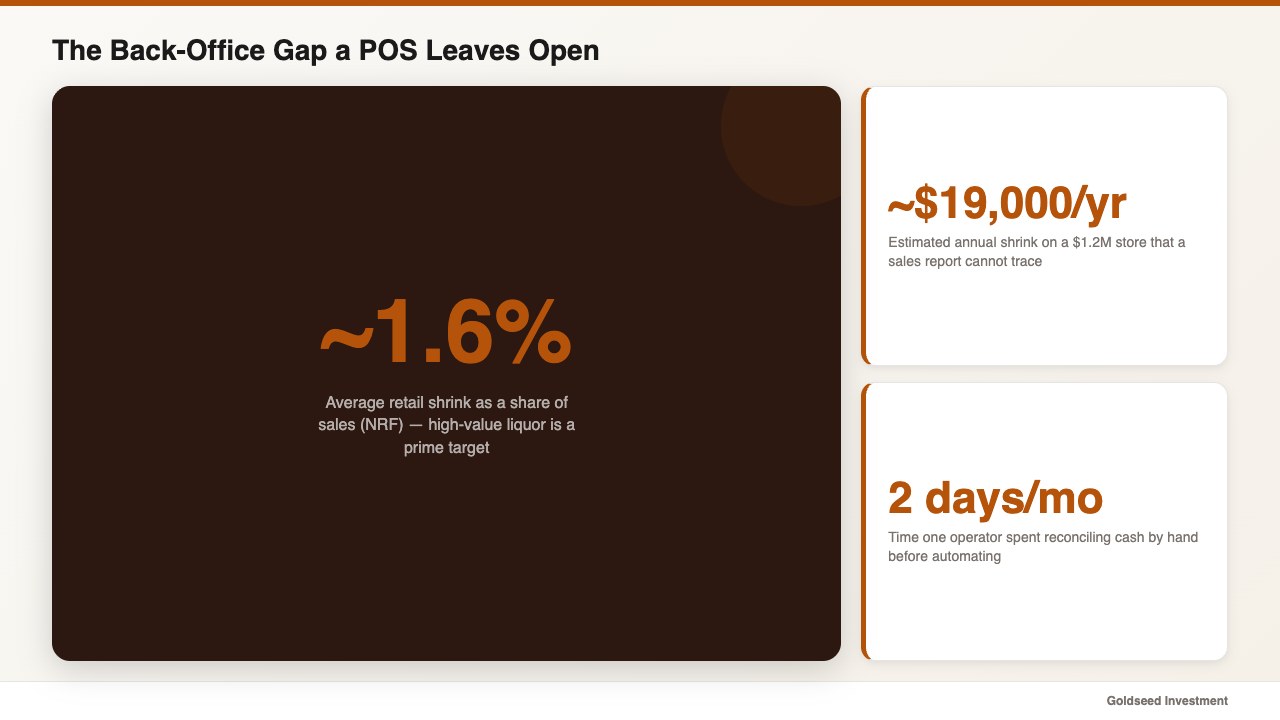
Here is the uncomfortable truth that no POS demo mentions: a point of sale tells you what sold, not whether you made money. It records the transaction and stops. Everything that determines your actual profit — labor cost, cash accuracy, true margin, shrinkage — happens after the sale, in the back office your POS doesn’t enter.
The gaps are expensive. Retail shrinkage averages roughly 1.6% of sales according to NRF research, and high-value, easily resold liquor is a textbook loss prevention problem. On a store doing $1.2M a year, that 1.6% is close to $19,000 in lost gross margin walking out the door annually, and a sales report won’t tell you who or when. Data from the U.S. Census Bureau shows beer, wine, and liquor stores remain a multi-billion-dollar category heading into 2025, yet a 2024 study of small retailers found most owners still track COGS and turnover rate by hand, if at all.
It is not a discipline problem. It’s a tooling problem. If your register is short $40 at close and you have no log of who counted the drawer or when cash moved to the safe, you cannot trace it — no spreadsheet was ever built to make that specific call easy. Marcus spent two days a month reconciling cash by hand and still couldn’t explain a recurring shortfall. Payroll was worse: hourly staff, overtime, and a busy holiday week meant errors that, in many cases, cost him both money and trust. And because his POS only knew sales, he was learning his real margin weeks late, long after he could act on it.
Most owners discover these leaks three to six months too late — if they catch them at all. The question worth sitting with is simple: how long could money be leaking out of your store before a sales report would ever show it? Understanding the difference between revenue and profit is the whole game here, which is why it helps to know how to analyze retail store profitability before you blame the register.
How Do Top Liquor Retailers Choose a POS and Cover the Gaps?
Smart operators do two things. First, they match the POS to their volume and compliance needs rather than chasing the flashiest terminal. A single-location store with steady traffic may be perfectly served by an affordable general POS; a high-volume or multi-store operation usually wants deeper inventory tooling. Second — and this is what separates the profitable owners — they accept that the POS is only the front counter, and they add a back-office layer on top of it.
That layer is not another POS. It’s the system that turns raw sales data into payroll, cash accountability, and a real profit-and-loss statement. You don’t switch your POS; you fill the gaps it can’t. Tools like Storebase are built for exactly this — they sit on top of Square, Clover, Lightspeed, or a specialized liquor POS and handle everything that happens after the sale.
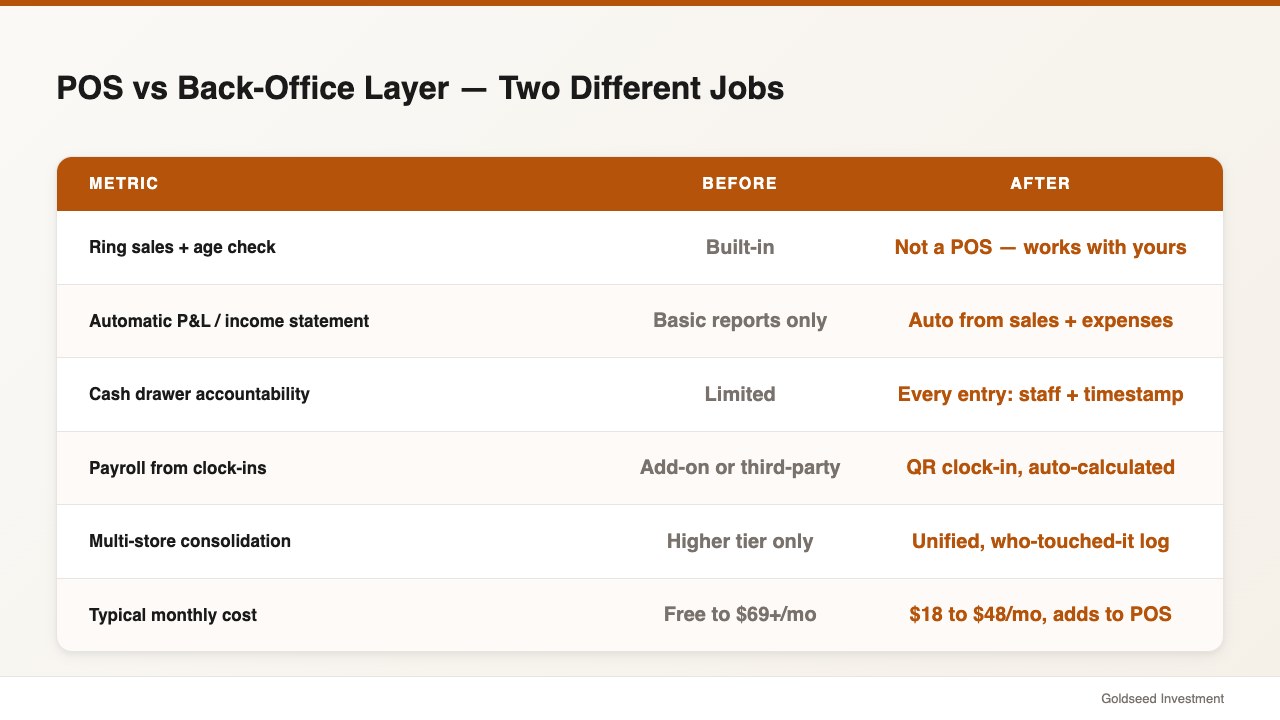
Here is how the back-office picture compares once you stop asking the POS to do a job it was never built for:
| Back-office capability | Storebase | Square | Lightspeed |
|---|---|---|---|
| Rings up sales + age check | ❌ Not a POS — works with yours | ✅ Built-in | ✅ Built-in |
| Automatic P&L / income statement | ✅ Auto from sales + logged expenses | ⚠️ Basic reports only | ⚠️ Reporting add-on |
| Cash drawer accountability (staff ID + timestamp) | ✅ Every entry logged | ⚠️ Limited | ⚠️ Limited |
| Payroll from actual clock-ins | ✅ QR clock-in → auto-calculated | ⚠️ Square Payroll (extra fee) | ❌ Third-party |
| Multi-store inventory accountability | ✅ Unified, who-touched-it log | ⚠️ Per-plan | ✅ Higher tier |
| Typical monthly cost | $18–$48/mo (adds to your POS) | Free POS; add-ons extra | From ~$69/mo |
The point isn’t that Storebase beats a POS — it isn’t a POS. It’s that the POS column and the back-office column are two different jobs, and most owners only buy the first one.
How Marcus Uses Storebase to Run Two Liquor Stores Profitably
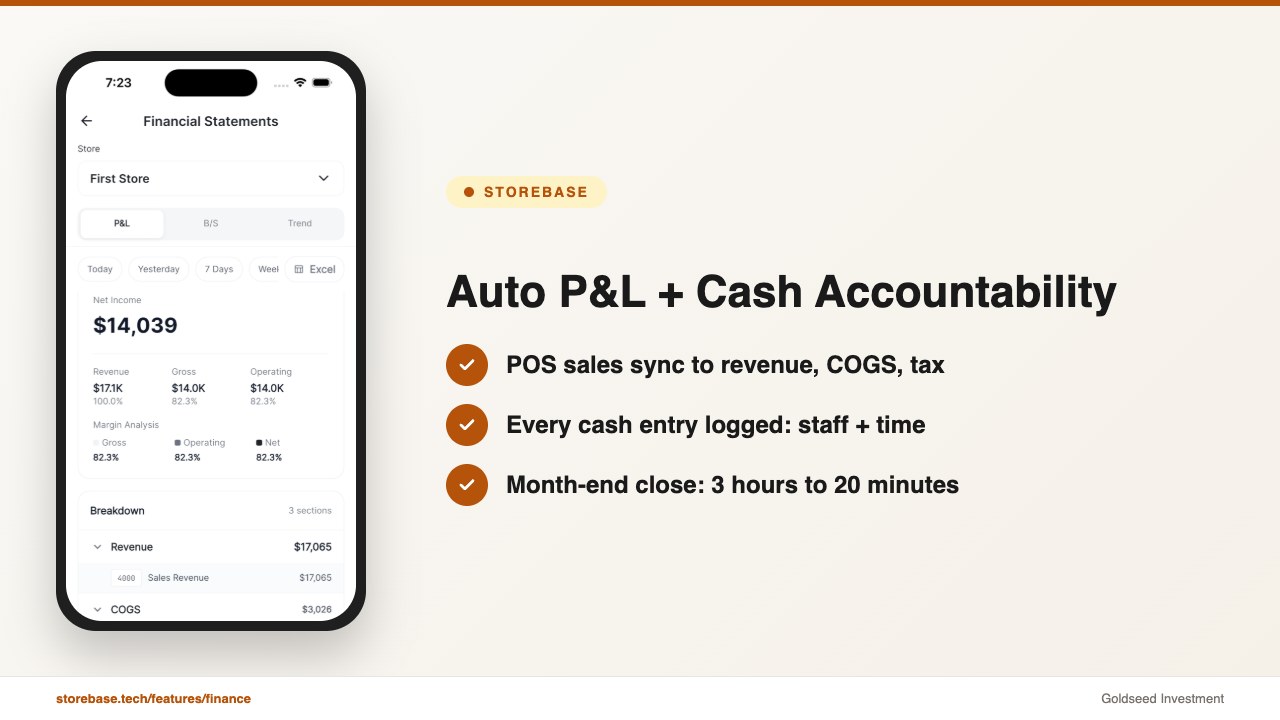
Marcus kept his existing terminals and added Storebase’s Sales & Finance module as the layer on top. Three features did most of the work.
Automatic profit-and-loss. Sales flow in from the POS, staff snap photos of expense receipts, and the app builds an Income Statement and Balance Sheet in real time. No more rebuilding the month in a spreadsheet at midnight — close dropped from 3 hours → 20 minutes per store, and for the first time he could see true gross margin by store while there was still time to act on it.
Cash accountability you can actually trace. With Storebase’s Cash Management module, every drawer count, safe drop, and deposit is logged with the staff member’s ID and a timestamp, and the system compares expected versus actual balance automatically. The mystery shortfall surfaced in days — it was a shift-handoff process gap, not theft — and went from about $300/month → zero once the log made it visible.
Inventory accountability across both stores. The platform records who changed a count, when, and by how much, across both locations on one screen, and flags unusual movement before a high-velocity SKU runs dry — improving sell-through on the fast movers. The two days a month Marcus burned on manual reconciliation fell to near zero, and over-ordered premium bottles dropped from $2,000 → under $400 in tied-up cash. A unified view like this is also what makes running more than one store realistic — the same logic behind retail financial management software that consolidates locations.
As one operator who runs two package stores put it: “The POS was never the problem — it did its job. I just never had anything watching the money after the sale. Now Storebase does.”
If month-end close, an untraceable cash gap, or dead inventory is quietly eating your liquor store’s profit, Storebase is built for exactly this — it works with the POS you already own, no rip-and-replace. Most owners are live in under 10 minutes and see their first automatic P&L by day two, with no credit card required. Start with Sales & Finance → or Download on the App Store →
What Does a Liquor Store POS System Cost in 2026?
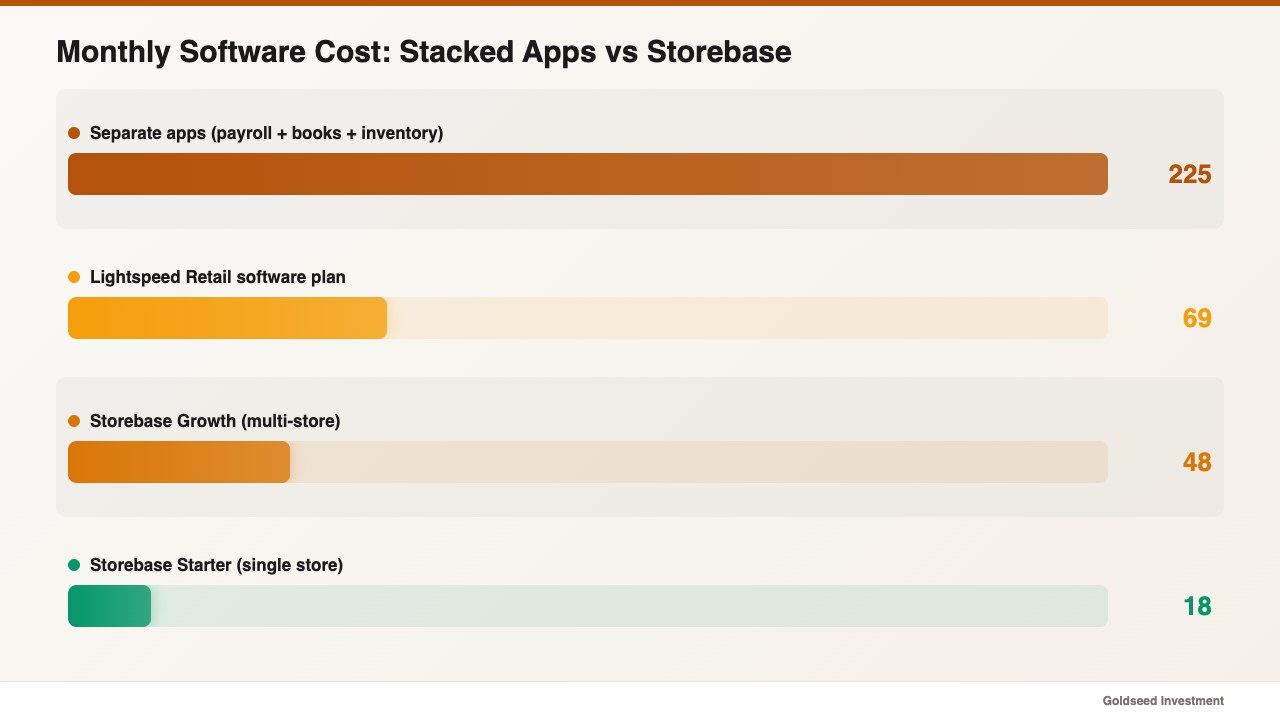
Budget for three separate line items, because they are genuinely separate. First, POS hardware — a terminal, scanner, cash drawer, and receipt printer typically run a few hundred to a couple thousand dollars per lane up front. Second, POS software and payment processing — monthly software ranges from free (basic Square) to roughly $69+/month for deeper systems, plus card processing fees that generally run about 2.5%–3% per swipe. Third — the line most owners forget — the back office.
That third cost is where the math gets friendly. Instead of stacking a payroll app, a bookkeeping subscription, and an inventory tool on top of your POS (often $150–$300+/month combined), a single back-office layer covers it. Storebase pricing is straightforward: Starter at $18/month for one store and up to five staff, Growth at $48/month for up to five stores and 30 staff, and Business at $149/month for up to ten stores and 70 staff. For a two-store operator like Marcus, the Growth plan works out to under $10 per store per month — a rounding error against a single untraced cash discrepancy or a few hundred dollars of dead stock. Pair it with a clear read on your retail store profit margin benchmarks and the back office pays for itself fast.
FAQ
Q: What is the best POS system for a liquor store? A: There is no single best — it depends on volume and compliance needs. General systems like Square and Clover are affordable and easy for single locations; Lightspeed goes deeper on inventory for higher-volume or multi-store operations. Whichever you choose, make sure it handles ID scanning, high SKU counts, and case-break selling, then add a back-office layer for payroll, cash, and P&L.
Q: Does a POS system handle payroll and accounting for a liquor store? A: No. A POS records sales and, at most, offers basic reports. It does not calculate payroll from clock-ins, reconcile your cash drawer with an audit trail, or produce a real income statement and balance sheet. That work lives in the back office, which is why owners pair a POS with a tool like Storebase.
Q: Can I add software without replacing my current liquor store POS system? A: Yes. Back-office platforms such as Storebase are designed to sit on top of any POS, so you keep your terminals and payment processing and simply layer in payroll, cash accountability, and financial reporting. There is no rip-and-replace.
Q: How much should a small liquor store spend on a POS system? A: Plan for hardware (a few hundred to a couple thousand dollars per lane), monthly software (free up to about $69+), processing fees (~2.5%–3% per transaction), and a back-office layer (Storebase starts at $18/month). Most single-store owners can run the full stack for well under $150 a month.
If your POS still leaves you closing the books at midnight, that gap is fixable today. Storebase covers the back office your liquor store POS system can’t — automatic P&L, traceable cash, and unified inventory — for $18–$48/month, no credit card required. Start free at storebase.tech or download it on the App Store and run your first automatic P&L this week.