Restaurants that pair their POS with Storebase cut monthly close from 4 hours to under 30 minutes, trace every cash-drawer entry to a person, and run payroll straight from clock-in data.
Maria Delgado’s 42-seat restaurant in San Antonio rings up about $42,000 a month. The point-of-sale terminal at her counter never misses a sale: orders fire to the kitchen, cards clear in seconds, tips post automatically. For two years she assumed that meant her numbers were under control.
They weren’t. Then she connected her POS to Storebase, and within a single cycle the part of the job she dreaded vanished. Her monthly close dropped from 4 hours of spreadsheet work to under 30 minutes. A nagging cash shortage of roughly $300 a week — money she could never trace — finally showed up against a name and a timestamp. Payroll, which used to eat half a Saturday, went from 4 hours to 20 minutes because it now runs from her staff’s actual clock-in data while she only approves it.
Nothing about her POS changed. She still rings up every sale exactly the way she did before. What changed is that the numbers behind the sale stopped being a mystery. “The POS told me what I sold,” Maria explained. “It never told me whether I made any money. Now I know before I lock the door.” That gap — between ringing a sale and actually understanding the business — is the single most important thing to grasp before you choose a restaurant POS system for your small business.
What Should a Restaurant POS System for Small Business Actually Do?
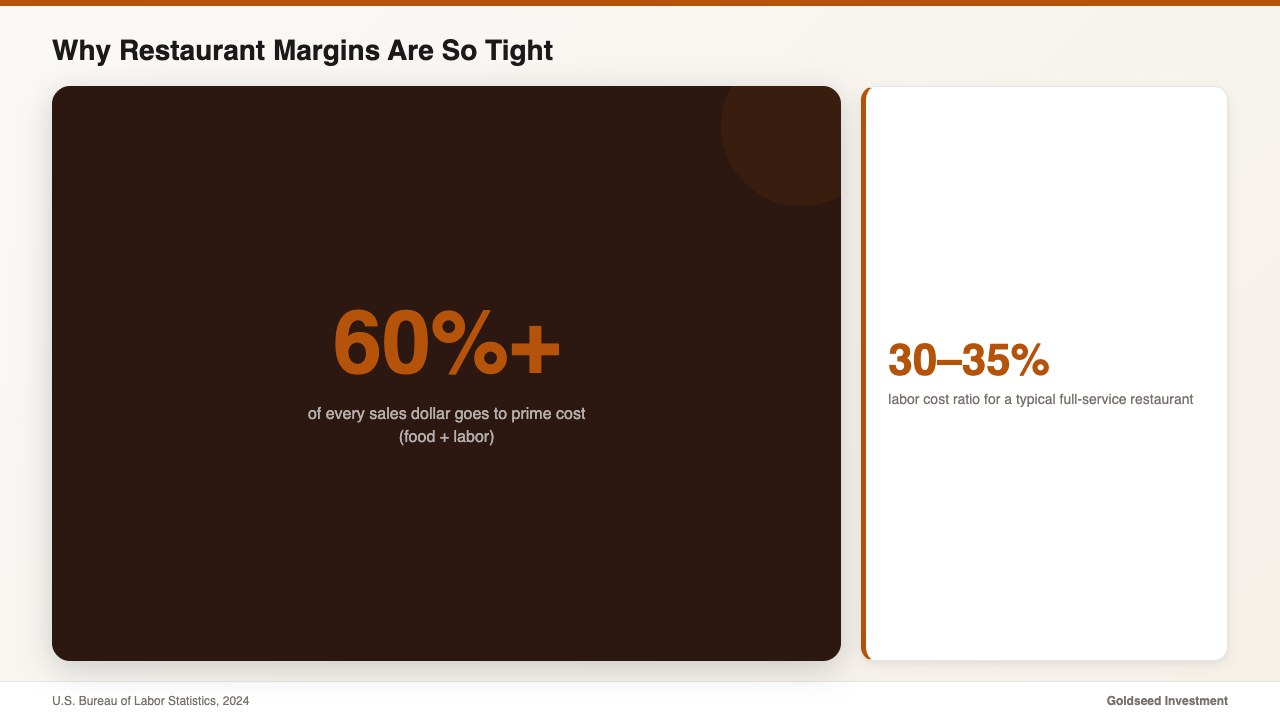
A small restaurant survives on a thin net margin. According to data from the U.S. Bureau of Labor Statistics (BLS, 2024), prime cost — food cost (your COGS) plus labor combined — typically eats 60% or more of every dollar, and full-service labor alone usually runs a labor cost ratio of 30–35% of sales. Research from industry analysts points the same way. On numbers that tight your break-even point is close, so the tools you choose are not a luxury; they generally decide whether you keep the difference between gross margin and contribution margin or hand it back.
Whether you call it a restaurant point of sale software platform or just “the register,” a restaurant POS system has one core job, and it does it well: turn a guest’s order into a paid ticket. That means sending orders to the kitchen, splitting checks, taking cards and contactless payments, handling tips, and giving you a sales report at the end of the night. Square, Toast, Clover and Lightspeed all do this competently for an independent restaurant.
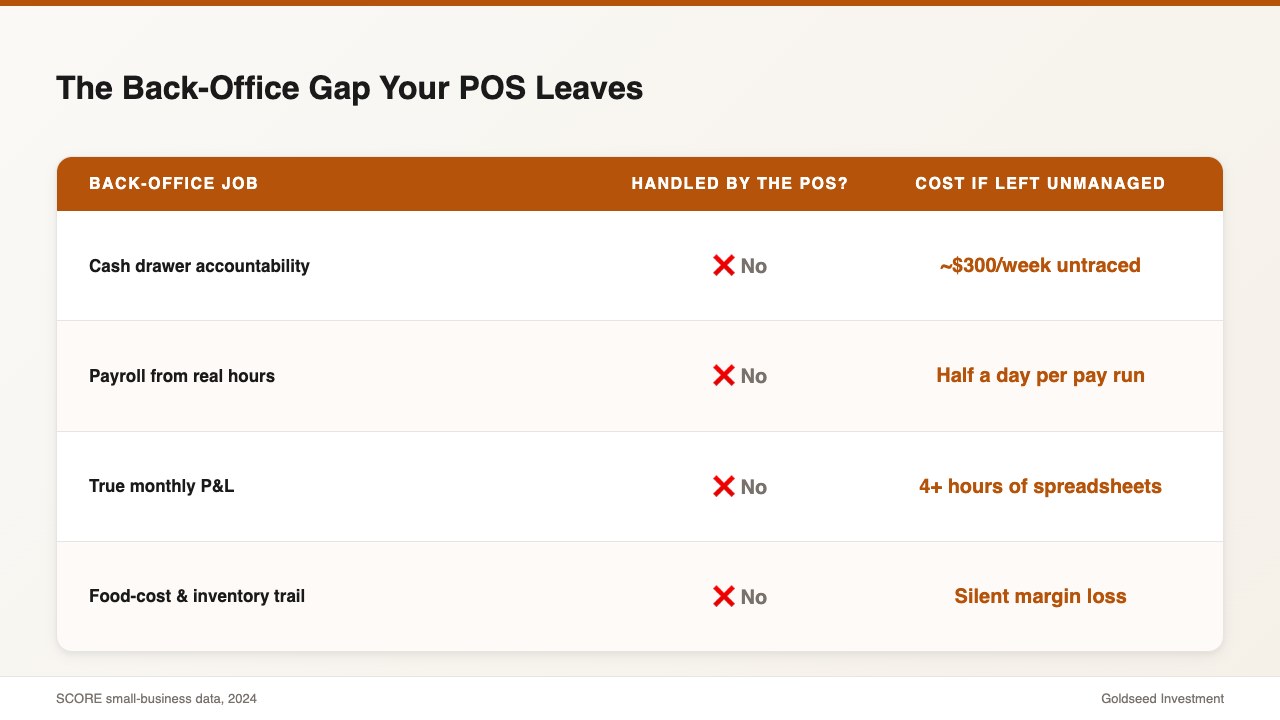
Here is what almost no POS does on its own, and where small operators often lose money:
- Payroll from real hours worked. The POS knows what sold, not what each server should be paid after late clock-ins, an overtime threshold being crossed, and split shifts.
- Cash accountability. When the drawer is short, a sales report can’t tell you who counted it, when, or where the gap opened.
- A true profit-and-loss statement. Sales reports show revenue. They don’t subtract food cost, labor, rent and supplies to show net income or net margin.
- Food-cost and inventory control with a paper trail. The POS deducts a sold item; it doesn’t tell you who received the delivery or where the missing cases went.
The sale is only the first step. Everything after it — payroll, cash, food cost, real margin — is back-office work, and the POS leaves most of it to you.
Why Do Most Small-Restaurant POS Setups Still Leave Owners in the Dark?
Maria’s restaurant was doing $42,000 a month in sales, and she still couldn’t answer a simple question on demand: did this month make money? Her POS gave her a tidy sales total. Then the real work started — exporting that total, opening three spreadsheets, typing in invoices from a shoebox, guessing at food cost, and reconciling a cash drawer that never quite matched.
That’s the trap. The problem isn’t that you’re careless. No POS was ever built to make these specific decisions easy, so the back office defaults to spreadsheets and memory. According to National Restaurant Association data, independent operators repeatedly cite fragmented systems and weak real-time visibility as a top operating barrier, and a 2024 SCORE study found cash-flow visibility is among the leading reasons small food businesses struggle in their first years. Spreadsheets fail silently, and most owners discover a leak three to six months after it starts — long after the money is gone.
For Maria the leak was cash. The drawer came up short by around $300 most weeks, and there was no log of who opened it, who counted it, or when the gap appeared. Over a quarter that’s nearly $4,000 walking out the door with no name attached. Payroll was the other drain: a half-day every pay run, transcribing clock-in slips into a spreadsheet, with the occasional overtime miscalculation that cost her a good server’s trust. None of this showed up on the POS dashboard, because none of it is the POS’s job. If you want the full picture of how those numbers add up, it helps to first understand how to analyze retail store profitability and the profit-margin benchmarks your restaurant should be hitting.
How Do the Top Restaurant POS Systems Compare in 2026?
Four POS platforms dominate the small-restaurant market in 2026, and each is strong at the sale itself. Square is the easiest to start with and has transparent flat-rate processing. Toast is purpose-built for restaurants with deep kitchen and menu features. Clover is flexible hardware with a broad app marketplace. Lightspeed is strong on inventory-heavy and table-service venues. Where they differ most is not the sale — it’s how much of the back office they leave on your desk.
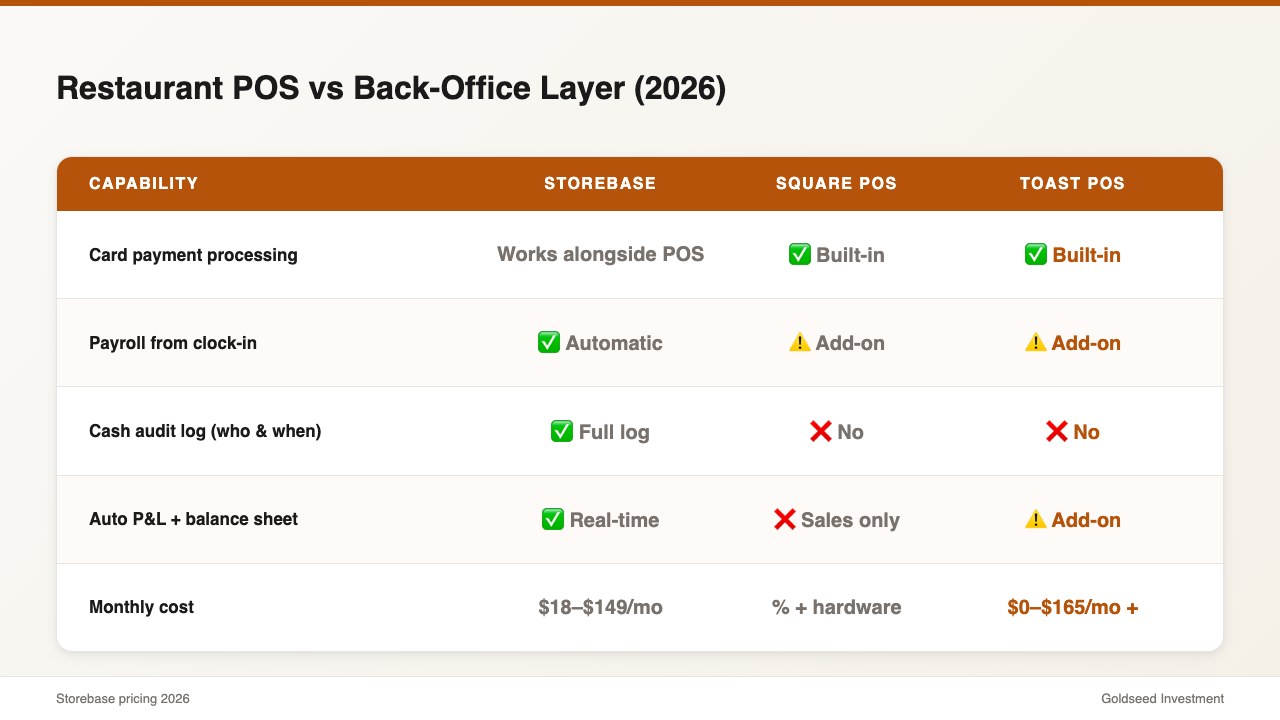
This is the part most comparison posts skip. When you shop for a small restaurant POS system, a fair comparison should also show what each platform doesn’t cover, because that gap is exactly where a back-office layer like Storebase fits in. Your POS handles the sale; the back-office layer handles everything after it — and it runs alongside whatever POS you choose rather than replacing it.
| Capability | Storebase | Square POS | Toast POS | Lightspeed |
|---|---|---|---|---|
| Card payment processing | ❌ Works alongside your POS | ✅ Built-in | ✅ Built-in | ✅ Built-in |
| Kitchen tickets / order routing | ❌ Stays in your POS | ✅ Built-in | ✅ Built-in | ✅ Built-in |
| Payroll from clock-in data | ✅ Automatic | ⚠️ Add-on (Square Payroll) | ⚠️ Add-on (Toast Payroll) | ❌ Not included |
| Cash-drawer audit log (who & when) | ✅ Full entry log | ❌ No | ❌ No | ❌ No |
| Auto Income Statement + Balance Sheet | ✅ Real-time | ❌ Sales reports only | ⚠️ Reporting add-on | ⚠️ Reporting add-on |
| Multi-location back-office dashboard | ✅ Included | ⚠️ Higher tier | ⚠️ Enterprise tier | ⚠️ Higher tier |
| Monthly cost | $18–$149/mo | Processing % + hardware | $0–$165/mo + processing | $89+/mo + processing |
Read the table the right way: keep the POS you like for the sale, and add a layer that closes the ❌ and ⚠️ rows.
How Does Maria Use Storebase to Run the Numbers Behind the POS?
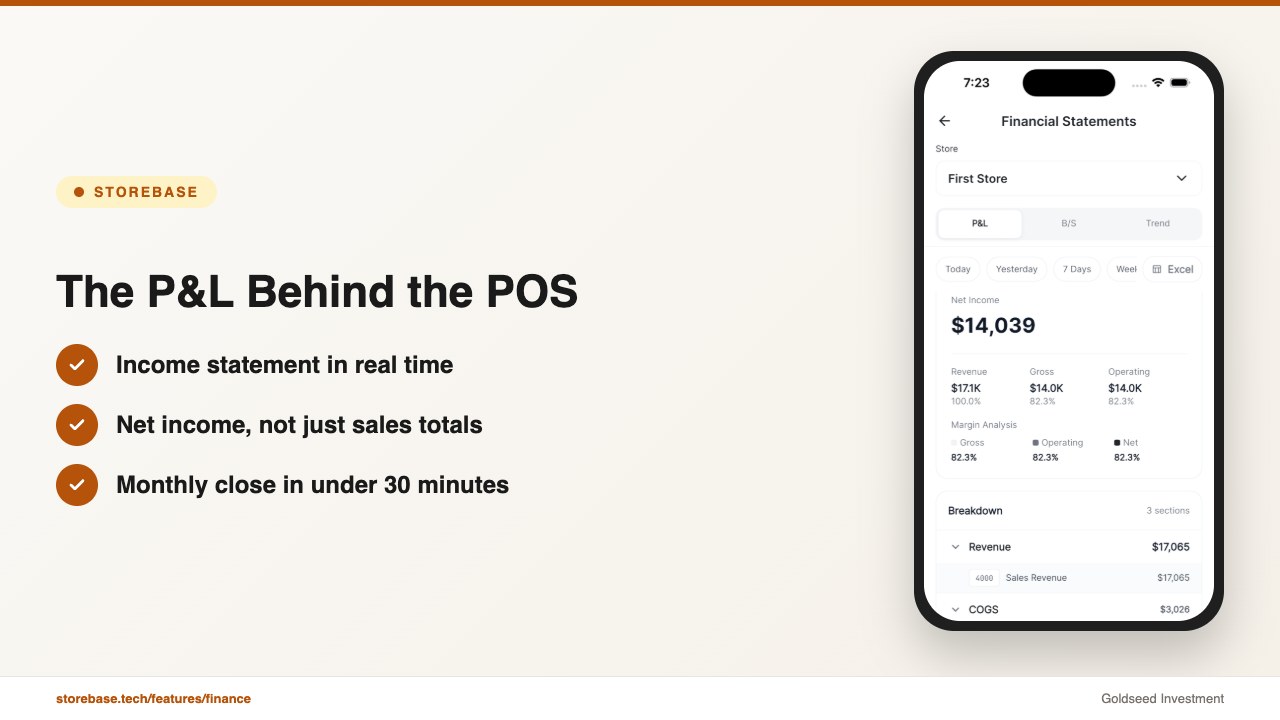
Maria kept her POS exactly as it was. What she added was the Sales & Finance module, which turns her operating data into a real Income Statement and Balance Sheet in real time — revenue, COGS, operating profit and net income, no midnight spreadsheet session required. The first time she ran it, the monthly close that used to take her a full evening cut her admin from 4 hours to 30 minutes. As she described it: “I stopped doing the books at midnight. The book was already done.”
Three features did the heavy lifting, each one closing a gap her POS left open:
- Cash that’s finally traceable. Cash Management logs every drawer and safe entry with the staff member’s ID, the amount, and the timestamp, and compares the system balance to the counted balance automatically. The recurring shortage went from $300 to $0 once every entry had a name attached — when a count is off now, she knows who, when, and how much within minutes instead of never.
- Payroll that runs itself. QR clock-in captures each employee’s location and time, and the Team & Payroll module calculates pay from real attendance — late arrivals, an overtime threshold crossed, split shifts — so Maria only approves it. Her half-day payroll task went from 4 hours to 20 minutes, and the disputes ended because the clock-in data is transparent to staff.
- Inventory with a paper trail. Every stock change — received deliveries, transfers, adjustments — is logged with a staff ID and timestamp, and the system flags a key item before it runs out. For a kitchen where food cost decides survival, knowing who touched the count matters as much as the count itself.
The throughline is accountability. The POS records the sale; the back office records who did what after it, and turns that into the financial statements Maria, like many owners, used to pay an accountant weeks later to assemble.
If your POS rings up the sale but you still close the books at midnight, Storebase is built for exactly the gap your POS leaves. Most owners connect it alongside their existing POS in under 10 minutes and see their first automatic P&L by day two — no credit card required. Download on the App Store →
Is a Restaurant POS Enough, or Do You Need a Back-Office Layer Too?
For a single small restaurant, the honest answer is that a POS alone covers maybe half the job. It nails the sale and stops there. The other half — labor, cash, food cost, and real profit — is what actually determines whether you stay open, and that’s the half a POS typically leaves to spreadsheets.
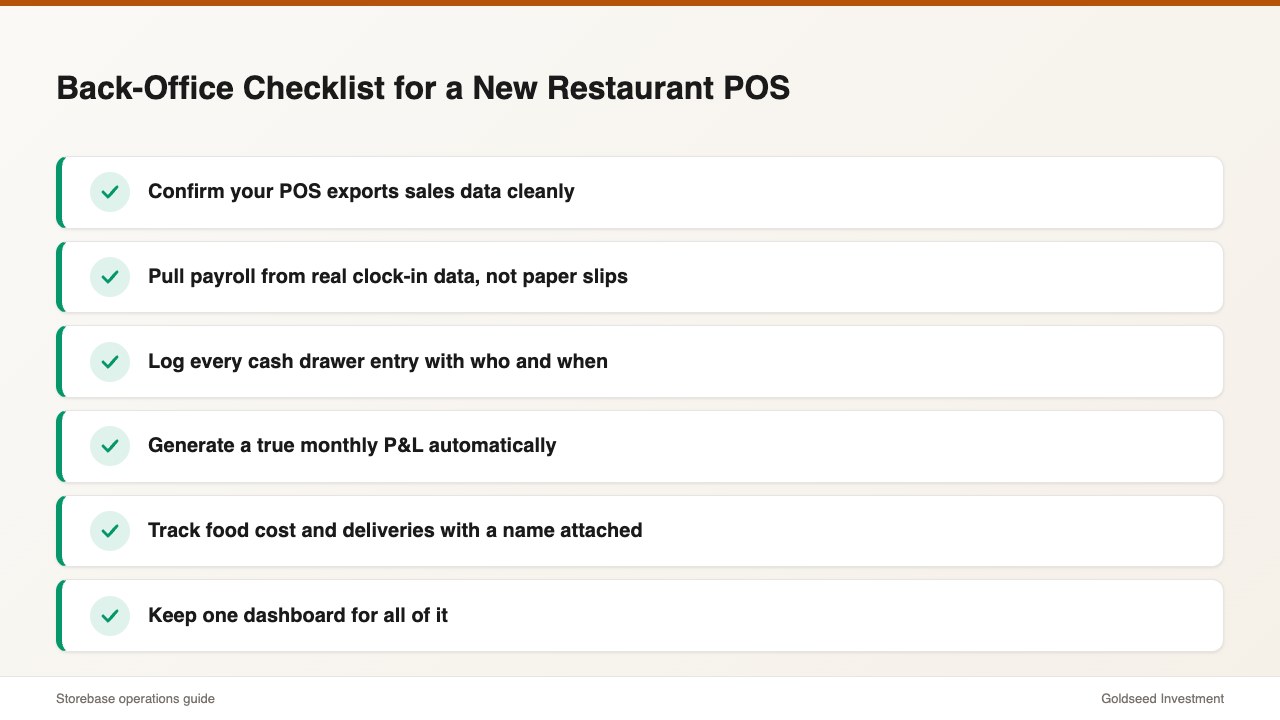
Use this checklist when you set up a POS system for small restaurant operations, so the back office is covered from day one:
- Confirm the POS exports sales data cleanly (you’ll feed it into your books).
- Decide where payroll comes from — a real clock-in source, not handwritten slips.
- Put a who-and-when log on every cash drawer and safe.
- Generate a true P&L monthly: revenue minus food, labor, rent and supplies.
- Track food cost and deliveries with a name attached to every count.
- Keep one dashboard that shows all of the above without re-keying.
A POS that’s strong on the sale plus a back-office layer that’s strong on everything after it is the combination most thriving small restaurants run in 2026.
What Does a Restaurant POS System Cost for a Small Business?
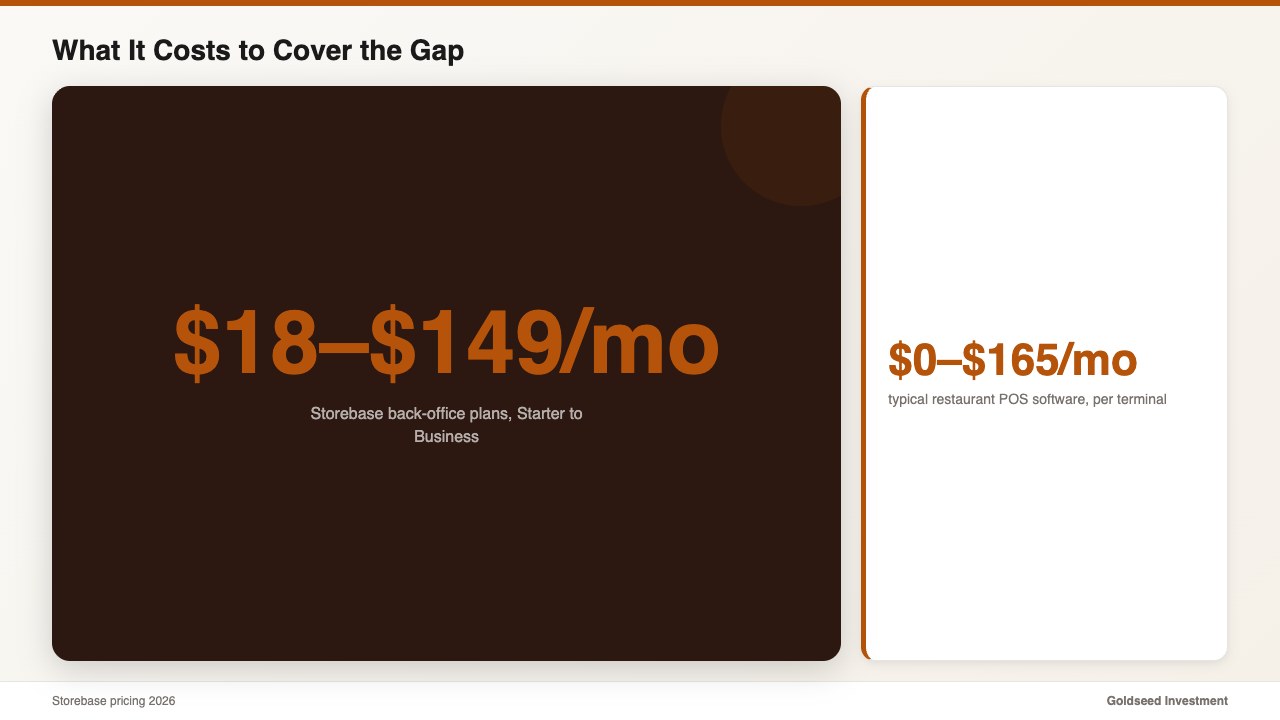
Budget for two separate line items, because they solve two separate problems. The POS itself carries hardware (a terminal and printer can run from a few hundred to a couple thousand dollars) plus payment processing, typically a percentage of every transaction. As of 2025, restaurant POS software subscriptions range from free tiers up to roughly $165 a month per terminal before processing.
The back-office layer is the smaller number with the bigger payoff. Pricing runs $18/month on the Starter plan for a single store (up to 5 staff), $48/month on Growth for up to 5 stores (up to 30 staff), and $149/month on Business for up to 10 stores (up to 70 staff). For an operator like Maria, recovering roughly three hours on monthly close and a half-day on payroll — and plugging a $300-a-week cash leak — pays for the subscription many times over in the first month. The math isn’t close; the recovered time and recovered cash dwarf the fee. For a deeper look at the numbers, the guide to retail financial management software breaks down where the savings come from.
FAQ
Q: What is the best restaurant POS for small business owners? A: There’s no single winner — Square is easiest to start, Toast is the most restaurant-specific, Clover is the most flexible, and Lightspeed is strongest for inventory-heavy venues. The best restaurant POS for small business owners is the one that fits your service style; then add a back-office layer for payroll, cash accountability, and real P&L, because no POS covers all of that on its own.
Q: Does a restaurant POS system handle payroll and accounting? A: Mostly no. A POS records sales and may offer add-on payroll or basic reporting, but it doesn’t calculate pay from real clock-in data, log cash discrepancies by person, or produce a true income statement and balance sheet. Those are back-office jobs that a tool running alongside your POS handles.
Q: Can I add software to my POS instead of replacing it? A: Yes, and for most small restaurants that’s the smarter move. A back-office layer works alongside Square, Toast, Clover, Lightspeed or any other POS — you keep ringing sales exactly as you do now and only add the financial, payroll, and cash-accountability layer the POS lacks.
Q: How much should a small restaurant spend on POS and back-office software? A: Expect POS hardware plus processing fees, with POS software from free up to about $165/month per terminal. A back-office layer is far cheaper — plans start at $18/month and you can start free with no credit card, so you can see your first automatic P&L before you commit.