Multi-store retailers using Storebase’s inventory accountability tracking system cut shrinkage 47% in the first quarter — every stock change logged with operator ID and timestamp, variance investigations dropped from 3 days to 12 minutes.
Keyword: retail inventory accountability tracking system
Marcus Patel owns four convenience stores across the Pacific Northwest. For eight months in 2024, he was quietly losing roughly $5,000 a month to inventory shrinkage he could not explain. The numbers always showed up at the end of the quarter — 31 units of a popular energy drink gone here, $1,200 of cigarettes off there, a $400 hole in the coffee category every two weeks. He kept asking the same question and getting the same answer.
“Who touched this last?”
“I don’t know.”
Today Marcus runs all four stores from his phone, and that question has an answer within twelve seconds. The shift that received the shipment is named. The employee who ran the count is named. The manager who adjusted the on-hand quantity is named. Shrinkage across the four-store group dropped 47% in the first quarter after he switched to Storebase, and the change was not because he hired more loss-prevention staff or installed more cameras. He installed a retail inventory accountability tracking system that logged every movement with an operator ID and a timestamp — and the visibility alone changed staff behavior.
That is the difference an accountability layer makes. Most retail owners are not careless. Most are not even understaffed. They are simply running on tools that were never designed to answer the question “Who changed this number, and when?” This 2026 guide explains what a modern accountability tracking system actually does, the numbers that justify the investment, and how a back-office app like Storebase handles it inside a single mobile interface.
Why Do Most Retail Stores Still Have No Idea Who Touched the Inventory?
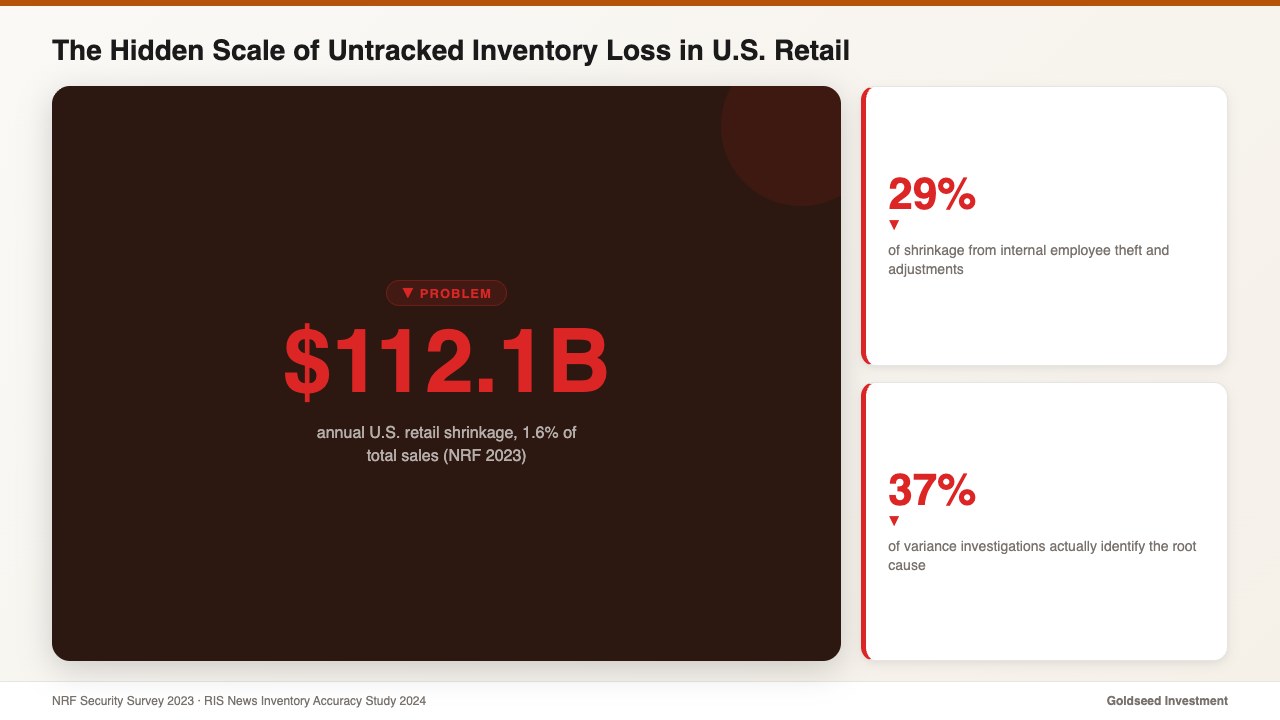
The National Retail Federation’s 2023 Security Survey put U.S. retail shrinkage at $112.1 billion — roughly 1.6% of total sales. About 29% of that loss is attributed to internal theft and another 26.5% to “process and control failures,” which is the polite industry term for staff making adjustments that nobody catches in time. Together, more than half of retail shrinkage happens inside the four walls of the store, often through the inventory system itself.
The reason it stays hidden is structural, not personal. Three things have to be true for a retailer to identify the source of a discrepancy: every inventory movement has to be captured, every movement has to be tied to the person who made it, and someone has to be able to query that record without digging through paper or spreadsheets. Most small and mid-size retail operations break on all three.
Marcus’s old setup was typical for a multi-store independent. Each location ran its own POS for sales. Receiving happened on a paper sheet that the back-stock manager filed in a binder. Adjustments — damaged units, theft write-offs, supplier shortages — got entered into a shared Excel file at the end of the week, usually without a name attached. Transfers between stores were tracked on text messages. Stock counts happened twice a year, both stores shut down for a Saturday, no record of who counted which aisle. When the quarter-end numbers were off by $5,000, there was nothing to investigate against.
This is the unspoken cost of retail shrinkage: not the dollar value of the missing inventory, but the inability to do anything about it. Research published in 2024 by RIS News found that manual inventory audits identify the root cause of variance only 37% of the time. The other 63% of incidents are simply written off. The store owner absorbs the loss and waits for it to happen again.
The Hidden Cost of Inventory Without Accountability
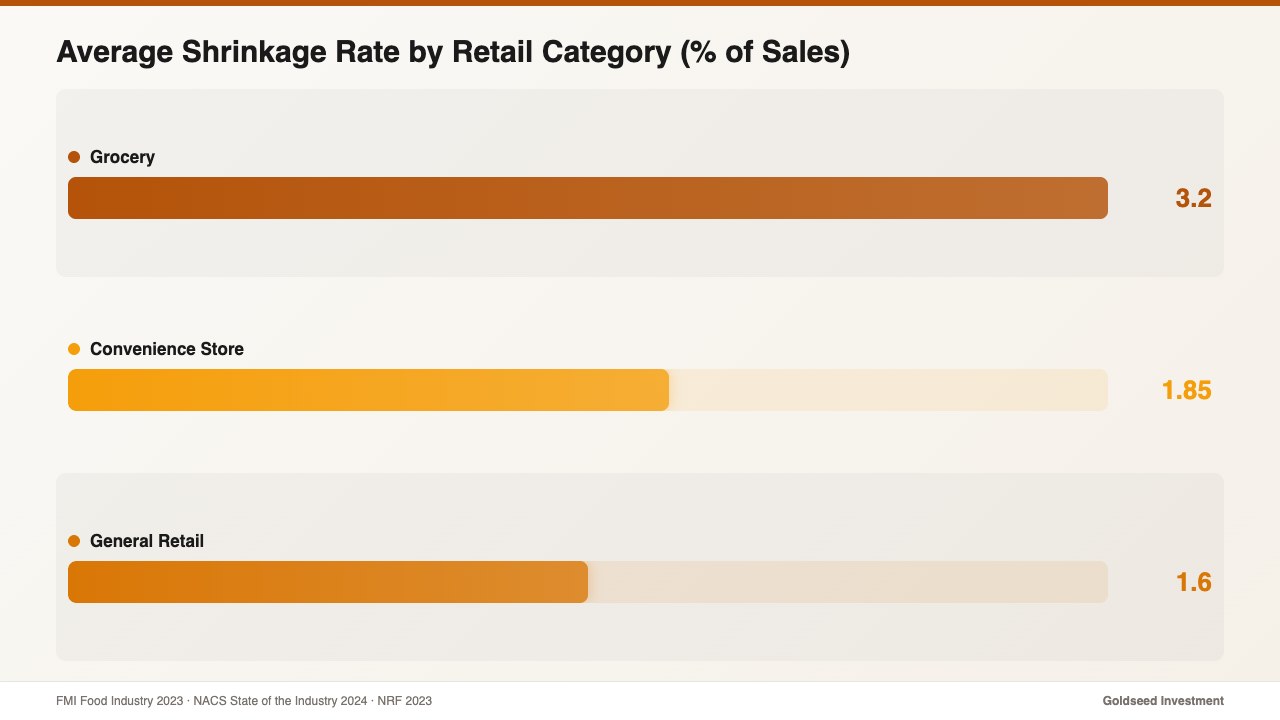
If you operate a small-format retail store, the shrinkage numbers in your category are probably worse than the 2023 NRF headline. Grocery stores see shrink averaging 3.2% of sales according to the FMI Food Industry Association’s 2023 report. Convenience stores sit at 1.85% per the NACS State of the Industry Report from 2024, which sounds modest until you do the math on a $2 million annual revenue location and realize that is $37,000 walking out the door each year. For categories with lower gross margin, that figure can erase the contribution margin of an entire SKU line.
Three numbers are worth holding in your head.
First, average inventory record accuracy in retail is only 63%. That figure comes from Auburn University’s RFID Lab in 2024, which has been measuring the gap between system inventory and physical inventory for over a decade. Two of every five SKUs in a typical store show a quantity in the system that does not match what is actually on the shelf. Some of that is theft, some is miscounting, some is supplier short-shipment, and some is staff entering the wrong COGS adjustment. Without a log of who entered what when, you cannot tell these causes apart.
Second, 75% of small business owners report that employees have stolen from them at some point. The U.S. Chamber of Commerce loss prevention data tracks this across years and across industries. The point is not that staff are dishonest — most are not — but that the absence of accountability removes the friction that keeps occasional bad behavior in check. People tend to be more careful when they know their name is attached to every action.
Third, out-of-stocks cost the global retail industry $1.2 trillion a year according to IHL Group’s 2023 Inventory Distortion Report. When your inventory records are wrong by 37%, you reorder against numbers that lie. You stockpile what you do not need and run out of what you do. Sell-through suffers, markdown rates rise on the wrong items, and the working capital tied up in slow-moving stock pushes you closer to your break-even line. Inventory accuracy is not a back-office concern — it directly determines whether the customer who walked in for a six-pack walks out with one or walks across the street.
The retailers who solve this do not solve it with more discipline. They solve it with a system that makes the disciplined behavior automatic.
What Is a Retail Inventory Accountability Tracking System?
A retail inventory accountability tracking system is software that logs every change to inventory — quantity, location, status — with the user who made the change and the timestamp of the action. It is not the same thing as basic inventory management software. Plenty of inventory tools track quantities. Far fewer track responsibility.
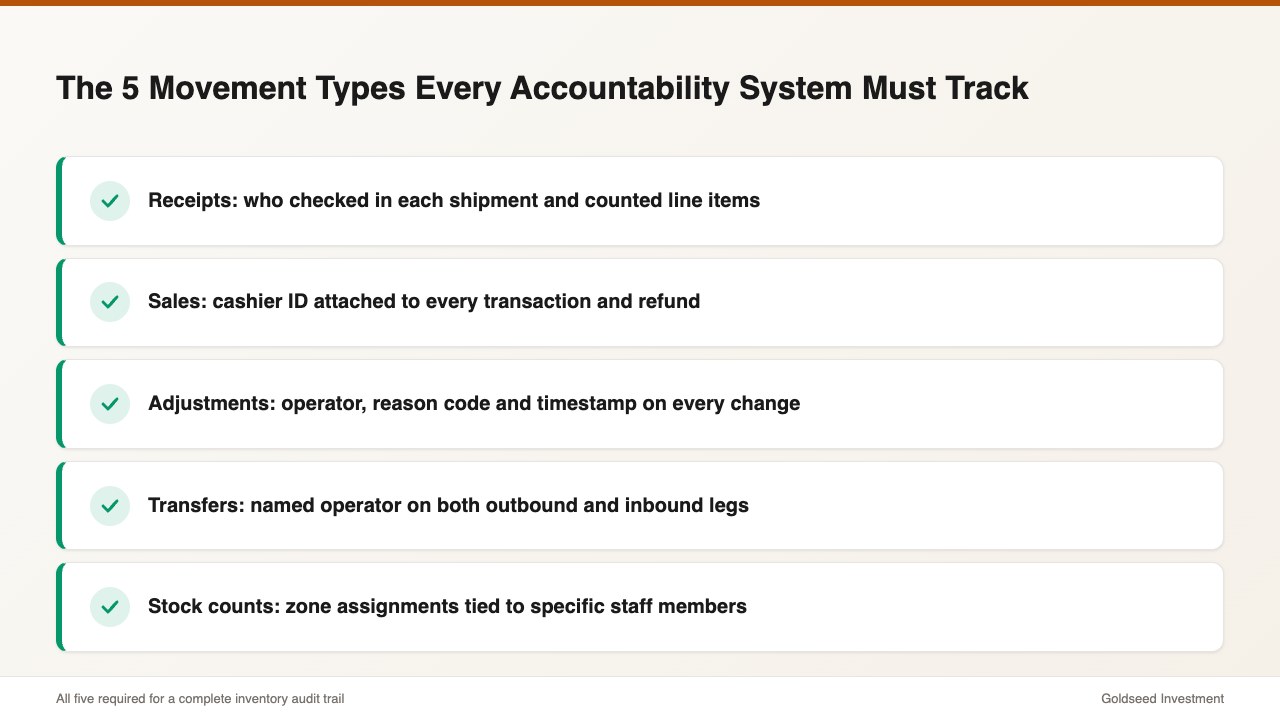
A genuine accountability system has to capture five movement types, each with operator attribution.
Receipts. When a shipment arrives, the system records which staff member checked it in, which line items were counted, and any short-shipment notes. This catches supplier discrepancies on day one rather than three weeks later when the shortfall shows up in a count.
Sales. Every transaction reduces inventory tied to the cashier who rang it. Most POS systems handle this, but only the accountability-grade ones tie a refund or void back to the person who processed it.
Adjustments. This is the category most spreadsheets miss completely. When a unit is damaged, expired, written off, or marked as “found,” somebody has to enter it. A real accountability system requires the entry to be tagged with the operator’s ID, the reason code, and the time. This is where retail stock tracking with audit trail diverges from simple counting.
Transfers. Moving stock between locations is two events — an outbound from the source and an inbound at the destination. Both legs need a named operator and the quantities need to match. Mismatches are flagged automatically.
Stock counts. The cyclical count of physical inventory has to record who counted which zone or category, the expected quantity at the moment of the count, the actual quantity entered, and the variance. This produces the audit trail that turns a count from a one-time exercise into a comparative dataset.
A retailer running all five with operator attribution can answer, within minutes, the only question that matters when something does not add up: who did what, when did they do it, and what did they say the reason was. That capability is what separates inventory management from inventory accountability.
How Does an Accountability System Compare to Spreadsheets and Basic POS?
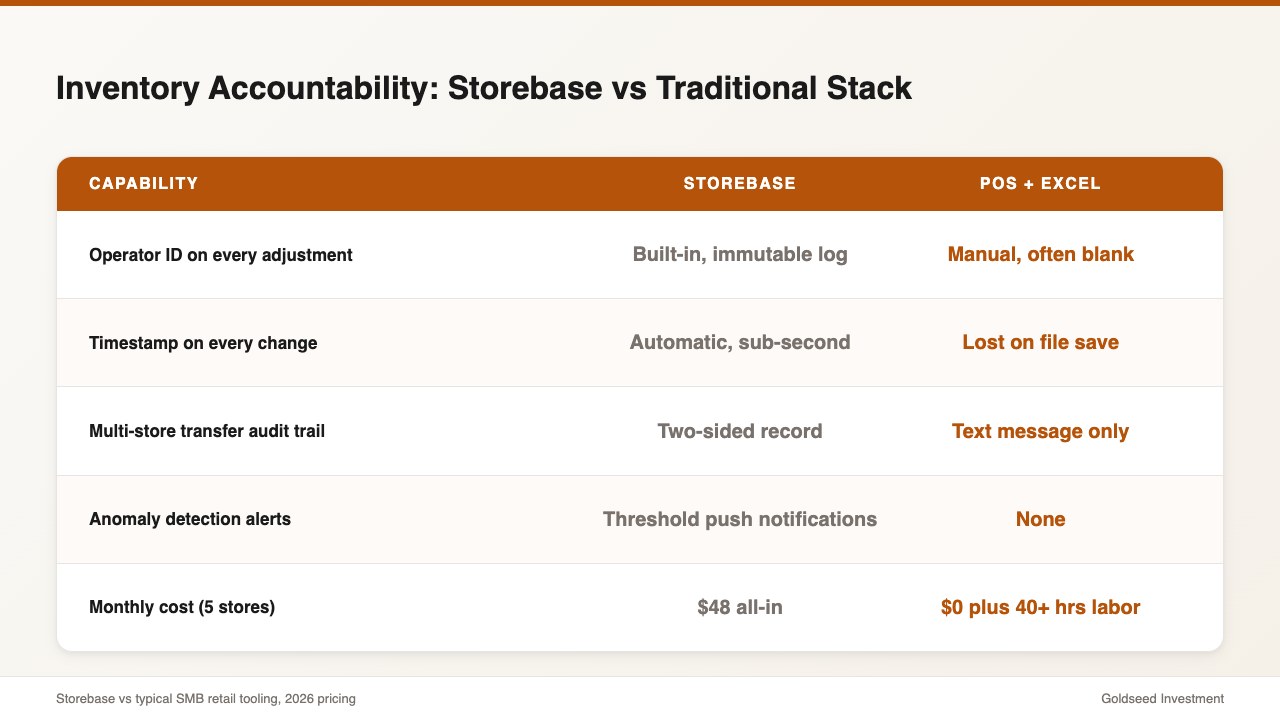
Many store owners try to retrofit accountability onto tools that were not built for it. The most common combinations — a POS plus Excel, or a basic inventory app plus a shared Google Sheet — fall short in predictable ways. The table below compares the standard options against an integrated inventory accountability software approach.
| Capability | Storebase | Lightspeed Retail | Square for Retail | Excel + POS |
|---|---|---|---|---|
| Logs every stock movement with operator ID | ✅ Built-in for all five movement types | ⚠️ Sales and receipts only | ⚠️ Sales only | ❌ Manual, often blank |
| Timestamp on every adjustment | ✅ Automatic, immutable | ⚠️ Available on Pro plan | ⚠️ Edits not logged | ❌ Lost on save |
| Multi-store transfer audit trail | ✅ Two-sided record | ⚠️ Add-on required | ❌ Not supported | ❌ Text message only |
| Anomaly detection alerts | ✅ Threshold alerts to owner | ❌ Add-on tool needed | ❌ No | ❌ No |
| Stock Count session attribution | ✅ Per-zone operator record | ⚠️ Manual entry | ⚠️ Manual entry | ❌ No |
| Mobile-first interface | ✅ Designed for phones | ⚠️ iPad-first | ✅ Tablet/phone | ❌ Desktop only |
| Monthly cost (1 store) | $18 (Starter) | $89+ | $89+ | “Free” (40+ hrs/mo labor) |
| Monthly cost (5 stores) | $48 (Growth, all-in) | $445+ ($89/location) | $445+ | Unmanageable |
The back-office accountability layer is positioned differently from the POS systems above. It does not replace Square, Clover, Lightspeed, or any other point-of-sale platform — those handle the transaction. The accountability layer sits on top of any POS and adds the back-office capabilities the POS was never designed to provide. Your POS tells you what sold; the accountability system tells you who handled it, who counted it, who adjusted it, and where the variance came from.
The cost gap matters more than the feature gap for most independent operators. Running Lightspeed across five locations costs roughly $445 a month before add-ons. The all-in pricing on a back-office app like Storebase covers all five locations at $48 with the accountability features built into the base product. For a four-store operator like Marcus, the math closed itself in the first conversation.
How Storebase Tracks Every Inventory Change With Full Accountability
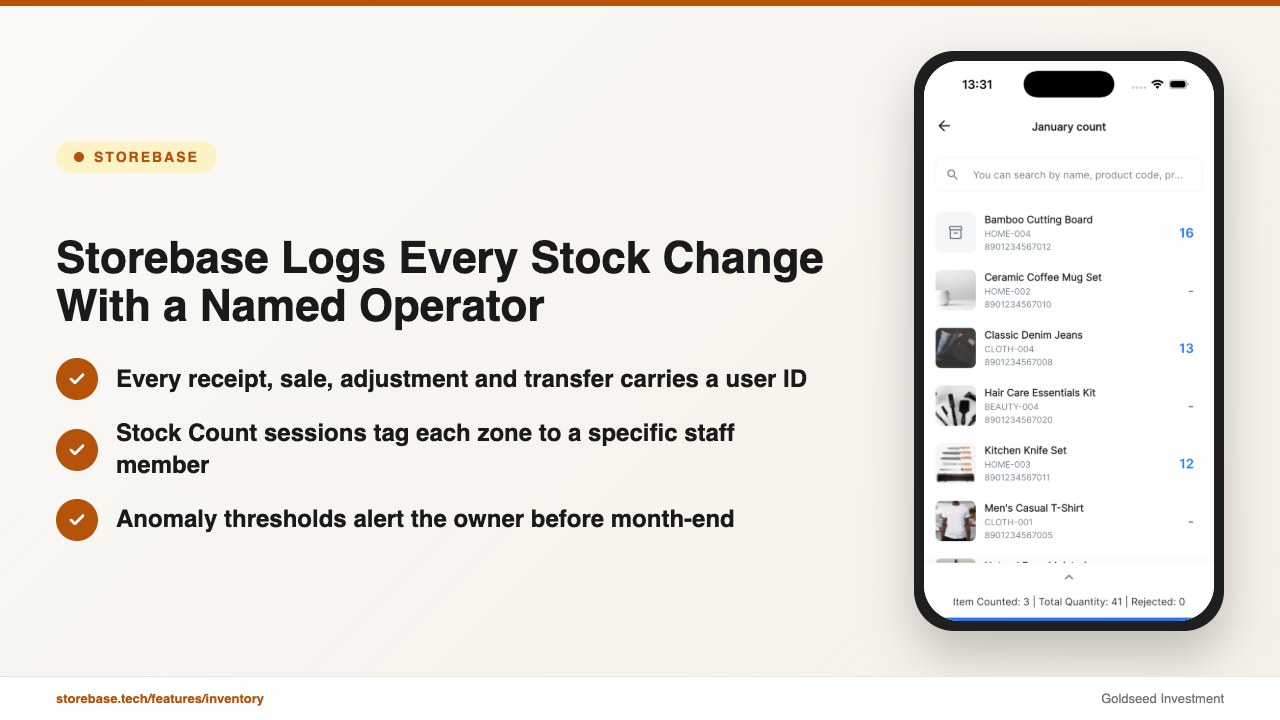
The accountability layer in Storebase’s Inventory module was built around a single principle: every number a staff member changes should carry that staff member’s name and the time they changed it. That principle plays out across four interlocking features.
Feature 1: Operator-tagged stock movements in the Inventory module. Every receipt, sale, adjustment, and transfer writes an immutable record. The record includes the staff member’s user ID, the timestamp, the SKU, the quantity delta, and (for adjustments) the reason code. The owner can pull the full movement history for any SKU in seconds and see exactly who did what. There is no edit-without-audit option — corrections themselves create new log entries.
Feature 2: Session-based Stock Count attribution. The Stock Count module lets multiple staff scan and count simultaneously, with each zone assigned to a named operator. When the session closes, the system compares the entered quantities against the expected on-hand and produces a variance report that names which operator’s zone the shortfall appeared in. Cycle counts that used to take 20 hours of one person’s time now take 30 minutes of three people’s time, and the audit trail tells you whose section to review when something is off.
Feature 3: Two-sided transfer history. When stock moves between stores, the outbound shipment requires an operator at the source location to confirm the quantity and the inbound requires an operator at the destination to verify it on arrival. The two records have to match. Discrepancies are automatically flagged and routed to the owner, not buried in an after-the-fact reconciliation.
Feature 4: AI anomaly detection. Anomaly thresholds are configurable per category. If a single SKU’s adjustments exceed the normal range, or if a specific operator’s variance rate is statistically out of line with peers, the app pushes a notification to the owner’s phone within minutes — not at month-end. This was the feature that surfaced the slow leak in Marcus’s coffee category. The system flagged a pattern of late-night adjustments by a single shift, and the loss stopped the week he was alerted.
A secondary benefit is what happens to staff behavior once everyone knows the system is watching in this way. Operators report that the friction of being attached to every action eliminates a category of casual loss — the “I just took one for break” pattern — without the owner ever needing to confront anyone. The log itself is the deterrent.
A fifth, less-discussed feature is that this accountability fabric extends across the back-office app’s other modules. Cash, payroll, shifts, and finance use the same operator-attribution architecture. The system that tells you who counted aisle four also tells you who closed the register short, who clocked in late, and who edited the schedule on Sunday night.
What Results Do Retailers See After Adding Accountability Tracking?
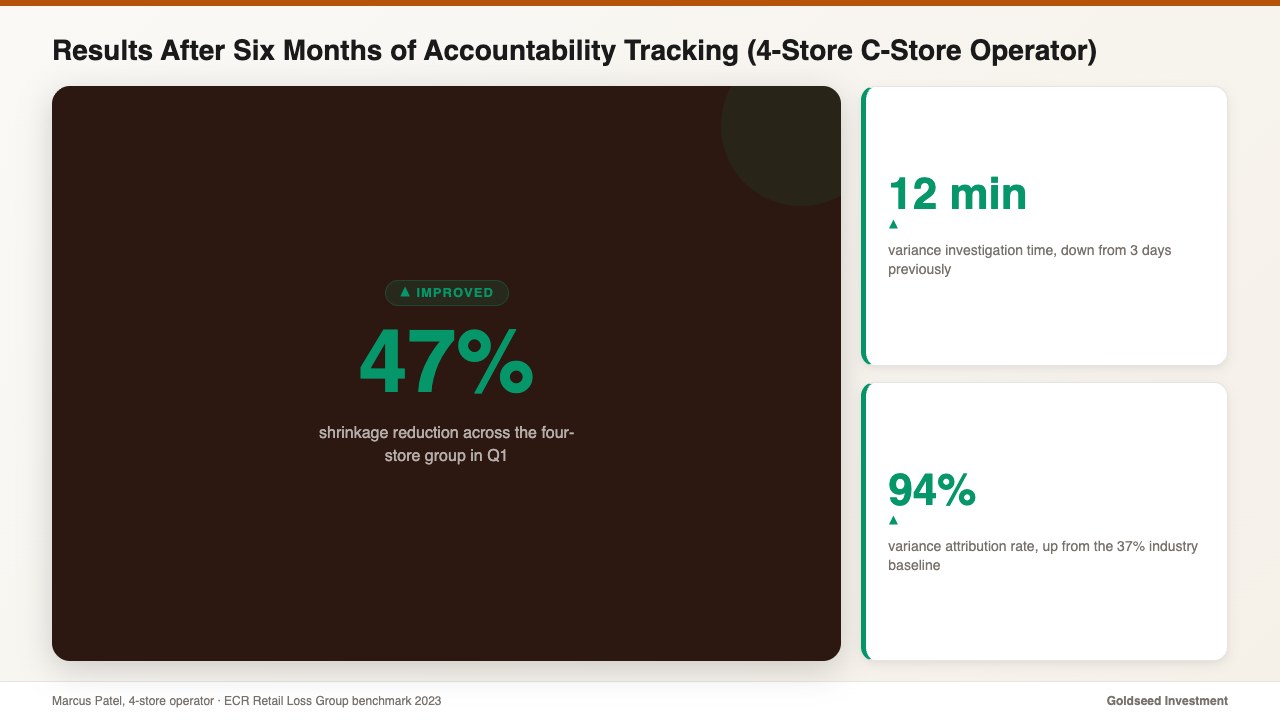
The transformation Marcus saw is consistent with what the ECR Retail Loss Group has documented across the industry. Their 2023 analysis found that retailers who move from manual or paper-based inventory tracking to a digital system with operator attribution reduce shrinkage by 30% to 50% in the first year. The mechanism is consistent across the case studies: better data identifies the leaks faster, and the visibility itself changes staff behavior.
For Marcus specifically, six months of data after the switch produced four numbers worth highlighting.
Shrinkage dropped from 2.1% of sales to 1.1% — a 47% reduction across the four-store group. The biggest single contributor was the catch-and-stop on the coffee-category leak, but the broader pattern was that staff became measurably more careful when they knew adjustments were attributed. The Q1 loss avoided exceeded $20,000.
Variance investigations went from 3 days to 12 minutes. The previous process was pull the spreadsheet, ask the four store managers what they remembered, cross-reference receiving paperwork, and usually give up. The new process is open the SKU history in the app and read the timestamped log.
Saturday reconciliation time dropped from 6 hours to 25 minutes. Marcus reclaimed roughly 22 hours a month — almost three working days — that had previously gone to spreadsheet janitorial work.
Variance attribution rate climbed from the industry-typical 37% to 94%. With a complete log, almost every discrepancy can be traced to a specific event, even if the resolution is “supplier short-shipped us by six units.”
The financial case for a convenience store inventory loss prevention system rarely depends on a single dramatic incident. It depends on the steady-state reduction in unattributed loss and the recovery of the owner’s time. For independents running on thin gross margin and tight contribution margin, both numbers matter.
If you want to validate your own numbers before investing in a tracking system, the related guides on retail shrinkage benchmarks and creating retail financial statements without an accountant walk through the math from the income-statement side. The companion article on retail financial management software covers how the same accountability fabric extends into automated P&L generation, and the retail shrinkage prevention playbook covers complementary loss prevention tactics.
How to Implement an Inventory Accountability System in 5 Steps
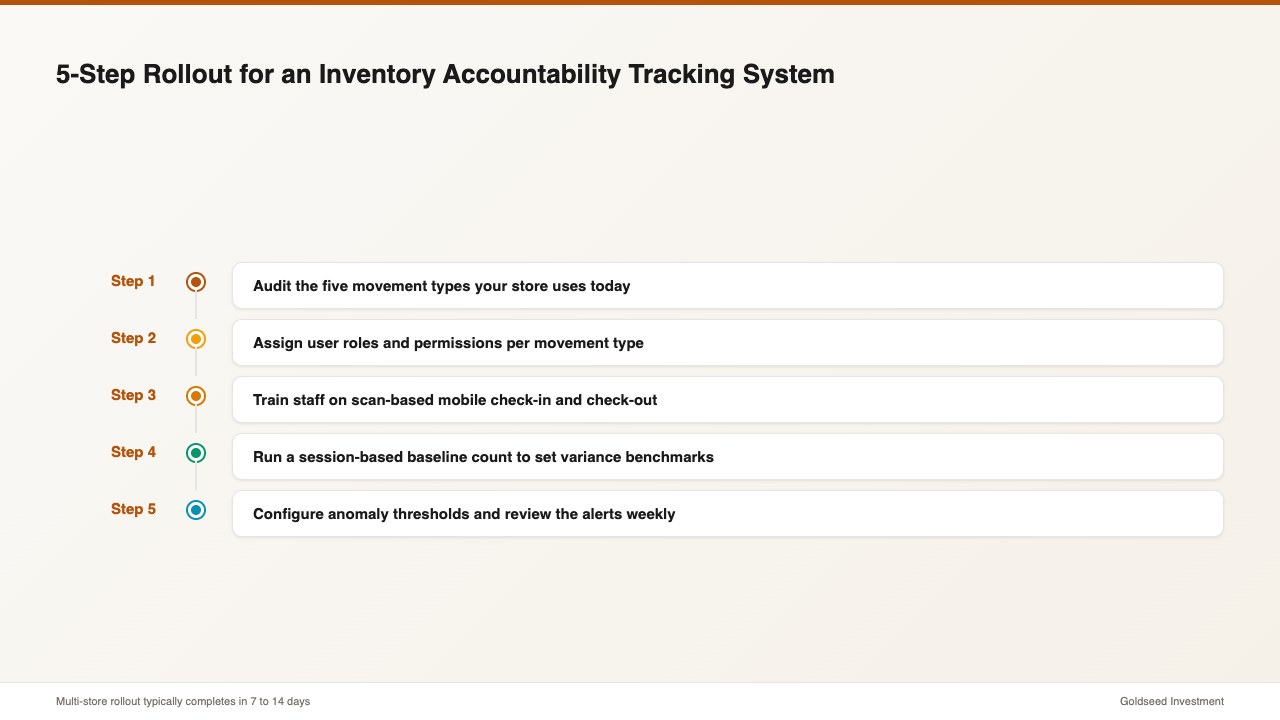
Most retailers can be running accountability tracking across a single store within an afternoon. Multi-store rollouts take longer because the staff training has to happen at each location, but the technical setup itself is rarely the bottleneck.
Step 1 — Audit your movement types. Before you configure anything, write down every way inventory changes in your stores today. Most operations end up with the standard five — receipts, sales, adjustments, transfers, counts — plus one or two edge cases (promotional bundles, customer returns, vendor swaps). Knowing the list ahead of time lets you map each one to the system’s tracking categories.
Step 2 — Assign user roles. Decide which roles can perform which movement types. A typical retail role structure has cashiers (sales only), shift supervisors (sales plus receipts), assistant managers (sales, receipts, adjustments, counts), and the owner (everything plus configuration). Role-based permissions are what make the log meaningful — if everyone can adjust quantities anonymously, you do not have accountability.
Step 3 — Train staff on scan-based check-in and check-out. The accountability log is only as good as the discipline of the people using it. Train every staff member to use the mobile app for receipts and adjustments rather than handwriting on paper. The friction is real for the first week and almost zero by week three.
Step 4 — Run a baseline stock count. Before you can detect variance, you need an accurate starting point. Run a full count using the session-based stock-count feature, with zones assigned to operators. This establishes the benchmark against which all subsequent activity is measured. Plan for one Saturday — but using session-based counting with three or four people, it will take a fraction of the time a one-person count requires.
Step 5 — Set anomaly thresholds and review weekly. Configure the AI alert thresholds for the categories that matter most to your shrinkage exposure. Review the flagged anomalies once a week for the first month, then adjust the thresholds based on what you learned. By month three, the system will be surfacing the right problems and ignoring the noise.
FAQ
Q: How is an inventory accountability tracking system different from regular inventory management software? A: Inventory management software tracks how many units you have. An accountability tracking system tracks how many units you have plus who changed the number, when they changed it, and why. The difference matters when you have a discrepancy and need to investigate — accountability systems produce a timestamped operator log, regular inventory systems usually do not.
Q: How much does an inventory accountability tracking system cost for a small retail store? A: Pricing varies widely. Enterprise loss-prevention platforms can run $500 to $2,000 per location per month. SMB-focused tools start at $18 per month for a single store and run $48 per month for up to five stores on more capable plans. The cost-effectiveness usually comes from shrinkage reduction, not the software fee itself.
Q: How often should I run a stock count in a small retail store? A: Industry guidance from the NRF recommends cycle counts at least monthly for high-velocity categories and a full physical count quarterly. With a session-based counting feature, weekly cycle counts on key categories become realistic because the time investment per count drops significantly.
Q: Will my staff feel surveilled if every action is logged? A: Most operators report the opposite reaction. Staff tend to prefer accountability systems because the logs protect them when discrepancies are not their fault — the timestamped record shows they were not on shift when the variance occurred, or that the adjustment was made by someone else. The log cuts both ways, which is why staff acceptance is usually higher than owners expect.
Q: Does a back-office accountability app replace my POS system? A: No. A back-office app works alongside any POS — Square, Clover, Toast, Lightspeed, or any other. The POS handles the sale at the register; the accountability layer handles the back-office work the POS does not cover, including the inventory log, payroll, cash reconciliation, and financial statements. You do not need to switch your POS to add accountability tracking.
Q: How long does setup take for a multi-store operator? A: Single-store setup typically takes under 10 minutes for the basic inventory module configuration. A four-store rollout including baseline counts and staff training typically takes 7 to 14 days. The technical setup is fast; the time investment is mostly the baseline count and the first week of staff habit change.
The Bottom Line for Multi-Store Retailers in 2026
If your inventory variance still hides until quarter-end and your Saturday spreadsheet ritual still eats six hours, that accountability gap is what is costing you — not the missing units themselves. The 2023 NRF data and the 2024 RIS News audits make the same case from two angles: most shrinkage is recoverable once you can see who touched what and when. The tools that produce that visibility used to be enterprise-only. They are now available to independent operators for less than the price of one stocking shift per month.
Start free with Storebase — most owners complete the setup in under 10 minutes for the first store and see measurable shrinkage reduction within 90 days. No credit card required to begin. Download on the App Store →