Boutique owners pairing any POS with Storebase report Sunday paperwork dropping from 6 hours → 25 minutes, monthly P&L generated automatically, and zero unexplained cash variances.
Meta description: Compare the best boutique POS systems for 2026 — Square, Shopify, Lightspeed, Clover — and learn which back-office software fills the gaps your boutique retail POS can’t cover.
Sarah Chen runs three women’s apparel boutiques in Austin. Three years ago, every Sunday looked the same: 6 hours hunched over the dining room table, exporting Shopify reports, matching cash drawer counts, calculating payroll in a spreadsheet, and trying to figure out whether she actually made money last month. The POS handled the ringing-up part. Everything else still landed on her.
Today, her Sunday paperwork went from 6 hours → 25 minutes. She didn’t switch POS systems. She just stopped expecting her POS to do things it was never built to do, and added a back-office layer from Storebase on top to handle the rest. Her Shopify POS still rings up the sale. The back-office app handles everything after.
That distinction — what a boutique POS system is supposed to do versus what owners actually need — is the heart of this guide. Below we walk through what to look for in a boutique POS in 2026, what each major option costs, where every POS leaves a gap, and how operators are closing those gaps without ripping out their checkout.
What Should a Boutique POS System Actually Do in 2026?
A boutique POS in 2026 needs to do far more than process a credit card. The typical specialty retailer now sells in-store, on Instagram, on a small Shopify storefront, and at the occasional pop-up — and customers expect their loyalty points and store credit to work across all of them.
A modern boutique POS generally needs to handle:
- In-store checkout with EMV chip, contactless, and mobile wallet support
- Inventory tracking across SKUs, variants (size, color, fabric), and locations
- Customer profiles with purchase history, sizes, and contact info
- Multichannel sync between in-store and an online storefront or Instagram Shop
- Hardware compatibility — receipt printer, barcode scanner, iPad stand, cash drawer
- Reporting on best-selling SKUs, sell-through rate, and gross margin by category
According to the U.S. Census Bureau, clothing and clothing accessory store sales generally run around $24.5 billion per month in 2024, and a Shopify Commerce Trends 2024 analysis notes that boutiques selling across multiple channels often maintain three separate inventory ledgers when their tools don’t connect. That fragmentation is usually the first thing a boutique owner is trying to solve when shopping for a boutique retail POS.
How Much Does a Boutique POS System Cost?
Boutique POS pricing tends to break into three layers, and the sticker price is rarely the full cost.
- Hardware — iPad ($329-$799), card reader ($49-$300), receipt printer ($200-$450), cash drawer ($100-$200), barcode scanner ($60-$200). A first-time boutique typically spends $800-$1,800 on hardware.
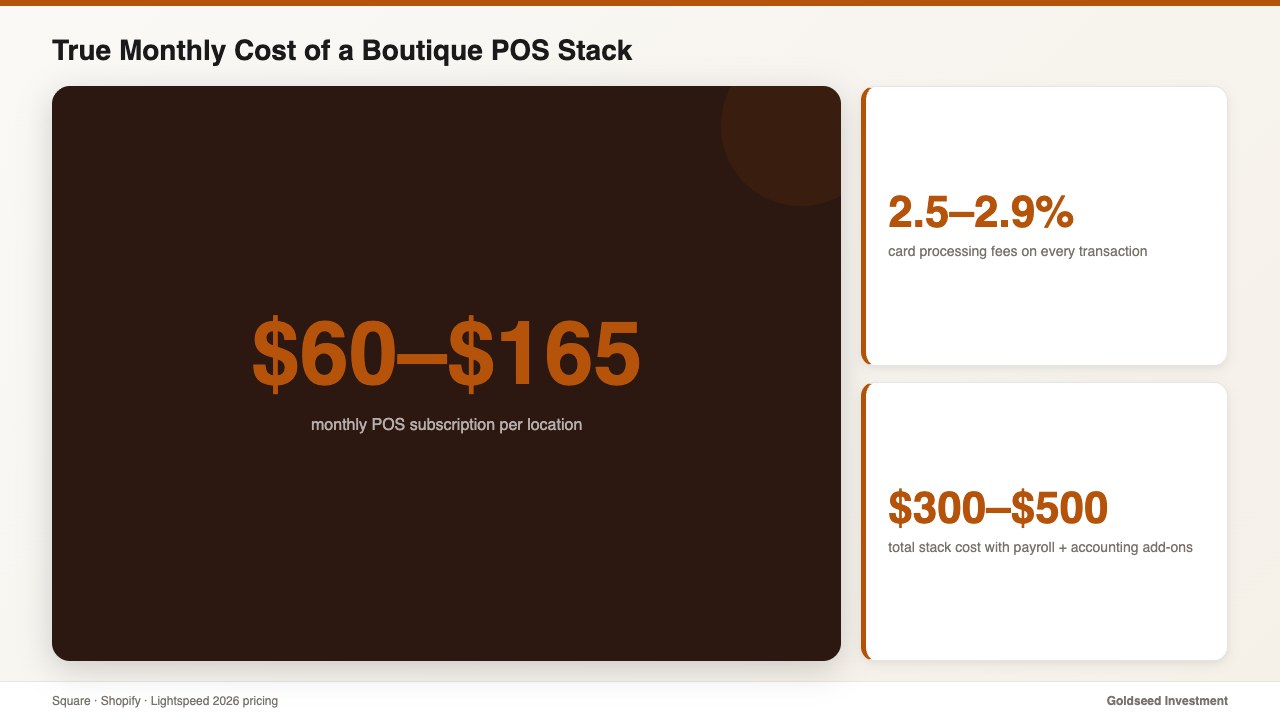
- Software subscription — usually $60-$165/month per location for retail-tier POS plans in 2025.
- Payment processing — usually 2.5%-2.9% + $0.10 per transaction. On $50,000/month in card volume, that’s $1,250-$1,500 in fees alone.
Where boutique owners get surprised is the hidden cost layer: payroll software ($40-$80/month), accounting software like QuickBooks ($35-$100/month), inventory add-ons for serial number tracking, and the labor cost of reconciling all of it. A boutique often pays $300-$500/month in software once everything is stacked, and still spends 5-8 hours a week tying numbers together by hand.
That “tying numbers together by hand” line is where the back-office layer matters more than the POS itself.
Which Boutique POS Systems Are Worth Considering?
There is no single best POS for boutique retailers. The right pick generally depends on whether you sell online, how many locations you run, what kind of inventory variants you carry, and whether you want hardware locked to one vendor.
The five most commonly chosen options for specialty retail in 2026:
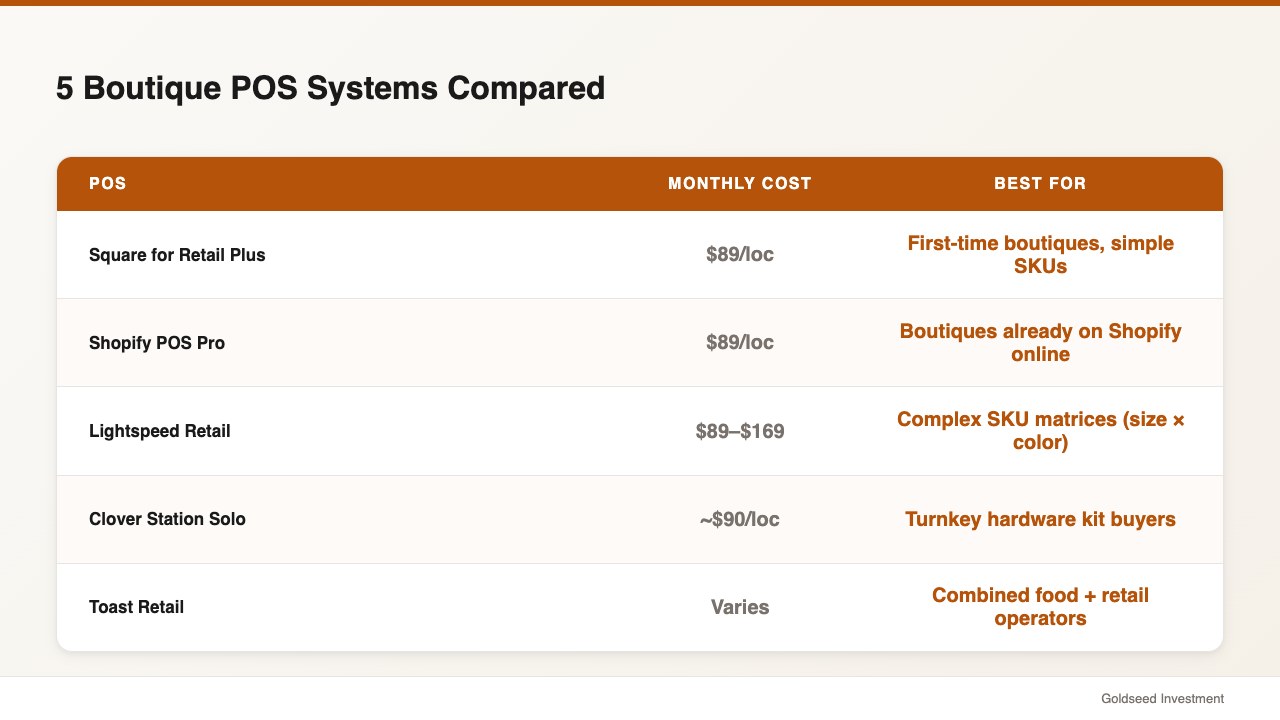
Square for Retail Plus generally costs $89/month per location. It offers a strong free starter tier, fast onboarding, and predictable processing fees. Inventory is decent for a single boutique POS setup but the multi-channel sync is light compared to Shopify. Best for first-time boutique owners, one or two locations, simple SKU catalogs.
Shopify POS Pro runs $89/month per location, layered on top of a Shopify online plan. It tends to have the strongest in-store + online sync in the market. Variant tracking (size + color + fabric) is excellent. Best for boutiques that already sell on Shopify online or plan to.
Lightspeed Retail sits at $89-$169/month depending on plan. It was built specifically for specialty retail. Deep matrix inventory (e.g. dress in 7 sizes × 4 colors), built-in purchase orders, vendor management. Best for established boutiques with complex SKU matrices.
Clover Station Solo generally lands around $90/month for the Register plan, plus hardware. Flexible app marketplace, often bundled by merchant services providers. Hardware lock-in is a drawback. Best for owners who want a turnkey hardware kit.
Toast Retail is the newer entrant — primarily restaurant-focused, but the small boutique POS tier has been growing. Usually only worth considering if you operate both food and retail (e.g. a bakery + gift shop).
Each of these is a fine sale-processing layer. None of them, on their own, will do your payroll, reconcile your cash drawer with staff accountability, or generate a clean Income Statement at month-end. That’s not a knock on any of them — it’s just not what a POS is built for.
Why Does Every Boutique Owner Still Spend Sundays on Spreadsheets?
Here’s the gap nobody talks about when they sell you a POS: your POS only knows what happened at the register. It doesn’t know what your staff cost was, what your rent was, what your fabric supplier invoiced, or whether the $400 missing from Tuesday’s drawer was a counting error or a deliberate pattern.
Most boutique owners eventually end up with this stack:
- POS (Shopify, Square, Lightspeed) → for sales
- QuickBooks or spreadsheet → for accounting
- Homebase or Deputy → for scheduling
- Gusto or ADP → for payroll
- Excel → for cash reconciliation, inventory shrinkage, and the financial reports nothing else generates cleanly
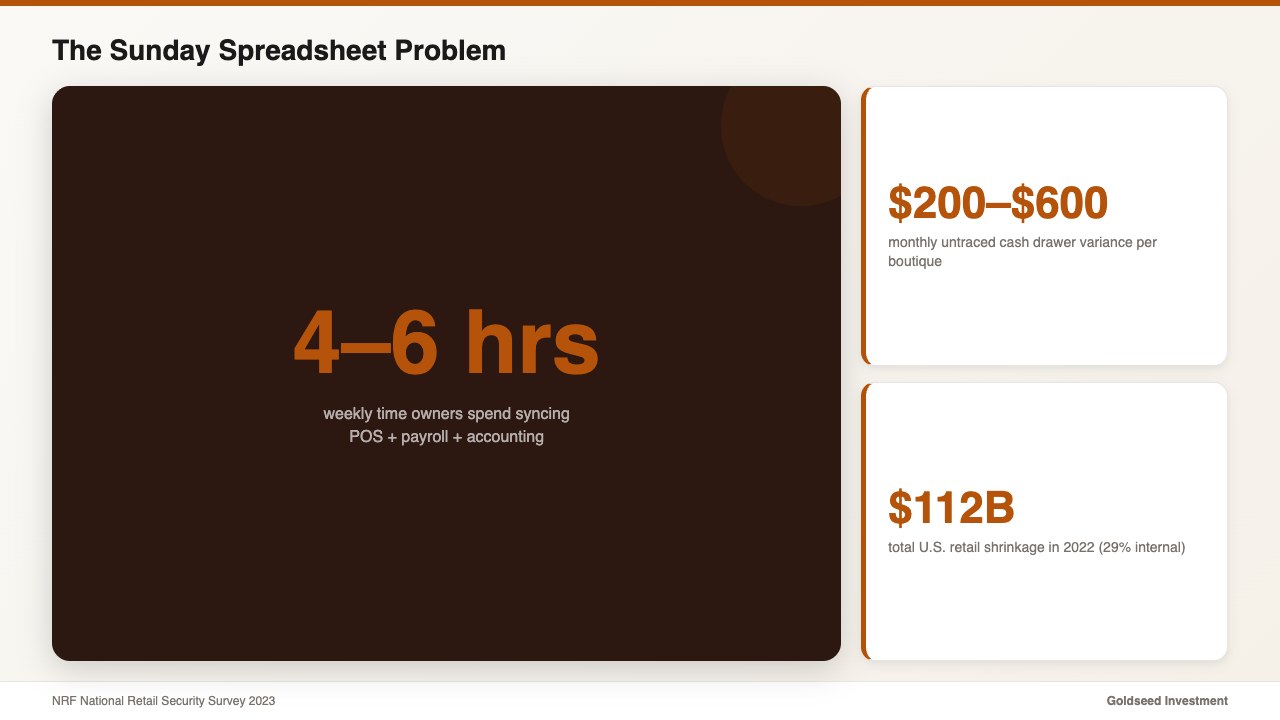
It tends to take 4-6 hours every week to keep this stack in sync. And here’s the part that hurts: a National Retail Federation security survey put total retail shrinkage at $112 billion in 2022, with internal causes accounting for roughly 29%. For a boutique owner, that often shows up as a $200-$600 cash drawer variance every month nobody can trace. The POS can’t help — it doesn’t know who opened the drawer.
This is the “data pipeline” problem. The data exists. Cleaning and combining it is what eats the weekend. As one boutique operator put it: “The data was always there. The problem was nobody had time to clean it. By the time I figured out a product wasn’t selling, the cash had already been sitting in fabric for months.”
If your inventory numbers never quite add up at the end of the month — it’s not because you’re not careful enough. It’s because no boutique store software was designed to make that specific decision easy for you. There’s no spreadsheet that tells you the probability that a 7-unit shortfall is a counting error versus a deliberate pattern. That’s not a human calculation. That’s a statistical one.
How Storebase Fills the Gaps Your Boutique POS Can’t Cover
Storebase is not a POS. It does not process payments and it does not compete with Square, Shopify, Lightspeed, or Clover. It is the back-office layer that sits on top of whichever POS you already use, and handles the parts your POS can’t: payroll, cash accountability, automatic financial statements, and inventory audit trails.
The core idea is simple: Your POS handles the sale. The back-office app handles everything after it.
Here’s how it maps to a typical boutique stack and the Before/After metrics owners typically report:
Sales & Finance — automatic P&L from POS sales + receipts. The Sales & Finance module pulls daily sales from any POS and combines them with expense receipts your staff photograph at the register. The Income Statement, Balance Sheet, and Cash Flow Statement generate on their own. Month-end closing went from 3 hours → 10 minutes, and you finally see whether your boutique is profitable in real time — not three weeks after you ask your accountant.
Cash Management — every drawer entry logged with staff ID and timestamp. If Tuesday’s drawer is short $80, you can trace exactly which staff member opened the drawer, when, and for what reason. The system compares book balance to physical cash daily and flags discrepancies the moment they happen. Monthly unexplained cash variance went from $200-$600 → $0 within the first month for most operators.
Team & Payroll — QR clock-in and automatic overtime. Staff scan a QR code on their phone at clock-in (location and timestamp captured automatically). The Team & Payroll module calculates hours, applies overtime thresholds, and produces a payroll number you approve in one tap. Boutique payroll went from 90 minutes → 20 minutes a cycle.
Inventory — per-SKU log of who touched what. Every adjustment, transfer, and receiving entry is logged with the staff member’s ID. If a $180 dress disappears from the system, you can see exactly who last edited that SKU and when — which is usually enough to resolve shrinkage investigations without an accusatory conversation.
Multi-Store Dashboard — every location on one screen. If you operate two or more boutiques, you can see sales, drawer status, payroll-to-date, and inventory levels per store on a single mobile screen. Owners stop driving across town to check on a store, because everything is already visible from their phone.
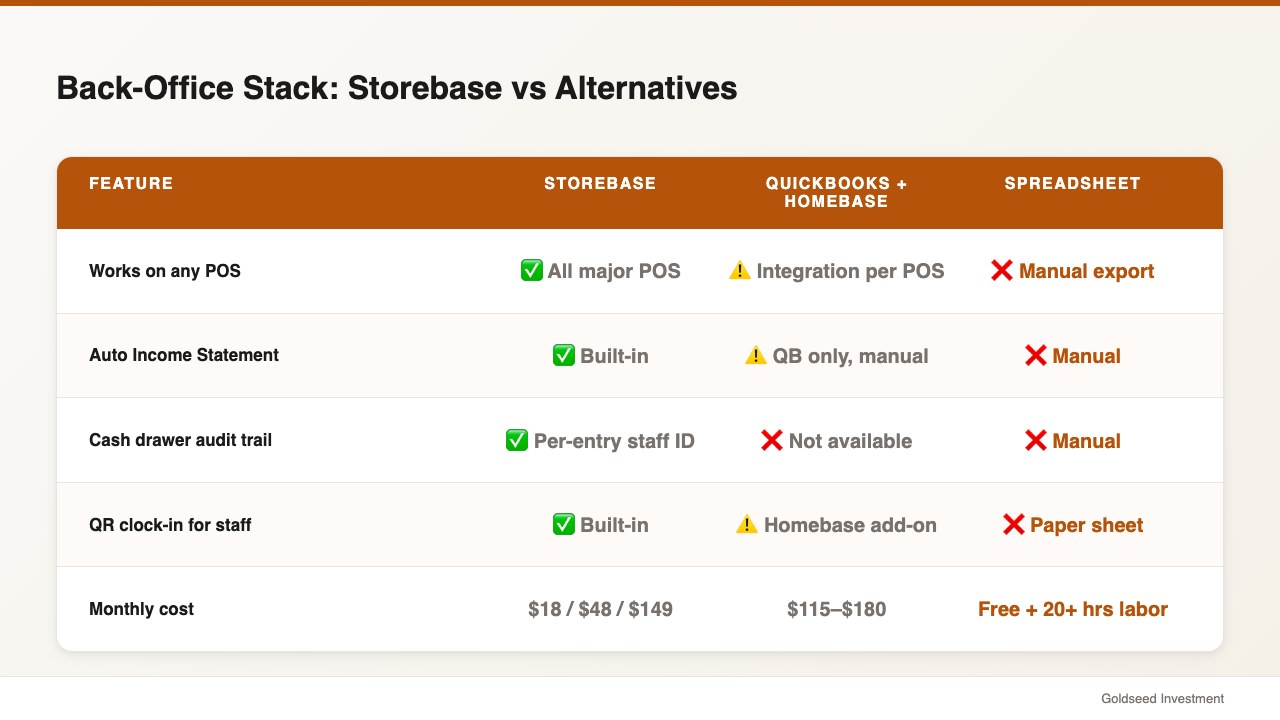
Here’s how this back-office layer generally compares to the typical boutique software stack:
| Feature | Storebase | QuickBooks + Homebase | Spreadsheet stack |
|---|---|---|---|
| Works on top of any POS | ✅ Square / Shopify / Lightspeed / Clover | ⚠️ QuickBooks needs integration per POS | ❌ Manual export |
| Automatic Income Statement | ✅ Built-in | ⚠️ QuickBooks only, manual categorize | ❌ Manual |
| Cash drawer audit trail | ✅ Per-entry staff ID + timestamp | ❌ Not available | ❌ Manual log |
| QR clock-in for staff | ✅ Built-in | ⚠️ Homebase add-on | ❌ Paper timesheet |
| Multi-store dashboard | ✅ One unified view | ⚠️ Separate QB entities | ❌ Multiple files |
| Monthly cost | $18/mo (1 store) / $48/mo (up to 5 stores) | $115-$180/mo combined | Free (but 20+ hrs/mo labor) |
The point isn’t that QuickBooks or Homebase are bad — they’re solid tools. The point is that for a single-owner boutique, stacking 3-5 separate subscriptions tends to cost more and still leaves the reconciliation work on your weekend.
If month-end at your boutique still means 4+ hours with spreadsheets, this back-office layer was built for exactly this. Most boutique owners complete setup in under 10 minutes and see Sunday paperwork drop from 6 hours → 30 minutes by week two — no credit card required. Start with Sales & Finance → or Download on the App Store →.
What Sarah Chen Stopped Doing on Sundays

Sarah Chen owns three women’s apparel boutiques in Austin, Texas. Combined revenue runs about $1.4M annually. Before she layered the back-office app on top of her Shopify POS, her Sunday breakdown:
- Hour 1-2: Export Shopify sales reports for each store; manually combine in a spreadsheet
- Hour 3: Reconcile cash drawer counts from the three stores against Shopify cash sale totals
- Hour 4-5: Calculate payroll in a spreadsheet from paper timesheets her staff filled out
- Hour 6: Attempt to produce a “profit estimate” by subtracting estimated expenses from sales
The estimate was almost always wrong. Twice in 2023, she paid herself a distribution she later had to return because her actual profit was lower than her spreadsheet suggested.
Eighteen months ago, she added the back-office layer to her existing Shopify POS setup. She didn’t change a single thing about how customers check out. What changed: staff now scan a QR code to clock in, photograph supplier receipts into the app, and log cash drawer counts directly. Sales sync from Shopify automatically.
Today her Sunday looks like this: open the app, review the auto-generated weekly P&L (one minute), approve payroll for all three stores (about 20 minutes), confirm no flagged drawer variances (a few minutes). Total time went from 6 hours → 25 minutes. She bought back roughly 23 hours of her month, and her distribution payments now match reality.
Pricing: What You Actually Pay When You Combine POS + Back-Office
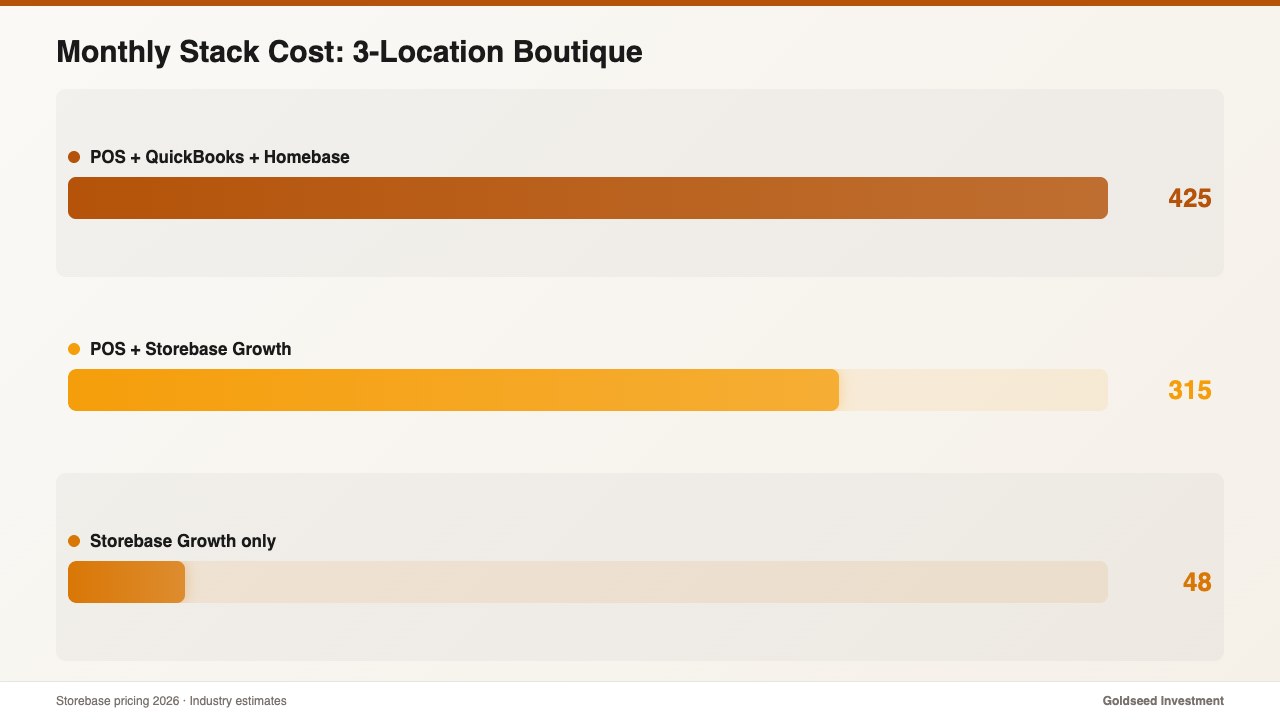
This is the part most boutique owners care about. Here’s the real cost for a 2-3 location women’s boutique using Shopify POS Pro plus the Growth plan:
- Shopify POS Pro: $89/month per location × 3 = $267/month
- Growth back-office plan: $48/month flat (covers up to 5 stores)
- Combined: $315/month — vs $300-$500/month for the typical POS + QuickBooks + Homebase + manual reconciliation stack
- Time saved: roughly 20-25 hours/month of owner reconciliation work
Back-office pricing by plan:
| Plan | Monthly Cost | Stores | Staff |
|---|---|---|---|
| Starter | $18/mo | 1 store | Up to 5 staff |
| Growth | $48/mo | Up to 5 stores | Up to 30 staff |
| Business | $149/mo | Up to 10 stores | Up to 70 staff |
The Growth plan tends to be the sweet spot for boutiques — at $48/month for up to 5 stores, the math works out to under $10 per store, which is roughly 80% cheaper than per-location pricing from QuickBooks Online or Homebase Premium.
For context on the financial side of running a boutique, our guide on how to analyze retail store profitability walks through the exact P&L ratios this back-office layer auto-generates. Boutique owners managing 2+ stores often pair it with our breakdown of retail financial management software for income statements, and operators benchmarking against the industry tend to read our analysis of retail store profit margin benchmarks before tax season.
If you are weighing whether to expand to a second boutique location, our walkthrough on how to manage two retail stores at once usually addresses the operational fears that hold owners back.
FAQ
Q: Is a boutique POS system different from a regular retail POS? A: It tends to overlap heavily. Most “boutique POS” systems are general retail POS platforms (Square, Shopify, Lightspeed) configured with variant tracking for size and color, customer profiles, and multichannel sync. The label often matters less than whether the system handles your specific SKU complexity and channel mix.
Q: How much does a boutique POS system cost per month? A: Software subscription is usually $60-$165/month per location in 2026, plus 2.5%-2.9% payment processing fees. Most boutique owners also pay an extra $100-$200/month for back-office tools like payroll, accounting, and scheduling — which is usually where the surprise cost lives.
Q: Do I need a separate inventory app if I have a boutique POS? A: Generally not for SKU-level inventory — most modern boutique POS systems handle that natively. You may still need a separate system for inventory audit trails, shrinkage investigations, and per-staff accountability logs, which most POS platforms do not provide in detail.
Q: Can I run my boutique with Shopify POS plus a back-office app, or do I need to switch POS? A: You don’t need to switch. The back-office layer works on top of any POS — Square, Shopify, Lightspeed, Clover, Toast — and handles payroll, P&L, cash reconciliation, and inventory accountability without touching your checkout flow.
Q: What’s the best boutique POS for a single-location store under $400K revenue? A: Square for Retail Plus or Shopify POS Pro are usually the two most cost-effective starting points. Both tend to clock in around $89/month per location with strong inventory and customer features. Pair either with a back-office plan like the Starter tier ($18/mo) if you want automatic financial reporting without QuickBooks.
Q: How long does it take to switch boutique POS systems? A: Most boutique POS migrations take 2-4 weeks if you have under 2,000 SKUs and a single location. The hard parts are usually exporting customer data, re-printing barcode labels, and retraining staff. Many boutique owners avoid the switch entirely by keeping their current POS and adding a back-office layer.
Ready to Get Back Your Sundays?
If your boutique POS still leaves you reconciling spreadsheets every weekend, the gap is fixable without changing your checkout. Get started free with Storebase — setup runs under 10 minutes, no credit card required. Most boutique owners cut Sunday paperwork from 6 hours → 25 minutes within two weeks. Start with Sales & Finance → or Download on the App Store →.